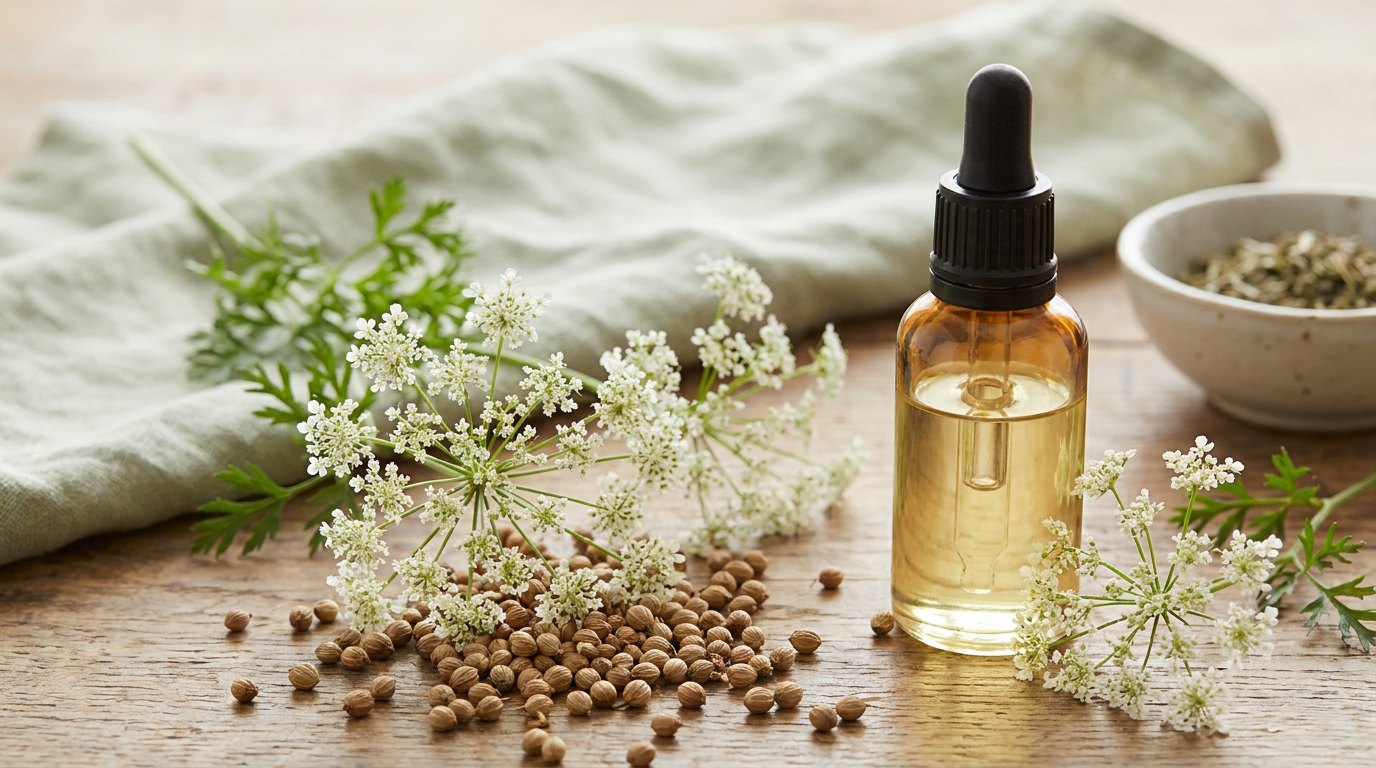
A Candle Studio's Coriander Trial Notes: Testing Cold Throw in a Spiced Autumn Pour
Every fall, small-batch candle studios face the same question: which spice notes actually survive the trip from raw oil to cured wax to a customer's living room. Cold throw, the scent a candle gives off before it's ever lit, is notoriously hard to predict from a bottle alone. A studio we consulted with this season wanted to know whether coriander essential oil could pull its weight in a spiced autumn pour, standing alongside the usual clove, cardamom, and orange peel lineup. What follows are their trial notes, shared here as an educational look at how one small operation approached the testing process, not as a guarantee of results for any other wax, wick, or workspace.
Coriander Essential Oil
Our own Coriander Essential Oil, in sizes from 0.5 oz to bulk.
From $10.99
Shop Now →Why Coriander Seemed Worth Testing
Coriander essential oil, steam distilled from the seed rather than the leaf, carries a scent profile that reads differently than most people expect. It is not simply "grocery store spice." The seed oil leans citrusy and slightly floral, with a warm, faintly woody undertone that sits closer to linalool-rich lavender than to the sharp, green note of fresh cilantro leaf. That combination made it an interesting candidate for a spiced autumn candle line: the studio wanted something that could soften the heavier notes of clove and cinnamon bark without disappearing into them.
The problem, as their lead blender put it, was that coriander has a reputation among candle makers as an oil that performs beautifully in a bottle and then goes quiet in wax. Essential oils in general are more volatile than most fragrance oils formulated specifically for candle making, and volatility is exactly what a cold throw test is built to catch. So the studio set out to document, batch by batch, what actually happened when coriander essential oil met soy wax, sat on a curing shelf, and was smelled cold, days later, by people who hadn't been in the room when it was poured.
Setting Up the Approach
The trial was kept deliberately small and repeatable. Six batches of 12 candles each were poured over three weeks, using a single-origin soy wax base and the same 8 oz amber glass vessel across every batch, so that vessel shape and glass thickness wouldn't become a hidden variable. Each batch varied only the coriander fragrance candle wax ratio and, in the later batches, the supporting notes blended alongside it.
- Batch 1: Coriander essential oil alone, at a 6% fragrance load, no blending partners.
- Batch 2: Coriander at 6%, blended with a small percentage of cinnamon bark.
- Batch 3: Coriander at 8%, same cinnamon pairing, to see whether a higher load changed the cold throw meaningfully.
- Batch 4: Coriander paired with clove bud and a trace of sweet orange, aiming for the "spiced autumn" profile in the studio's brief.
- Batch 5: A repeat of Batch 4 using a different wick size, to separate scent performance from burn performance.
- Batch 6: A control batch using a commercial spice fragrance oil, poured the same day, for a side-by-side comparison point.
Each candle cured for a minimum of two weeks before any cold throw evaluation, which matches general guidance for soy wax, where fragrance oils and essential oils continue binding to the wax crystals for a period after the pour. Testers smelled candles cold (unlit, at room temperature) at the 3-day, 7-day, and 14-day marks, then again after a full month, to track whether the coriander note held, faded, or shifted in character over time.
Cold Throw Observations
The studio's notes here are worth reading with the understanding that scent perception is subjective and varies from person to person, and that a single trial in one workshop, using one wax supplier and one climate, is not a controlled scientific study. With that caveat, a few patterns showed up consistently enough that the team felt comfortable writing them down.
Batch 1 (coriander alone, 6%) produced what testers described as a thin, almost powdery cold throw at day 3, noticeably weaker than the fragrance load would suggest for most commercial candle fragrance oils. By day 14, several testers reported struggling to detect it at all without holding the jar close. This tracked with the studio's suspicion going in: coriander oil's lighter, more volatile aromatic compounds seem to off-gas from cured wax faster than heavier spice notes do, so a candle that smelled bright and citrusy in the melted wax at pour time can read as nearly scentless a couple weeks later.
Batch 2 and Batch 3 (coriander with cinnamon bark) told a more interesting story. Blended with cinnamon, the coriander's cold throw held up noticeably better through the 14-day mark, and testers described the combined scent as rounder, with the cinnamon's heavier, longer-lasting aromatic profile seeming to anchor coriander's lighter top notes rather than simply masking them. Raising the coriander load from 6% to 8% (Batch 3) didn't produce a proportional increase in perceived strength, which matched what the studio had read about diminishing returns past a certain fragrance load in soy wax, though they noted they hadn't tested loads above 8% and couldn't speak to that range.
Batch 4 and Batch 5 (coriander, clove, and orange) were the closest to the studio's original creative brief, and testers rated this combination as the most balanced of the trial. The clove carried well into the cold throw on its own, as clove typically does, and testers felt the coriander's floral edge kept the blend from reading as a straightforward "holiday spice" candle, giving it a slightly more unexpected, less predictable character. The wick change between Batch 4 and Batch 5 didn't meaningfully affect cold throw, as expected, since wick size mostly governs hot throw and burn pool rather than the unlit scent.
Batch 6 (commercial spice fragrance oil, control) outperformed every essential-oil batch on raw cold throw strength at every interval tested, which the studio expected going in. Fragrance oils formulated for candles are generally engineered for wax retention in a way single-note essential oils are not. The point of the trial wasn't to prove coriander could match that strength number for number. It was to see whether coriander could contribute a distinct, worthwhile character within a blend, even at lower overall throw, and on that narrower question the studio felt the answer trended positive.
A Note on Hot Throw
Cold throw was the stated focus of this trial, but the studio also burned a handful of candles from each batch to get a general sense of hot throw, the scent given off while lit. Their informal impression was that coriander's contribution became harder to distinguish once the candle was burning, particularly in the blends with clove and cinnamon, where the heavier spice notes tended to dominate the room-filling scent. This lines up with a broader pattern reported anecdotally among small-batch candle makers: lighter, more volatile essential oils often read more clearly in cold throw than in hot throw, where heat can push heavier aromatic compounds to the front. The studio flagged this as an area they'd like to test more rigorously in a future round, ideally with instrumented headspace sampling rather than relying on tester noses alone.
Working With Coriander in Candle Wax: Practical Notes
A few handling details came up repeatedly in the studio's process notes and are worth passing along for anyone considering a similar coriander essential oil candle making trial of their own.
- Add fragrance at the right temperature. The studio added coriander oil to melted wax at the wax supplier's recommended pour temperature, generally in the 170 to 185°F range for soy wax, and stirred for a full two minutes. Adding essential oil too early, at higher temperatures, is widely believed among candle makers to burn off more of the lighter aromatic compounds before the wax ever sets, which may partly explain why bottle scent and cured cold throw diverge so often.
- Flash point matters for safety, not just scent. Coriander essential oil has a flash point that is lower than some heavier fragrance oils. The studio kept their workspace ventilated, worked away from open flame while pouring, and followed their wax supplier's safety data sheet guidance rather than guessing. Anyone testing essential oils in candle wax at home should read the relevant safety data sheet for both the oil and the wax before starting.
- Fragrance load limits are wax-specific. The 6 to 8% range used in this trial reflected the studio's soy wax supplier's stated maximum. Paraffin and coconut wax blends can have different maximums, and exceeding a wax's recommended load is generally discouraged, both for scent consistency and for burn safety, since excess unbound oil can affect how a candle burns.
- Sourcing affected consistency. The studio ran their trial with coriander oil from a single supplier and noted, almost as an aside, that they'd smelled noticeable batch-to-batch variation in coriander oil from other sources in the past. Seed oils in general can shift somewhat depending on growing region and distillation batch, so a studio serious about a repeatable scent trial will want to lock in one supplier before drawing firm conclusions.
Key Learnings
Pulled together, the studio's spiced candle scent trial notes suggest a few honest takeaways rather than a single verdict.
Coriander essential oil used alone, at a moderate fragrance load, did not hold up well as a standalone cold throw across a full curing and shelf-life window in this particular trial. Blended with heavier, longer-lasting spice notes like cinnamon or clove, it fared better and contributed a floral, slightly citrus-forward character that testers found distinctive rather than generic. Raising the fragrance load past a certain point didn't reliably translate into a stronger cold throw, at least within the range this studio tested. And the gap between coriander's bright bottle scent and its more muted cured cold throw was consistent enough across batches that the studio now treats it as an expected part of working with the oil, not a one-off fluke.
None of this amounts to a scientific conclusion about coriander oil cold throw performance in general. It's one studio's documented experience with one wax, one set of vessels, and one climate, over a few weeks in late summer. Humidity, storage conditions, wax chemistry, and even the individual noses doing the smelling can all shift results. The value of trial notes like these is less about a definitive ranking and more about giving other small-batch makers a starting point, and a set of variables worth controlling for, if they want to run their own coriander fragrance candle wax test.
Would the Studio Use It Again
The studio's working conclusion, offered as their own opinion rather than a settled fact, was that coriander earns a place in a blend rather than a bottle of its own. For their spiced autumn line, the clove, coriander, and orange combination from Batch 4 moved forward into a small pilot run, with plans to revisit fragrance load and possibly test a coriander and cardamom pairing in a future trial. They were candid that a different wax base, a different climate, or a different coriander source could shift these results, and they've kept their raw batch notes on file specifically so future trials can be compared against this baseline rather than starting from scratch.
For candle makers weighing whether to run a similar test, the most useful habit this studio modeled wasn't a specific ratio or blend. It was the discipline of testing at multiple time intervals, keeping every other variable fixed, and writing down what didn't work as carefully as what did.