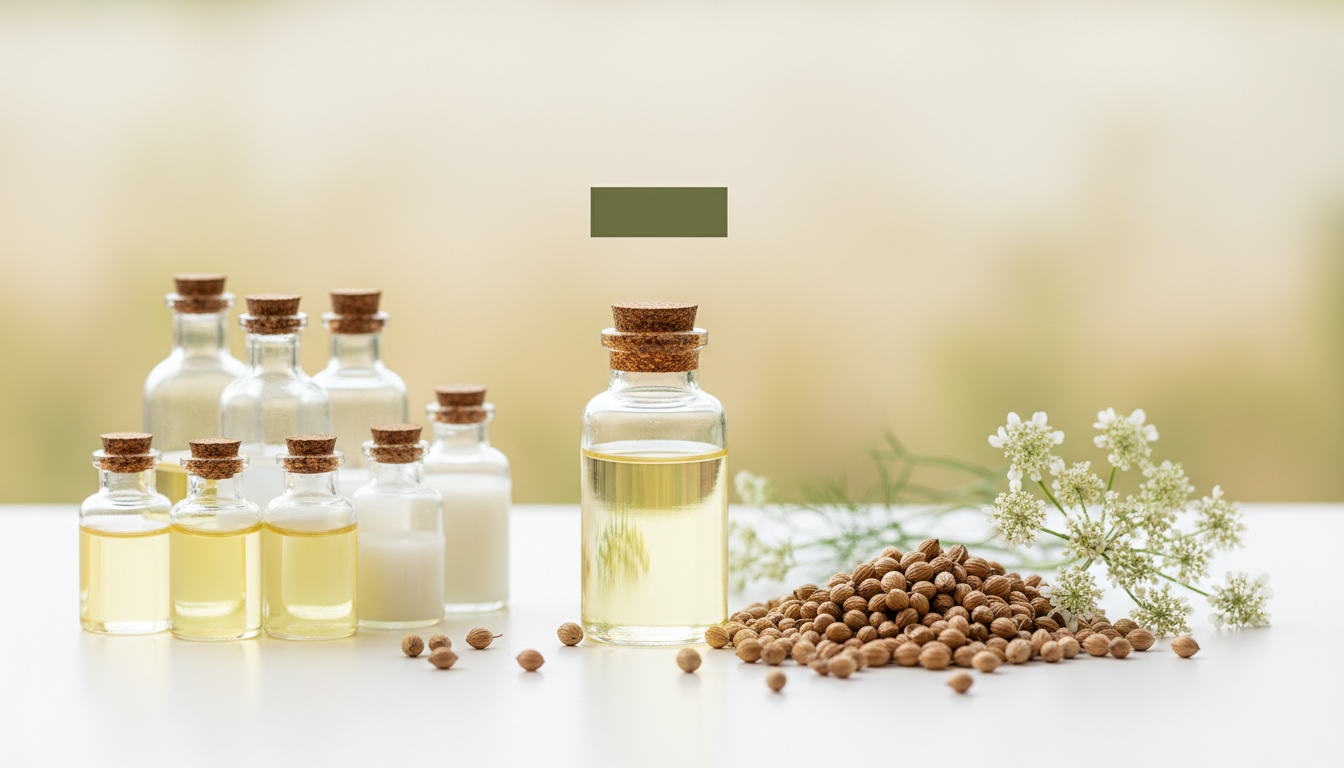
Coriander Essential Oil vs Coriander Seed CO2 Extract: Aroma and Cost Compared
Anyone who has shopped for coriander seed aromatics for long enough eventually runs into a choice they didn't expect: essential oil or CO2 extract. Both come from the same small, round seed. Both smell unmistakably of coriander. And both show up in perfumery and soap-making supply catalogs with wildly different price tags and technical notes attached. If you've added a bottle of "coriander CO2 total extract" to your cart and paused, wondering whether it's worth the premium over the steam-distilled oil sitting next to it, you're asking the right question.
Coriander Essential Oil
Our own Coriander Essential Oil, in sizes from 0.5 oz to bulk.
From $10.99
Shop Now →This guide lays out how coriander oil extraction methods compare, what each process actually does to the seed's aromatic compounds, and where the aroma and cost differences actually matter in practice. We'll keep this focused on scent, sourcing, and formulation use, not on any wellness or health outcome.
Two Different Ways to Pull Aroma From the Same Seed
Coriander essential oil is made by steam distillation. Crushed or whole dried coriander seeds are packed into a still, and pressurized steam is passed through the plant material. The heat and moisture carry the seed's volatile aromatic molecules, mostly linalool along with smaller amounts of other terpenes, up and out of the still. The vapor is then condensed back into liquid, where the oil separates from the water (the water that's left behind is sold separately as coriander hydrosol). This is the older of the two methods, and it's the one most people picture when they think of essential oil production.
CO2 extraction is newer and mechanically different. Instead of steam, carbon dioxide is compressed under high pressure until it reaches a "supercritical" state, meaning it behaves partly like a gas and partly like a liquid. In that state, CO2 is an efficient solvent. It's pushed through the plant material, where it dissolves not just the light volatile compounds that steam distillation captures, but also heavier aromatic and waxy compounds that steam tends to leave behind. When the pressure is released, the CO2 simply reverts to a gas and evaporates off, leaving behind a concentrated extract with no solvent residue.
That difference in mechanism is the reason the two end products don't smell, pour, or price out the same way, even though they start from an identical seed.
Comparison Table: Coriander Essential Oil vs CO2 Extract
| Attribute | Steam-Distilled Essential Oil | CO2 Extract |
|---|---|---|
| Extraction method | Steam distillation | Supercritical CO2 extraction |
| Typical appearance | Pale yellow to clear, thin, watery viscosity | Amber to olive-brown, noticeably thicker |
| Aroma character | Bright, sharp, citrusy-green, lighter top notes | Rounder, warmer, closer to the actual seed with earthy, slightly waxy undertones |
| Aroma longevity | Fades faster, evaporates as a top-to-mid note | Lingers longer, reads more as a base-supporting note |
| Yield from raw seed | Lower yield per kilogram of seed | Higher yield, captures more of the seed's total aromatic profile |
| Typical cost per ounce | Moderate | Noticeably higher, often 1.5 to 3 times the oil's price |
| Solubility | Dissolves cleanly in carrier oils, wax, and most diffuser bases | Can be thicker or waxier; sometimes needs gentle warming to blend evenly |
| Common uses | Diffusing, roll-on blends, soap and candle scenting | Fine perfumery, natural fragrance formulation, small-batch luxury blends |
| Shelf stability | Sensitive to light and heat; benefits from refrigeration after opening | Generally more stable, though still best stored cool and dark |
Aroma Profile Compared, Side by Side
If you've only smelled one of these two, the other will probably surprise you. The steam-distilled oil is the version most people associate with coriander seed: bright, a little sharp, with citrusy-green top notes that lift off the strip almost immediately. It reads clean and lively, closer to what you'd expect from crushing a handful of dried seeds under your nose.
The CO2 extract tells a rounder story. Because supercritical CO2 pulls in heavier aromatic constituents that steam distillation can't fully capture, the extract carries more of the seed's warm, slightly spicy, almost nutty undertone alongside the citrus-green brightness. Perfumers who work with coriander CO2 extract for perfume projects often describe it as smelling "truer to the raw seed" than the essential oil, with a rounder body and a longer dry-down.
Neither is more "correct." They're capturing different slices of the same aromatic material. If your reference point is a fresh-cracked coriander seed on a cutting board, the CO2 extract will likely feel closer. If your reference point is a classic citrus-forward essential oil blend, the steam-distilled version will feel more familiar.
Cost: Why CO2 Extract Costs More
The price gap between the two isn't arbitrary. Supercritical CO2 equipment is expensive to build, run, and maintain compared to a standard steam still, and CO2 extraction batches are typically smaller. The process also tends to require more raw seed input relative to finished extract volume once you account for the heavier, more viscous end product. All of that gets built into the price per ounce.
For a rough sense of the coriander seed extract comparison on cost, expect the CO2 version to run anywhere from 50% to 200% more than steam-distilled oil from a comparable supplier, depending on seed origin and current crop pricing. Coriander itself is one of the more affordable essential oils to begin with, so even at a premium, CO2 extract is rarely as expensive as CO2 extracts of costlier botanicals. But if you're formulating at any real volume, that markup adds up fast.
The practical question isn't "which one is cheaper" (the oil almost always wins that on paper). It's whether the CO2 extract's rounder, more complex aroma earns its keep in your specific formulation, or whether the brighter, thinner-bodied essential oil gets you 90% of the effect for a lot less money.
Pros and Cons: Steam-Distilled Coriander Essential Oil
Pros
- Lower cost per ounce, making it easier to use generously in diffuser blends and larger soap or candle batches
- Thin viscosity blends easily into carrier oils, unscented lotion bases, and diffusers without warming or extra steps
- Widely available from most essential oil suppliers, with more options for organic or single-origin sourcing
- Familiar, bright aroma that many blenders already know how to work with
Cons
- Lighter aromatic footprint fades faster in a finished blend, especially in unheated applications like room sprays
- Misses some of the rounder, heavier notes present in the raw seed
- More sensitive to heat and light degradation over time
Pros and Cons: Coriander CO2 Extract
Pros
- Rounder, more complete aroma that many perfumers consider closer to the true seed profile
- Longer-lasting scent presence in a finished blend or candle
- No solvent residue, since the CO2 fully evaporates off during processing
- Generally holds up a bit better in storage
Cons
- Meaningfully higher cost per ounce
- Thicker, sometimes waxy consistency can require gentle warming before it blends evenly
- Harder to find; fewer suppliers carry it compared to the widely stocked essential oil
- Overkill for simple, low-cost applications where a brighter, cheaper aroma does the job fine
Best For, by Use Case
Diffusing at home: the essential oil is the practical choice. It's inexpensive enough to use freely, disperses cleanly through a standard ultrasonic diffuser, and its brighter top notes carry well through a room.
Cold process and melt-and-pour soap: essential oil again, mainly on cost grounds. Soap scenting requires enough fragrance load per batch that the CO2 extract's price premium is hard to justify unless you're making a small-batch luxury bar where the rounder aroma is part of the pitch.
Candle making: this one's closer. Essential oil works fine in most wax blends, but some candle makers reach for the CO2 extract specifically because its heavier aromatic compounds tend to survive the hot-throw process better than the oil's lighter top notes, which can burn off quickly in a lit candle.
Fine perfumery and natural fragrance formulation: this is where coriander CO2 extract for perfume work earns its price tag. Perfumers building layered, natural-forward compositions often prefer the extract's rounder body and better staying power as a supporting note, especially in blends meant to sit close to the skin over several hours.
Roll-on blends and small personal-care projects: either works, but the essential oil's easier solubility in carrier oil makes it the more practical everyday pick unless you're specifically chasing the extract's deeper aroma.
Both coriander essential oil and coriander CO2 extract are concentrated aromatic materials and should always be diluted before contact with skin. A common starting dilution for body-safe blends is 1% to 2% in a carrier oil (roughly 6 to 12 drops per ounce of carrier). Always patch test a small area of skin before wider use, and keep concentrated oils and extracts away from children and pets. If you are pregnant, nursing, or managing any ongoing health condition, check with a qualified healthcare provider before adding a new aromatic material to your routine.
The Verdict
Neither material beats the other outright. This comes down to what you're formulating and what you're willing to pay for.
If you're diffusing at home, scenting soap or candles on any kind of production scale, or you just want a reliable, budget-friendly coriander aroma to work with, steam-distilled essential oil is the smarter buy. It's cheaper, easier to source, and blends without any extra fuss.
If you're working in perfumery, building a small-batch natural fragrance line, or you've smelled the CO2 extract next to the essential oil and noticed how much rounder and truer to the raw seed it is, the extract is worth the premium. You're paying for a more complete aromatic picture and better staying power, not just a fancier label.
A lot of experienced blenders end up keeping both on the shelf: the essential oil for everyday, high-volume work, and a small bottle of the CO2 extract reserved for projects where the extra depth actually shows up in the finished product. Given how affordable coriander essential oil already is relative to other aromatics, that's a reasonable way to hedge, letting the project decide which bottle you reach for rather than picking one and sticking with it out of habit.