What Therapeutic Grade Means on Coriander Oil: Verdict
No government or standards body awards a "therapeutic grade" to coriander oil, or to any essential oil, so the phrase on a bottle is a seller's word and tells you nothing you can check. There is, though, a real international standard for coriander fruit oil, and there are real tests that separate one lot from another. This piece covers what the phrase means, what the real standard is, and what to ask for instead.
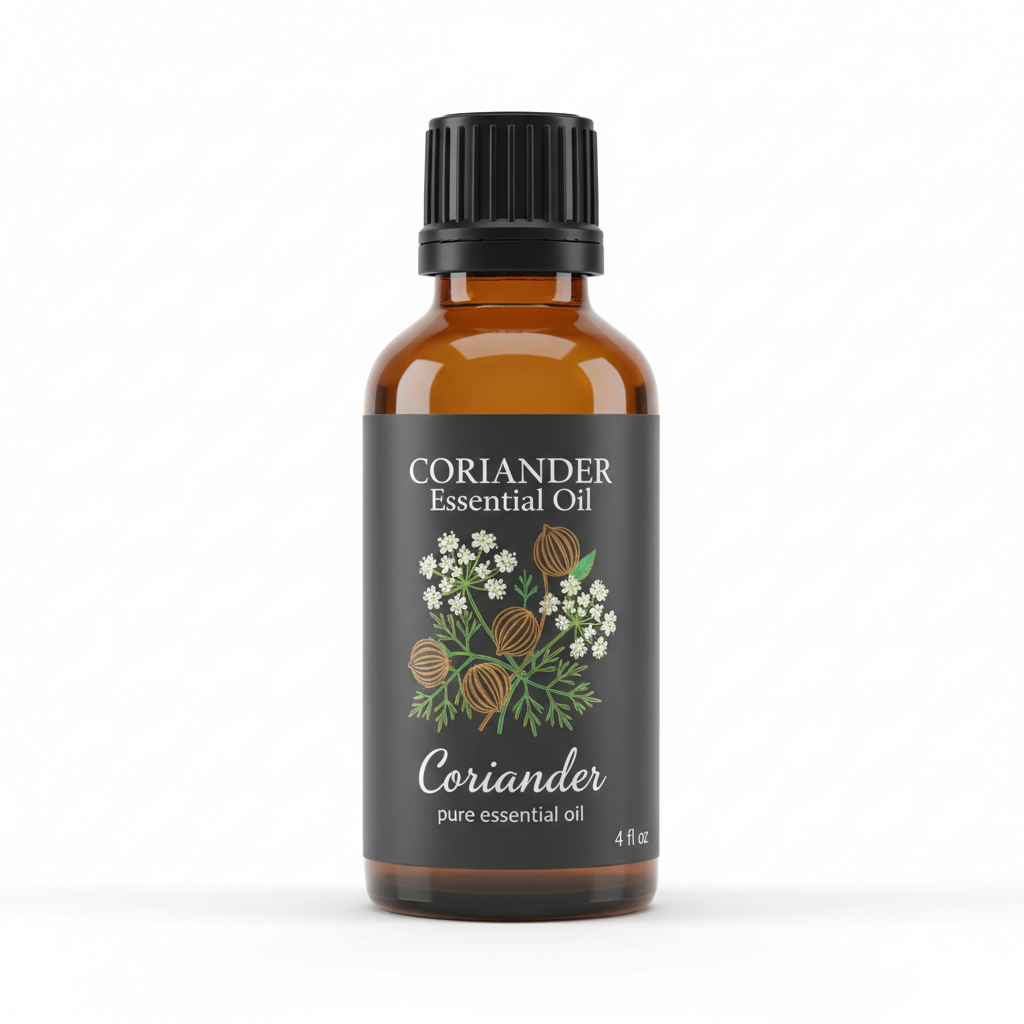
Coriander Essential Oil
Our own Coriander Essential Oil, in sizes from 0.5 oz to bulk.
From $12.99
Shop Now →Who defines the term: nobody
A 2023 family-medicine review in the Journal of Family Practice (Shah et al.) states that no US regulatory agency, such as the FDA or the USDA, certifies or approves essential oils for quality and purity, and that marketing terms such as "therapeutic grade" or "pure" do not reflect a product's quality or purity. The FDA's aromatherapy page does not use the phrase at all. What it says is that how an aromatherapy product is regulated depends mainly on its intended use, judged from labeling claims, websites and advertising, and that a plant origin "doesn't keep it from being regulated as a drug." Read together: that label does not raise an oil's quality, and it can move a product toward the drug side of the line. That is one reason we make no therapeutic claim and sell our coriander seed oil for aromatic and cosmetic use only.
The labels our own shop uses
Our shop page describes the oil as botanical grade and publishes a Certificate of Analysis (a PDF on the product page). "Botanical grade" has no legal definition either, so by the logic above it is not evidence of anything. The evidence is the certificate, which is why this article keeps pointing at it. Our pages also say species identity details are available on request, and we would rather you ask than assume.
What does exist: ISO 3516
The standard for this oil is ISO 3516:1997, "Oil of coriander fruits (Coriandrum sativum L.)", a five-page standard from ISO technical committee 54 (essential oils), which per its catalogue record was confirmed current on 17 July 2023 and replaced a 1980 edition. We have not bought or read it, so we quote none of its limits. What the catalogues show is that the standard is for the fruit, meaning the seed, and not the leaf oil that smells of fresh cilantro. If a seller waves "grade" at you and cannot say whether their lot was checked against a published specification, that gap is the point. Our seed versus leaf piece covers why the two oils differ.
What a real specification looks like, and how much lots differ
The EFSA's 2023 assessment of coriander fruit oil as a feed additive (EFSA FEEDAP Panel, EFSA Journal, 2023) shows the kind of thing a specification contains: linalool 65 to 78% of the GC-FID peak area, camphor 3 to 6%, plus refractive index, density and optical rotation. Five batches averaged 71.7% linalool (67.3 to 76.4%). The same oil analyzed by GC-MS averaged 58.72% (56.2 to 60.5%), and the authors note GC-MS is not used to set specifications. So one oil gave figures roughly 13 points apart by method alone. A linalool percentage on a label without the method is close to meaningless, which our GC-MS checklist expands on.
Natural variation is wide too. In a 2026 study of six coriander genotypes sown on different dates in Adana, Turkey (Ali Ali et al., ACS Omega, 2026), the essential oil's linalool ranged from 47.44 to 74.96%, and autumn sowing favored linalool while spring sowing favored aliphatic aldehydes. A Peruvian seed oil steam-distilled and analyzed by GC-MS (Rojas-Armas et al., Vet World, 2025) had linalool at 59.80%, with alpha-pinene 8.65%, camphor 8.48% and gamma-terpinene 7.09%. Honest lots differ, so a single "correct" number is not on offer, and a lot outside a given range is a reason to ask questions, not proof of a problem.
Seed and leaf differ by more than a few points. In a 2026 study of 48 global accessions (Kim and Kim, Molecules, 2026) the oil was steam-distilled from aerial parts, not seed, and was dominated by (E)-2-decenal at a mean 44.56%, with linalool averaging 15.39% in the most linalool-rich climate group. A "linalool-rich" claim attached to leaf oil would be a different product, and our oil is described on our shop page as linalool-rich seed oil.
The adulteration that a percentage will not catch
Linalool is cheap to make synthetically, so a seller could raise a low lot's number. The best primary evidence we found concerns other oils: Capetti et al., Molecules, 2021 spiked genuine bergamot and lavender oils with synthetic racemic linalool and linalyl acetate (9% and 11% for bergamot; 27% each for lavender). Standard GC did not clearly flag it because values stayed within pharmacopoeia ranges. Chiral analysis did: (S)-(+)-linalool in bergamot rose from 0.4% to 24%, and in lavender from 6.2% to 33.6%. That study did not include coriander, and coriander's natural enantiomer balance differs from lavender's, so those numbers are not a coriander cut-off. The transferable lesson is the method. Percent linalool alone cannot catch a spike; an enantiomer analysis compared against an authentic coriander reference can. Our pages do not say whether the certificate on our shop page includes chiral data, so if that matters to you, ask us before buying and ask any other seller the same.
What to ask for instead of "grade"
- The Latin name and plant part: Coriandrum sativum, fruit (seed).
- A lot-specific GC report that names the method, with the full constituent table and not just linalool.
- Whether the lot was checked against ISO 3516 or another stated specification, and which one.
- Chiral data, if adulteration is your worry.
- Date of distillation or analysis, and storage advice, because linalool oxidizes in air into hydroperoxides that are skin sensitizers (Botvid et al., Contact Dermatitis, 2026: 3.1% positive among 6,719 patch-tested patients). See our storage notes.
For the full buying sequence, see the buyer's guide. A certificate of analysis describes what is in one lot on one day; it does not turn an aroma oil into a health product, and a certificate with no method, date or lot number is weaker than it looks. If you are asking because of a health condition, that conversation belongs with a physician or pharmacist, not with a bottle's grade.
Coriander Essential Oil
Coriander Essential Oil from our own shop, in sizes from 0.5 oz to bulk.
From $12.99
Shop Now →Sources & Further Reading
- Shah PA et al., 2023. Essential oils: how safe? How effective? J Fam Pract 72(9). mdedge.com/JFP07211374
- FDA. Aromatherapy. fda.gov/cosmetics/cosmetic-products/aromatherapy
- ISO 3516:1997. Oil of coriander fruits (Coriandrum sativum L.), catalogue records. dinmedia.de/iso-3516 and genorma.com/iso-3516-1997
- EFSA FEEDAP Panel, 2023. Safety and efficacy of a feed additive consisting of an essential oil obtained from the fruit of Coriandrum sativum L. EFSA Journal. PMC10613936
- Ali Ali DA et al., 2026. Yield performance and oil chemotype variation of Coriandrum sativum genotypes under different sowing dates. ACS Omega. pubmed/41939328
- Rojas-Armas JP et al., 2025. Linalool-rich Coriandrum sativum essential oil in rodent models. Vet World. pubmed/41113205
- Kim M, Kim S, 2026. Climate zone of geographical origin and essential oil composition in Coriandrum sativum. Molecules. pubmed/42280252
- Capetti F et al., 2021. Adulteration of essential oils: a multitask issue for quality control. Molecules 26(18):5610. PMC8471154
- Botvid S et al., 2026. Ten years of patch testing to hydroperoxides of limonene and linalool. Contact Dermatitis. pubmed/41638887