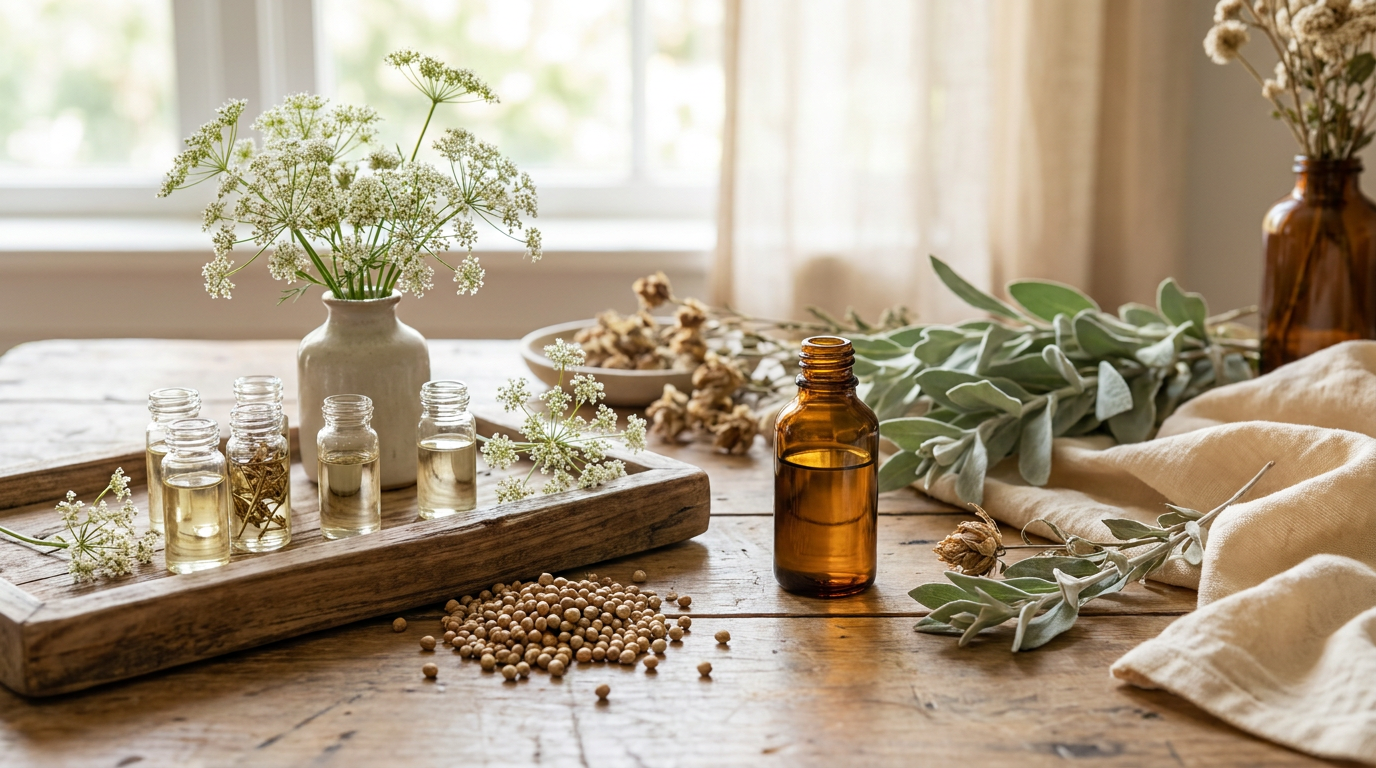
How to Blend Coriander Essential Oil into Cold-Process Soap: A Ratio Guide
Coriander essential oil brings a bright, spicy-citrus note to cold-process soap that's hard to replicate with synthetic fragrance. It sits somewhere between a top note and a mid note, so it shows up fast in the shower and fades into something warmer and rounder as the bar cures. If you've been making soap for a while and want to move past the usual lavender-and-oatmeal rotation, coriander is worth a batch. This guide walks through the actual math of coriander oil cold process soap, from calculating your ratio to pouring the mold, so you're not just guessing at how much to add.
Coriander Essential Oil
Our own Coriander Essential Oil, in sizes from 0.5 oz to bulk.
From $10.99
Shop Now →Why Coriander Works in Cold-Process Soap
Coriander essential oil is steam-distilled from the seed of Coriandrum sativum, the same plant that gives us the herb cilantro, though the seed's scent is a different animal entirely: peppery, faintly citrus, with a soft woody base. In soap, it pairs well with sweeter florals, with warm spices like clove bud or cardamom, and with citrus oils that reinforce its top notes. On its own it can read a little sharp, so many soapmakers blend it at a lower percentage of the total fragrance load rather than using it as a solo scent.
Essential oils behave differently in cold-process soap than they do in a diffuser or a lotion. The batter is alkaline during saponification, and that chemical environment, plus the heat of gel phase, can shift or soften a scent over the four-to-six-week cure. Ratio and timing both matter more here than in almost any other application.
What You'll Need
- Coriander essential oil (a supplier that lists a batch-specific GC/MS report is worth the extra cost)
- Your base soap recipe: carrier oils/butters, lye (sodium hydroxide), and distilled water
- A digital gram scale accurate to at least 0.1g
- A stick blender
- A soap-safe thermometer
- Soap mold(s) sized to your batch
- Small glass or stainless steel measuring beaker, reserved for essential oils only
- Safety gear: gloves, goggles, and a well-ventilated workspace for lye handling
- A notebook or spreadsheet for recording your ratio and cure notes
Understanding Essential Oil Ratios for Soap
Most cold-process soapers calculate their essential oil ratio for soap as ounces per pound of oil (ppo), meaning ounces of essential oil per pound of the carrier oils and butters in the recipe, not per pound of the finished bar. A common starting range across the craft is 0.3 to 1 oz ppo, depending on how strong the oil is and how much scent throw you want after cure.
Coriander sits on the lighter-to-moderate end of that range. Because it's a fairly volatile top note, pushing the ratio too high doesn't necessarily buy you more scent at the six-week mark, it just risks a sharper, less balanced smell in the first two weeks. A coriander soap fragrance ratio of about 0.5 to 0.7 oz ppo is a reasonable starting point for a solo blend, and something closer to 0.3 to 0.4 oz ppo when coriander is one part of a larger blend.
| Batch Size (total oil weight) | Coriander Oil (solo, 0.6 oz ppo) | Coriander Oil (blended, 0.35 oz ppo) |
|---|---|---|
| 1 lb | 0.6 oz | 0.35 oz |
| 2 lb | 1.2 oz | 0.7 oz |
| 5 lb | 3.0 oz | 1.75 oz |
| 10 lb | 6.0 oz | 3.5 oz |
Treat this table as a starting point, not a fixed rule. Run your own recipe's total oil weight through a soap calculator first to confirm your lye and water amounts, then apply the essential oil ratio on top of that. If you're wondering how to add coriander oil to soap for the first time, start at the lower end of the range and take detailed notes; you can always scale up on the next batch once you know how the bar smells after cure.
Step-by-Step: Blending Coriander Oil into Your Batch
- Weigh your total oil amount and calculate your ratio. Before you touch the lye, decide on your batch size and multiply it by your target ppo (0.5 to 0.7 oz ppo for a solo coriander batch is a solid default). Write the number down; don't try to eyeball it later while the clock is running on trace.
- Prepare your lye solution and carrier oils as usual. Follow your base recipe for lye-to-water ratio and oil blend. Bring both to your normal working temperature range before moving to the next step. Coriander oil isn't part of this stage.
- Pre-measure the coriander essential oil separately. Weigh it out in its own beaker rather than eyeballing it into the batter. This keeps your ratio accurate and makes the recipe repeatable next time.
- Combine lye solution and oils, then blend to a light trace. Use the stick blender in short pulses, checking consistency often. You're aiming for a thin-to-medium trace, thin enough that the essential oil disperses evenly, thick enough that it won't separate.
- Add the coriander oil at light trace, not before. Adding essential oils too early, while the batter is still very fluid, increases the chance of the scent fading unevenly or pooling near the surface. Pour it in, then blend by hand with a spatula or a few short pulses of the stick blender until fully incorporated.
- Watch for acceleration. Some essential oils speed up trace once added. Coriander is generally moderate in this regard, but if your batter suddenly thickens, work quickly and get it into the mold before it sets up in the bowl.
- Pour into the mold and insulate as your recipe directs. Cover and insulate (or not) according to whether you want the batch to gel. Gel phase runs hotter and can shift a scent's character slightly, so note whether you gelled or not for future reference.
- Unmold, cut, and cure for four to six weeks. Set bars on a rack with airflow on all sides. Check the scent at week two and again at week six; coriander's profile often mellows and rounds out over that stretch.
Common Mistakes to Avoid
- Guessing instead of weighing. "A generous glug" is not a ratio. Small measurement errors compound fast in a full batch.
- Adding essential oil at too thin a trace. Batter that's still very liquid can let the oil separate or float, leading to uneven scent distribution in the finished bar.
- Overloading the ratio to chase a stronger scent. Past a certain point, more essential oil doesn't mean more throw after cure, it just means a harsher initial smell and a higher cost per batch.
- Skipping the cure-time check-in. Judging the final scent from a fresh-poured bar is misleading. Coriander's profile changes over the cure, so wait before deciding your ratio was wrong.
- Storing essential oil poorly. Heat, light, and air all degrade essential oils over time. Keep the bottle capped, cool, and out of direct sun between batches.
- Ignoring your total fragrance load. If you're blending coriander with other essential oils, add up the combined ppo across all of them, not just the coriander portion, when deciding your overall ratio.
Tips for Better Scent Retention
Blending coriander with a small amount of a fixative-style base note, such as patchouli or sandalwood, may help round out the top note and give the overall scent more staying power in the cured bar. Cooler cure environments with steady airflow tend to preserve scent better than hot, humid ones. Some soapmakers also wrap cured bars in wax paper rather than leaving them fully exposed, which can slow scent loss during long-term storage without trapping moisture the way plastic does.
What to Expect
A cold-process bar made with a well-measured coriander ratio typically has a noticeable spicy-citrus scent fresh out of the mold, which softens over the cure into something warmer and less sharp. Scent strength at the four-to-six-week mark is generally lighter than a fresh fragrance-oil bar, since natural essential oils tend to have less staying power through saponification than synthetic fragrance blends built for cold process. That's a normal characteristic of working with essential oils rather than a sign you did something wrong. If a batch comes out fainter than you'd like, note the ratio you used and adjust upward slightly on the next attempt rather than assuming the oil itself was ineffective.
Safety Notes and Patch Testing
Cold-process soapmaking involves sodium hydroxide, which is caustic and requires gloves, eye protection, and good ventilation any time you're mixing lye solution. Keep it away from children and pets, and always add lye to water, never the reverse.
Coriander essential oil should always be measured within an established ratio, not added freehand, and undiluted essential oil should never contact skin or eyes directly during the soapmaking process. Once bars are cured, it's still a good idea to try a small patch of the finished soap on a discreet area of skin before regular use, and to discontinue use of that batch if you notice any irritation. Everyone's skin responds differently to essential oils, even at low ratios, and a patch test on the actual cured bar tells you more than any general guideline can. If you have ongoing skin concerns, it's worth checking with a qualified healthcare provider before introducing a new essential oil into your routine.
Getting a coriander soap fragrance ratio right is mostly a matter of measuring carefully, adding at the right stage of trace, and giving the bar a full cure before judging the result. Once you've run one batch and taken notes, the next one gets a lot easier to dial in.