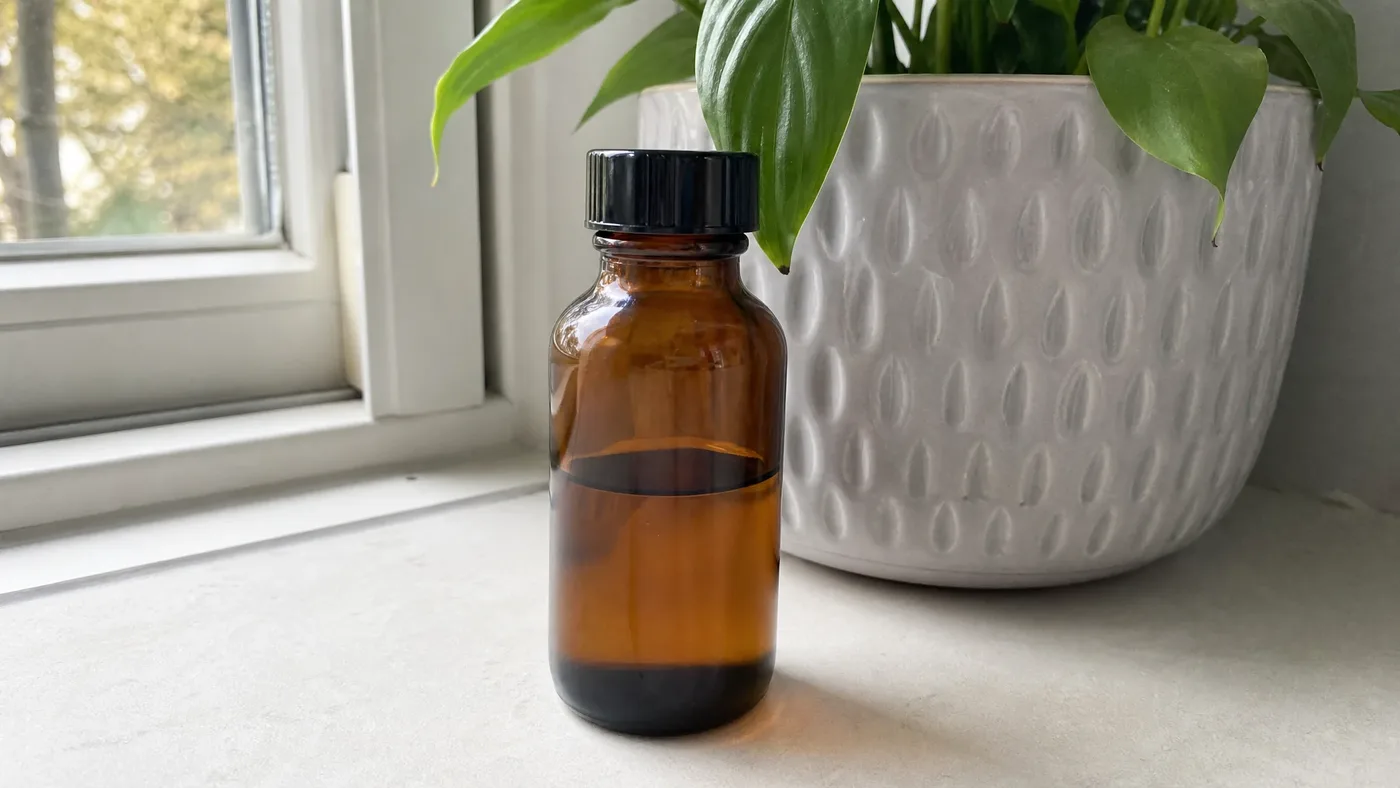
Can You Ingest Coriander Essential Oil? What the Rules Say
No. Do not swallow the coriander seed essential oil we sell, or any essential oil from a bottle labelled for aroma. Our shop labels it for aromatic and cosmetic use, not internal use, and nothing about a food-flavouring entry for coriander changes that. The rest of this page is the reasoning: how concentrated the bottle is, what the US regulations do and do not cover, and what poison centres have documented.
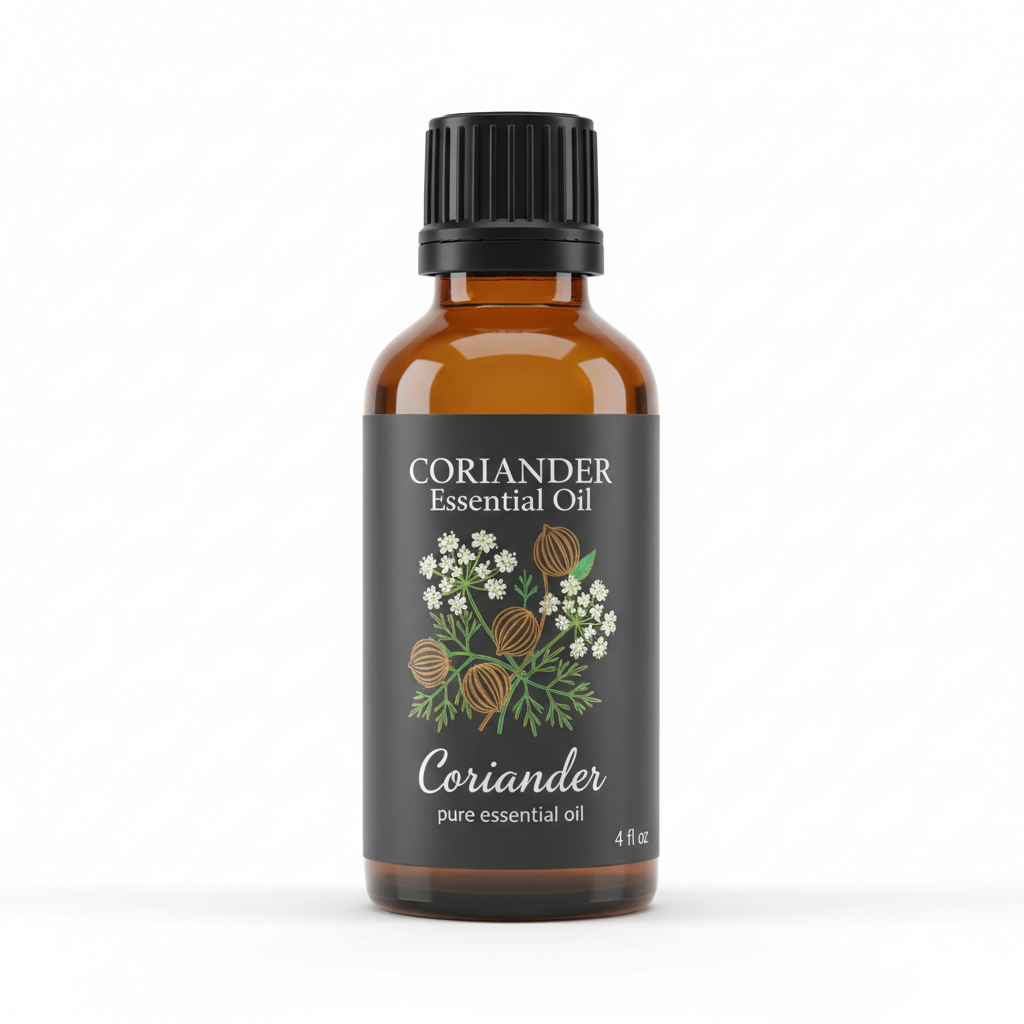
Coriander Essential Oil
Our own Coriander Essential Oil, in sizes from 0.5 oz to bulk.
From $12.99
Shop Now →Start with the arithmetic of one drop
Our shop copy says 0.5% to 2% in a carrier is roughly 3 to 12 drops per ounce. Working that backwards: an ounce is 29.57 mL, 0.5% of that is 0.148 mL, and 0.148 mL spread over 3 drops is about 0.05 mL a drop. That is the figure we use below.
Now the seed side. A 2023 study in Plants (Machado et al., 2023) distilled 11 coriander fruit (seed) samples grown in Portugal and reported that the European Pharmacopoeia sets a floor of 3 mL of essential oil per kilogram of dried fruit. The authors' own samples came in below that floor. At exactly 3 mL/kg, one 0.05 mL drop holds the oil from about 16.7 g of seed (0.05 divided by 3, times 1,000). A 0.5 oz bottle, about 14.8 mL, is roughly 4.9 kg of seed at that floor. Lower-yielding seed means more seed per drop, so these are minimum figures.
The kitchen comparison follows from that. Reasoning from that figure: a pinch of ground coriander in a curry is a gram or less of seed (my assumption), so it carries a small fraction of one drop's worth of volatile oil, spread through a pot of food. A drop of the distilled oil is the volatile fraction of about 17 g of seed with the bulk removed. The two are different materials that happen to share a plant name. Our post on coriander in gin and the kitchen covers the culinary side.
One more number, treated as reasoning because we are assuming a weight and a density. EFSA's 2023 opinion on coriander oil as an animal-feed additive quotes an estimated consumer intake of coriander oil of 0.049 mg per kg of body weight per day, taken from a handbook. For a 70 kg adult that is about 3.4 mg a day. If a drop weighs 40 to 50 mg (essential oils are usually a little lighter than water), a drop is more than ten times that daily estimate. The intake figure describes background dietary exposure, not a dose anyone has tested as acceptable from a bottle.
What the "generally recognised as safe" entries cover
People who ask this question usually have one fact in hand: the FDA lists coriander as GRAS. We read the current federal text. Title 21 of the Code of Federal Regulations lists "Coriander" (Coriandrum sativum L.) in both 21 CFR 182.10 (the spices and natural seasonings section) and 21 CFR 182.20 (essential oils, oleoresins and natural extractives). Part 182 treats these as substances generally recognised as safe under their intended use as food ingredients, within the meaning of section 409 of the Act.
What that entry is: a classification for a flavouring added to food. What it is not: approval of a retail bottle of oil for swallowing, a dose, or a statement about the product in our shop, which is labelled for a different use entirely. Swallowing a bottled aroma oil is a different use from the one the entry describes.
We looked for EFSA, JECFA and FEMA statements on linalool as a flavouring and fetched only the EFSA opinion above, so we are not reporting the others.
What is documented when essential oils are swallowed
We found no case report specific to coriander oil. What exists is for essential oils as a class. A review of calls to the New South Wales Poisons Information Centre (Lee, Harnett and Cairns, Medical Journal of Australia, 2020) covered July 2014 to June 2018: 4,412 essential oil exposure calls. Of those, 2,790 (63%) involved someone under 15, 2,179 (49.4%) involved a child aged 1 to 4, 3,530 (80%) were accidental, and 1,387 (31%) of callers already had symptoms. The paper lists vomiting, central nervous system depression or excitation, and aspiration pneumonitis, and says as little as 5 mL can cause life-threatening toxicity in children. Coriander is not mentioned in it. The data are from Australia and are call records, so they show who rings a poison line, not how often a given oil harms.
US Poison Control says the same type of thing in plain terms: misuse of essential oils can cause serious poisoning, and an oil that goes down the wrong way into the lungs can cause pneumonia (Poison Control, essential oils article). Its named examples are camphor, wintergreen, sage, eucalyptus and pennyroyal oils. Coriander is not on that list. EFSA's specification for coriander oil allows 3 to 6% camphor (mean 4.59% in its five batches). We will not turn that into a toxicity claim: camphor poisoning data concern camphor products, not a 5% constituent of a seed oil. Whether that matters swallowed is a toxicologist's question, which is one more reason this is not a do-it-at-home experiment.
The Tisserand Institute disagrees with the flat rule only in a narrow way: it says one or two drops of most essential oils can be taken in a day, but only on the advice of a practitioner qualified and licensed to prescribe oils that way, and it does not name coriander. That is a practitioner's call about a specific oil. It is not a reason to improvise from a bottle, and we are not that practitioner.
If it already happened
Poison Control (US): 1-800-222-1222, free and available around the clock, or its online tool. It says not to induce vomiting, and to call 911 if the person collapses, has a seizure, has trouble breathing or cannot be woken. For a child, call before symptoms appear. Our shop already says to keep the oil away from children and pets, and the 63% under-15 figure above is the reason that line matters.
What to do instead
- If you want coriander flavour, use the spice or leaf from a food supplier. We sell neither; we sell only the one coriander seed oil.
- If you want a fragrance, use ours as the aroma material it is sold as, diluted. The dilution maths is yours because the bottle is undiluted. See the uses guide and the side-effects post for the skin side.
- If a product promises an oral dose of coriander oil, ask who formulated it and what it is labelled for. A pharmacist can tell you what is in a licensed product.
The short version: a food entry says coriander is an accepted ingredient in food, a drop of our oil is the distillate of about 17 g of seed, and no source we read gives a swallowing dose for a bottle sold for aroma. We sell aromatic oil, not medical advice. For questions about what is in your body, ask a pharmacist or physician.
Coriander Essential Oil
Coriander Essential Oil from our own shop, in sizes from 0.5 oz to bulk.
From $12.99
Shop Now →Sources & Further Reading
- Machado et al., 2023. Chemical Variability of the Essential Oils from Two Portuguese Apiaceae. pubmed.ncbi.nlm.nih.gov/37514362
- EFSA FEEDAP Panel, 2023. Safety and efficacy of a feed additive consisting of an essential oil obtained from the fruit of Coriandrum sativum L. (FEFANA asbl). pmc.ncbi.nlm.nih.gov/PMC10613936
- US Government, Title 21 CFR 182.10. ecfr.gov/182.10
- US Government, Title 21 CFR 182.20. ecfr.gov/182.20
- Lee, Harnett and Cairns, 2020. Essential oil exposures in Australia: NSW Poisons Information Centre. pubmed.ncbi.nlm.nih.gov/31709543
- Poison Control. Essential oils: poisonous when misused. poison.org/articles/essential-oils
- Tisserand Institute. Safety guidelines. tisserandinstitute.org/safety/safety-guidelines