Coriander Oil Side Effects: Irritation, Allergy and Oxidation
The skin allergen in a linalool-rich oil is mostly not linalool as it leaves the still. It is what linalool turns into after it has sat in air. That one fact explains most of what can go wrong with a bottle of coriander seed oil, and it is why how you store and dilute it matters more than which day you bought it. This page is organised by what can happen: irritation, allergy, breathing, other routes, and how to decide when to stop.
Coriander Essential Oil
Our own Coriander Essential Oil, in sizes from 0.5 oz to bulk.
From $12.99
Shop Now →Irritation and allergy are different events
The Tisserand Institute separates them. Irritation is the milder reaction and usually settles within hours; more dilution will usually stop it recurring. Sensitisation is the immune system being primed, so that a later exposure causes an allergic reaction that can last days or weeks, and dilution "may not prevent" it. For practical purposes: a stinging patch that fades the same day points to irritation; a rash that spreads, itches for days or returns on re-exposure is the pattern to take to a dermatologist.
For coriander oil in particular, EFSA's 2023 panel opinion on the fruit oil (written for animal feed, with no user studies submitted) says it should be considered an irritant to skin and eyes and a skin and respiratory sensitiser (EFSA FEEDAP Panel, 2023). That is a hazard classification of the neat oil, which is the state ours arrives in.
The oxidation problem, with numbers
Linalool makes up 65 to 78% of the specification for that EFSA oil (mean 71.7% across five batches), and 60 to 73% in 11 Portuguese fruit samples (Machado et al., 2023). Gothenburg dermatologists have studied what air does to it. Pure linalool is not allergenic or only a very weak allergen, but it autoxidises on air exposure and the oxidation products can cause contact allergy (Bråred Christensson et al., Contact Dermatitis, 2010). In a 2009 test in dermatitis patients and controls, oxidised linalool was more irritating than the unoxidised form (Bråred Christensson et al., 2009).
How often does it happen? In the 2010 study, 3,418 consecutive dermatitis patients were patch tested with oxidised linalool at four strengths in petrolatum. Positive reactions rose with concentration: 0.83% at 2%, 3.2% at 4%, 5.3% at 6%, and 7.2% at 11%. A 2016 multicentre study (Bråred Christensson et al., 2016) tested 2,900 dermatitis patients in six countries with oxidised linalool at 6% (1% hydroperoxides) and reported contact allergy in 6.9%. Read these with care: the people tested already had dermatitis, the test material was deliberately oxidised linalool rather than coriander oil, and a patch under a chamber is not the same as a diluted oil on a forearm. They show the hazard exists and that it depends on oxidation, not that 7% of oil users react.
Practical consequence, from reasoning: the oil's age and storage are variables you control. Our storage post covers the bottle; our shop gives a typical shelf life of 2 to 3 years cool, dark and tightly capped. If a bottle has been open for a long time and smells different, treat it as a different material. Our linalool post has the chemistry.
Dilution: where our range sits against the numbers we could read
Our shop says 0.5% to 2% in a carrier (roughly 3 to 12 drops per ounce) and to start at the low end. Tisserand's published dermal maximum for coriander seed oil could not be read here: the dilution tables online are images, and the book was not available to us. So we cannot tell you whether it is above, below or equal to our range, and we will not guess. What we could fetch: Robert Tisserand wrote that coriander seed "need[s] to be used at about 0.5% concentration" in a skin-care article, in the context of sensitivity (Tisserand Institute, five steps). The Institute's irritation page says oils with the highest skin-reaction risk should have a dermal maximum of 1.5% or less, and that a single oil or blend should not be used above 5% for months or years.
The disagreement is visible: our upper figure, 2%, is above that 1.5% marker, and the one coriander-specific line we read says about 0.5%. Reasoning from those sources, the sensible reading is to treat 0.5% as the working figure for skin, which is 3 drops in an ounce at 0.05 mL a drop, and to treat 2% as a ceiling for someone with no history of fragrance reactions. For tasks beyond that, the dilution and phototoxicity post owns the basic dilution and the sun question.
The patch test, and where Tisserand disagrees with us
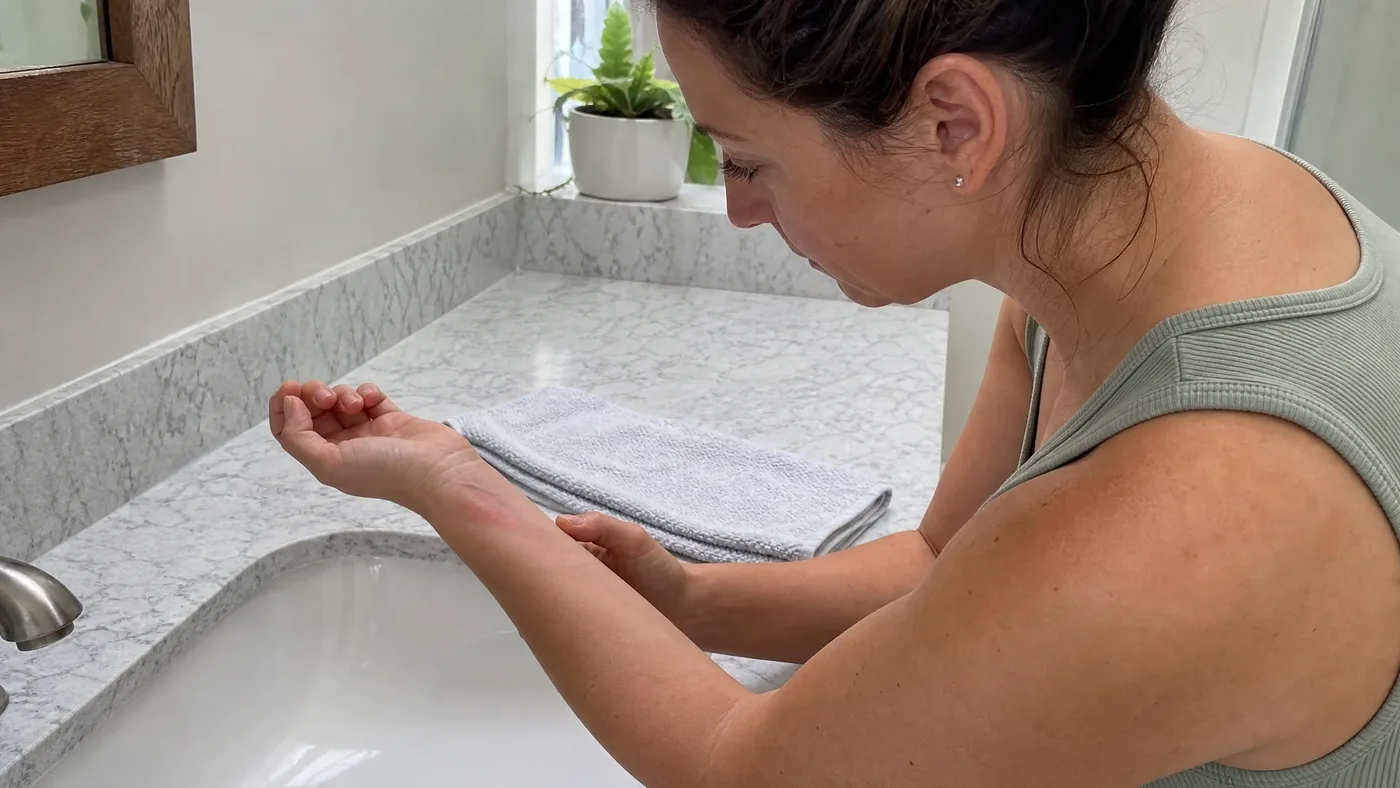
Our copy says patch test first. Tisserand's page says the Institute does not generally recommend patch testing: professional tests use special patches consumers cannot buy, they are not 100% reliable, and intensive testing can itself cause allergy. For high-risk people it recommends dose escalation instead, starting at perhaps 1% and rising in 0.5% steps. Both can be true. A dab of diluted oil on the inside forearm will show you an irritant reaction, and a clear result does not guarantee you will never become allergic. Use it as a cheap check, not a clearance, and stop at the first itch or redness.
If you are a maker selling into the EU
Linalool is one of the 26 fragrance allergens that EU cosmetics rules require to be declared individually (Directive 2003/15/EC); the thresholds are 0.001% in leave-on products and 0.01% in rinse-off. The European Commission's own explainer calls those thresholds a "pragmatic administrative decision" (EU Commission, perfume allergies explainer). Worked: a 1% coriander oil body oil with oil that is 71.7% linalool contains about 0.72% linalool, around 700 times the leave-on threshold, so the declaration would apply. That is arithmetic, not legal advice.
Other reactions: breathing, spice allergy, swallowing
- Breathing. EFSA lists coriander oil as a respiratory sensitiser. If a diffuser makes you cough or tighten, stop. A person with asthma should ask a physician before diffusing.
- Spice allergy. A 2025 review of spice allergy in children names coriander among the commonly implicated spices, with cross-reactivity to birch and mugwort pollen, and a case report describes anaphylaxis to coriander in beer (Berghea et al., 2025; Brussino et al., 2018). Those are food reports, and whether they apply to the oil is an inference. If you have a spice allergy, ask an allergist first.
- Swallowing or eyes. Not what our oil is for; see the ingestion post. For a rash, Poison Control says wash the oil off with soap and water, and that difficulty breathing is an emergency. Poison help: 1-800-222-1222.
- Children and pregnancy. See kids and the pregnancy post, which are separate decisions.
Who should skip it
Anyone with a past reaction to scented products, a spice or celery-family allergy, active eczema, or a prescribed skin medicine. We sell aromatic oil, not medical advice. For a reaction that persists beyond a day or returns, a dermatologist is the right person, and an allergist for anything involving breathing or swelling.
Coriander Essential Oil
Coriander Essential Oil from our own shop, in sizes from 0.5 oz to bulk.
From $12.99
Shop Now →Sources & Further Reading
- Tisserand Institute. Irritation and allergic reactions. tisserandinstitute.org/safety/irritation-allergic-reactions
- Tisserand Institute. Five steps to successfully using essential oils in skin care. tisserandinstitute.org/five-steps
- EFSA FEEDAP Panel, 2023. Safety and efficacy of a feed additive consisting of an essential oil obtained from the fruit of Coriandrum sativum L. pmc.ncbi.nlm.nih.gov/PMC10613936
- Machado et al., 2023. Chemical Variability of the Essential Oils from Two Portuguese Apiaceae. pubmed.ncbi.nlm.nih.gov/37514362
- Bråred Christensson et al., 2010. Linalool, a significant contact sensitizer after air exposure. pubmed.ncbi.nlm.nih.gov/20136877
- Bråred Christensson et al., 2009. Air oxidation increases skin irritation from fragrance terpenes. pubmed.ncbi.nlm.nih.gov/19125719
- Bråred Christensson et al., 2016. Oxidized limonene and oxidized linalool, concomitant contact allergy. pubmed.ncbi.nlm.nih.gov/26918793
- European Commission. Perfume allergies (SCCS opinion explainer). ec.europa.eu/perfume-allergies
- Berghea et al., 2025. Spices, herbs and allergic reactions in children. pubmed.ncbi.nlm.nih.gov/41306764
- Brussino et al., 2018. Beer anaphylaxis due to coriander as hidden allergen. pubmed.ncbi.nlm.nih.gov/30093499
- Poison Control. Essential oils: poisonous when misused. poison.org/articles/essential-oils