Coriander Oil for Anxiety and Sleep: What Each Study Tested
Coriander seed oil is linalool-led, and linalool is the compound people point to when they link coriander with calm or sleep. The evidence for that link is a ladder, and coriander seed oil used as an aroma is not on a single rung of it that involves people. This article climbs the ladder one step at a time, saying at each step what was tested and what that does and does not tell you about the bottle we sell, which is for aroma and cosmetic use and makes no claim about stress, anxiety or sleep.
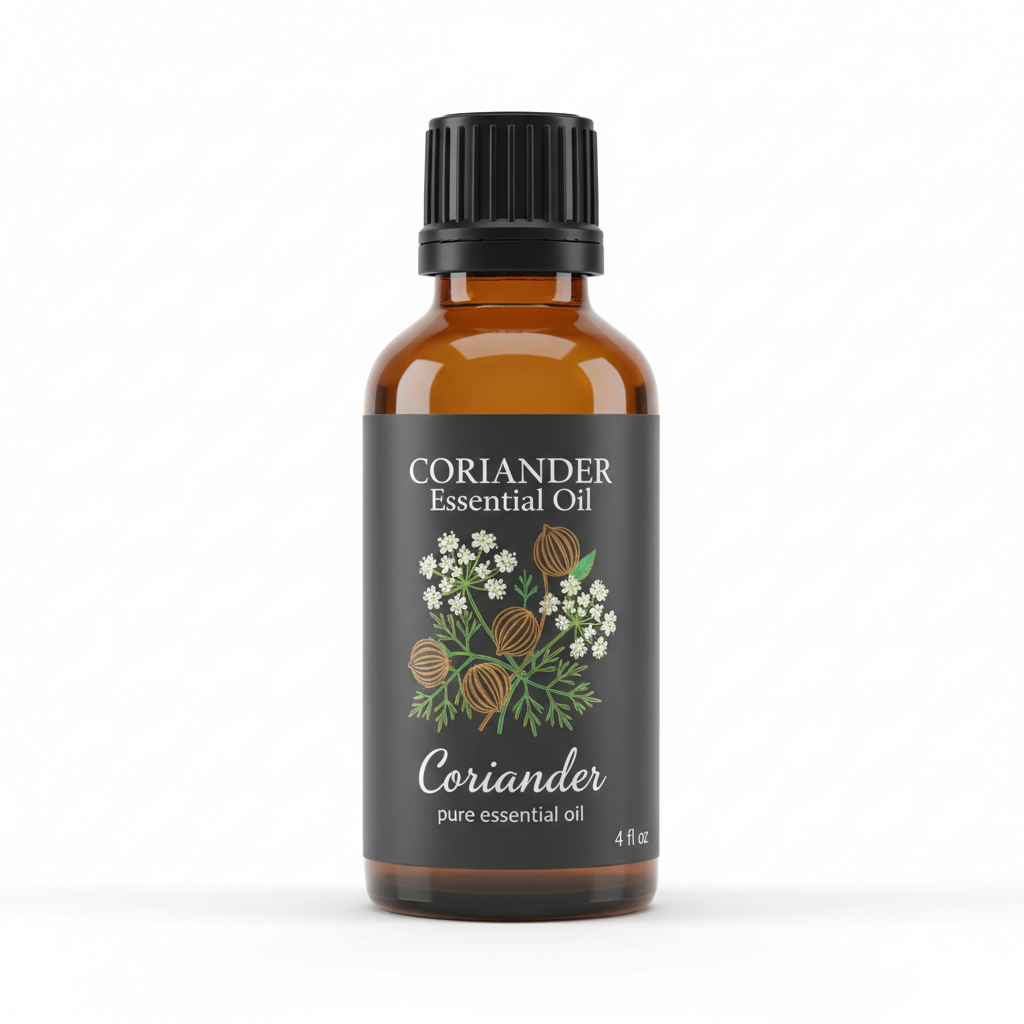
Coriander Essential Oil
Our own Coriander Essential Oil, in sizes from 0.5 oz to bulk.
From $12.99
Shop Now →Rung 1: a single molecule in a dish
Linalool, the main constituent of seed oil, has been studied on neurons. An in vitro study on GABA-A receptors, a receptor for the inhibitory messenger GABA, reported that linalool enhances GABA currents (Milanos et al., Frontiers in Chemistry, 2017). That is a mechanism in isolated cells. It tells you how linalool might act if enough of it reached the receptors; it does not tell you whether a diffuser or a diluted skin oil delivers that.
Rung 2: inhaled linalool in mice
Linck et al., Phytomedicine, 2009 put mice in a chamber for 60 minutes in air saturated with linalool at 1% or 3%. Both exposures lengthened sleep time induced by the sedative pentobarbital and lowered body temperature; the 3% exposure also reduced movement, and coordination on the rota-rod was unaffected. A follow-up, Linck et al., Phytomedicine, 2010, reported less anxiety-like behaviour in the light/dark test, more social interaction and less aggression, with memory impaired only at the higher dose. Both used linalool alone, not essential oil, and the abstracts we read do not give group sizes. Applying them to coriander seed oil is an inference: the seed oil also carries camphor, alpha-pinene and gamma-terpinene (Rojas-Armas et al., Veterinary World, 2025 measured linalool at 59.8% in a Peruvian seed oil), and a mouse breathing a one-hour chamber is not a person with a diffuser running in another room.
Rung 3: coriander seed extracts in rodents
Two studies used coriander seed or fruit extracts, not oil:
- Mahendra and Bisht, Indian Journal of Pharmacology, 2011: a hydroalcoholic extract of the fruit given to mice at 50, 100 and 200 mg/kg, compared with diazepam at 0.5 mg/kg across four anxiety models. The 100 and 200 mg/kg doses showed effects roughly similar to diazepam; 50 mg/kg showed none.
- Emamghoreishi et al., Journal of Ethnopharmacology, 2005: an aqueous seed extract injected into the abdomen of male mice. At 100 mg/kg, mice spent more time on the open arms of an elevated plus-maze. Activity and coordination fell at 50 mg/kg and above, which the authors read as possible sedation and muscle relaxation.
Reasoning from the Mahendra dose: a straight multiplication of 100 mg/kg by a 70 kg adult gives 7 grams of extract. Animal-to-human dose conversion is not linear, so that number proves nothing, but it shows how far these doses sit from a few drops of oil in the air. The injection route in the second study bypasses digestion entirely, and the extract in both is water or alcohol soluble material, which is chemically different from distilled oil. A review pulling these together, Hosseini et al., Avicenna Journal of Phytomedicine, 2021, describes anti-anxiety and sedative activity of coriander and linalool; its reach is only as good as the rodent work beneath it.
Rung 4: people breathing coriander oil
This is the rung that matters for a buyer, and we could not find it. On 2026-10-23 we searched Europe PMC for coriander or Coriandrum AND (aromatherapy OR inhaled OR inhalation) AND (anxiety OR sleep OR stress) limited to randomized or clinical trial publication types. It returned zero records. We found no human trial of inhaled coriander seed oil for anxiety, stress or sleep. A zero from one database search is not proof of absence, but it is the honest state of what we could verify.
The better-studied relative: lavender
Lavender is the linalool-rich aroma people have actually trialled. Shen et al., Holistic Nursing Practice, 2026 pooled 11 randomized trials with 628 adults and reported better sleep scores with lavender essential oil (standardized mean difference -0.56, 95% CI -0.96 to -0.17), while the authors say the number and quality of studies limit the conclusion. That tells you about lavender oil. It does not transfer to coriander: aromatherapy effects differ by oil, and a meta-analysis of anxiety trials in heart-attack patients found very high heterogeneity (I² of 96.7%) with only some oils individually significant (Hu et al., Acta Cardiologica Sinica, 2025). Sharing a major constituent does not make two oils interchangeable, and the two oils differ in scent too; our coriander versus lavender comparison goes through that. We do not sell lavender; our shop page lists it only as a blend partner someone would source elsewhere.
NCCIH is blunt about the general case: aromatherapy "is sometimes used for insomnia, but we don't know whether it's helpful because little rigorous research has been done on this topic" (NCCIH, Aromatherapy). It also describes a study of lemon and lavender in stressed people where lemon improved mood and neither scent changed the stress indicators measured.
What the ladder means in practice
- What we can say. Our oil is a distilled seed oil with a warm, woody, softly spicy aroma and a published Certificate of Analysis, sold botanical grade. People choose scents they like for a room, and that is the extent of what our product claims.
- What we will not say. That it calms, relaxes, or helps anyone sleep. No trial of the thing we sell supports that.
- If you diffuse it anyway. Our shop copy says a little goes a long way in a diffuser, and the page lists citrus blends; see the sunlit spice blend and what blends with coriander. Keep it away from children and pets, and stop if you get irritation. We have not tested any blend or diffuser run; those articles are formulations, not results.
Who should see a person, not a bottle
Everyday stress after a bad week is one thing. Persistent anxiety, low mood, panic, or sleep trouble that does not settle belongs with a physician, psychologist or other licensed clinician. The CDC says to talk to a healthcare provider "if you regularly have problems sleeping," lists 7 or more hours as the adult range for ages 18 to 60, and names the basics: a consistent schedule, a quiet and cool bedroom, no devices for 30 minutes before bed, and avoiding caffeine late in the day (CDC, About Sleep). If you are in crisis or thinking about suicide, call or text 988 in the US, or chat at chat.988lifeline.org; it is free and runs every day around the clock (988 Suicide & Crisis Lifeline). Pregnant readers, and anyone whose child or pet shares the room, should ask an OB-GYN or midwife, pediatrician or veterinarian before diffusing anything.
If you buy our coriander seed oil, buy it because you like the smell. The mouse chamber work is interesting, and it stays in the lab column until someone tests the real thing in people.
Coriander Essential Oil
Coriander Essential Oil from our own shop, in sizes from 0.5 oz to bulk.
From $12.99
Shop Now →Sources & Further Reading
- Milanos S et al., 2017. Linalool and GABA-A receptors (in vitro). pubmed.ncbi.nlm.nih.gov/28680877
- Linck VM et al., 2009. Inhaled linalool-induced sedation in mice. pubmed.ncbi.nlm.nih.gov/18824339
- Linck VM et al., 2010. Inhaled linalool, anxiety, social interaction and aggression in mice. pubmed.ncbi.nlm.nih.gov/19962290
- Rojas-Armas JP et al., 2025. Linalool-rich Coriandrum sativum essential oil in rodent models. pubmed.ncbi.nlm.nih.gov/41113205
- Mahendra P, Bisht S, 2011. Anti-anxiety activity of Coriandrum sativum in different experimental anxiety models. pubmed.ncbi.nlm.nih.gov/22022003
- Emamghoreishi M et al., 2005. Coriandrum sativum: evaluation of its anxiolytic effect in the elevated plus-maze. pubmed.ncbi.nlm.nih.gov/15619553
- Hosseini M et al., 2021. Neuroprotective effects of Coriandrum sativum and its constituent, linalool: a review. pubmed.ncbi.nlm.nih.gov/34745916
- Shen H et al., 2026. Sleep-enhancing effect of lavender essential oil in adults: systematic review and meta-analysis. pubmed.ncbi.nlm.nih.gov/40600743
- Hu JY et al., 2025. Aromatherapy and anxiety in acute myocardial infarction patients: systematic review and meta-analysis. pubmed.ncbi.nlm.nih.gov/41018287
- NCCIH. Aromatherapy. nccih.nih.gov/health/aromatherapy
- CDC. About Sleep. cdc.gov/sleep/about
- 988 Suicide & Crisis Lifeline. 988lifeline.org