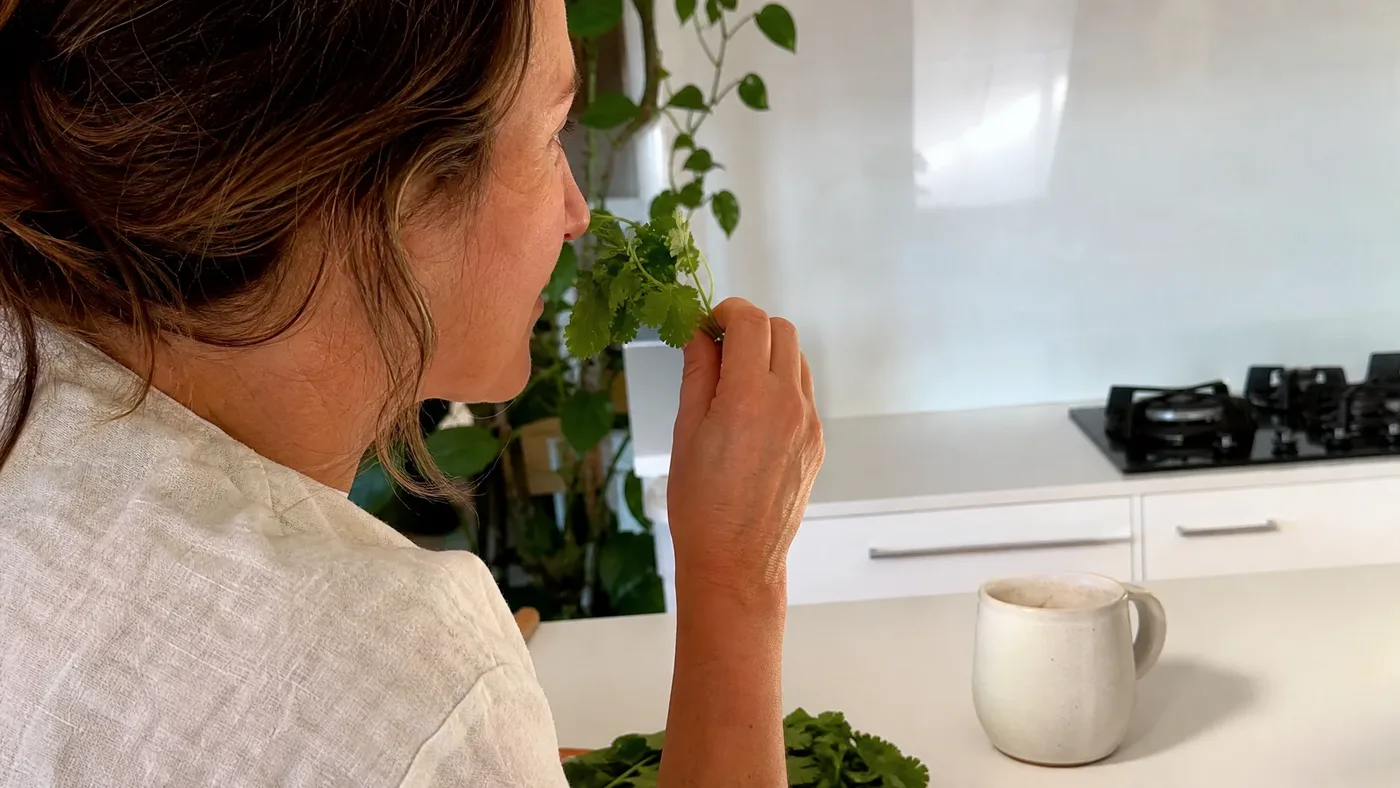
Why Coriander Tastes Like Soap: What the Gene Study Shows
If fresh cilantro tastes like soap to you, the usual explanation is a smell-detection quirk, not a bad bunch of herbs, and the molecules involved are mostly leaf aldehydes. Our oil is distilled from the coriander seed, which the literature describes as a different chemical profile, so the soap story is much weaker for this bottle. Weaker is not the same as zero, and this piece shows where the evidence stops.
Coriander Essential Oil
Our own Coriander Essential Oil, in sizes from 0.5 oz to bulk.
From $12.99
Shop Now →What the genetics study found, and how small it is
The best-known paper is a genome-wide association study by Eriksson and colleagues at 23andMe, published in the journal Flavour in 2012. The discovery group was 14,604 customers of mostly European ancestry who answered an online question: does fresh cilantro taste like soap to you? One variant, rs72921001, on chromosome 11 near a cluster of olfactory receptor genes (including OR6A2), reached genome-wide significance (p = 6.4e-9, odds ratio 0.81 per A allele). The authors checked it against a different question, whether people like the taste of fresh cilantro, in 11,851 other participants. It held, but weakly (p = 0.0057, odds ratio 0.92).
Read the size of the effect before repeating the headline. The authors estimated the variant explains about 0.5% of the variance in soapy-taste perception. Their SNP-based heritability estimate was 0.087 with a confidence interval running from roughly -0.037 to 0.211, which includes zero, and they call it a lower bound. So the honest summary is: one real but small signal near an aldehyde-sensitive receptor, most of the trait unexplained. The authors themselves list environment, including diet in early life, as a possible contributor.
Their stated candidate is OR6A2, a receptor already known to respond to aldehydes, with OR10A2 as another gene in the same linked region. "Candidate" is the operative word: the paper proposes a mechanism and does not demonstrate it in a receptor assay.
How common is the dislike
A separate 2012 Flavour study, by Mauer and El-Sohemy, asked 1,639 adults aged 20 to 29 in the Toronto Nutrigenomics and Health Study to rate cilantro on a 9-point scale; a score of 1 to 4 counted as disliking it. The percentages that disliked it differed widely by ethnocultural group:
| Group | Classified as disliking cilantro |
|---|---|
| East Asian | 21% |
| Caucasian | 17% |
| African descent | 14% |
| South Asian | 7% |
| Hispanic | 4% |
| Middle Eastern | 3% |
Two cautions. Dislike is not the same as "tastes like soap" (Mauer measured liking, Eriksson measured the soap perception), and the Toronto sample is young adults in one city, so these are not national rates. Note also that the strongest genetic association in Eriksson was in Europeans; the authors reported a significant result in only one other subgroup (South Asian, with a small sample).
Which molecules, and which part of the plant
The soap note is attributed to aldehydes in the fresh leaf. A 2022 analysis by Kumar and colleagues in Frontiers in Plant Science distilled essential oil from the fresh leaves of four coriander cultivars and found (E)-2-decenal, decanal, (E)-2-dodecenal and (E)-2-tetradecenal as the main components in all four. That is leaf oil. Delaquis and colleagues at Agriculture and Agri-Food Canada (2002) analysed the oils of coriander (the seeds) and cilantro (the leaves of immature plants) separately, and tied the cilantro oil's character to long-chain (C6 to C10) alcohols and aldehydes.
Seed oil is built differently. A 2024 Scientific Reports study by Önder and colleagues hydrodistilled seeds grown on a university research farm in Turkey and reported 98.96% linalool (with 1.04% of a hydroperoxide) by GC-MS. That figure is unusually concentrated: the paper itself notes only two compounds were identified, which is few compared with the other six Apiaceae seed oils in the study, so do not treat 99% as the number for every lot of seed oil. What matters here is the direction: in the seed oil they analysed, the leading molecule is an alcohol, not a decenal.
What this means for a bottle of seed oil (our reasoning, not a finding)
Reasoning from those composition papers and the receptor study, the practical consequence is this: the compounds linked to the soap perception are dominant in leaf oil, and the seed oil in the Turkish analysis was almost all linalool. Someone who dislikes cilantro leaf may or may not react the same way to a seed oil, and no study we found tested soap-perceivers against seed oil. We will not tell you the bottle never smells soapy to anyone. We can tell you what the shop describes: a warm, woody, softly spicy, linalool-rich seed oil with a rounded sweetness and a light floral edge, which is not the smell of fresh coriander leaf. Our seed versus leaf comparison and the scent profile go through the aroma, and the linalool article covers the molecule.
If you are deciding whether to buy, the cheap test is a small bottle. The smallest size we list is 0.5 oz. If you want the composition of the lot before you order, the shop publishes a Certificate of Analysis, and our guide to reading a GC-MS report shows how to look for aldehydes on it. This is a smell question only; none of it is a health claim.
One practical note on how to test. Our oil is sold undiluted, so the first sniff should come from a paper strip or tissue with a single drop on it, held at arm's length, not from the open bottle neck and not on skin. Concentrated oil smells sharper than it does once it is diluted into a carrier oil or a diffuser, which is an ordinary property of concentrated aromatics rather than anything specific to coriander. If the first impression is soapy, wait a few minutes: the top notes leave first and a linalool-led oil settles into its middle note. That last point is reasoning from the fact that it is a perfumery middle note, not something we have measured on a smelling panel.
What nobody has shown
- That OR6A2 is the receptor, in a laboratory assay with cilantro compounds, as opposed to a statistical neighbour.
- How much of the trait is inherited. The only SNP-based estimate in the paper has a confidence interval that includes zero.
- Whether the perception can be unlearned. The authors flag environmental and epigenetic influences without testing them.
- Anything about seed oil and soap perception. The 23andMe questions were about fresh cilantro, not oil, not seed.
Also keep in mind the sample: self-reported answers from consumer-genetics customers, and every author on the Eriksson paper was a 23andMe employee. That does not invalidate the result, and a genome-wide threshold was met, but it is a reason to hold the numbers loosely.
The short version: soap taste is a leaf-aldehyde story with a small, real genetic signal behind it, and the seed oil in our bottle is a different material. If your reaction to the herb was strong, try a small size before a large one.
Coriander Essential Oil
Coriander Essential Oil from our own shop, in sizes from 0.5 oz to bulk.
From $12.99
Shop Now →Sources & Further Reading
- Eriksson N, Wu S, Do CB, et al., 2012. A genetic variant near olfactory receptor genes influences cilantro preference. Flavour 1:22 (preprint read in full). arxiv.org/abs/1209.2096
- Mauer L, El-Sohemy A, 2012. Prevalence of cilantro (Coriandrum sativum) disliking among different ethnocultural groups. Flavour 1:8. doi.org/10.1186/2044-7248-1-8
- Kumar S, et al., 2022. Chemical composition of fresh leaves headspace aroma and essential oils of four coriander cultivars. Front Plant Sci. pubmed.ncbi.nlm.nih.gov/35251089
- Delaquis PJ, Stanich K, Girard B, Mazza G, 2002. Antimicrobial activity of individual and mixed fractions of dill, cilantro, coriander and eucalyptus essential oils. Int J Food Microbiol. pubmed.ncbi.nlm.nih.gov/11929164
- Önder S, et al., 2024. Chemical composition and biological activities of essential oils of seven cultivated Apiaceae species. Sci Rep. pubmed.ncbi.nlm.nih.gov/38698117