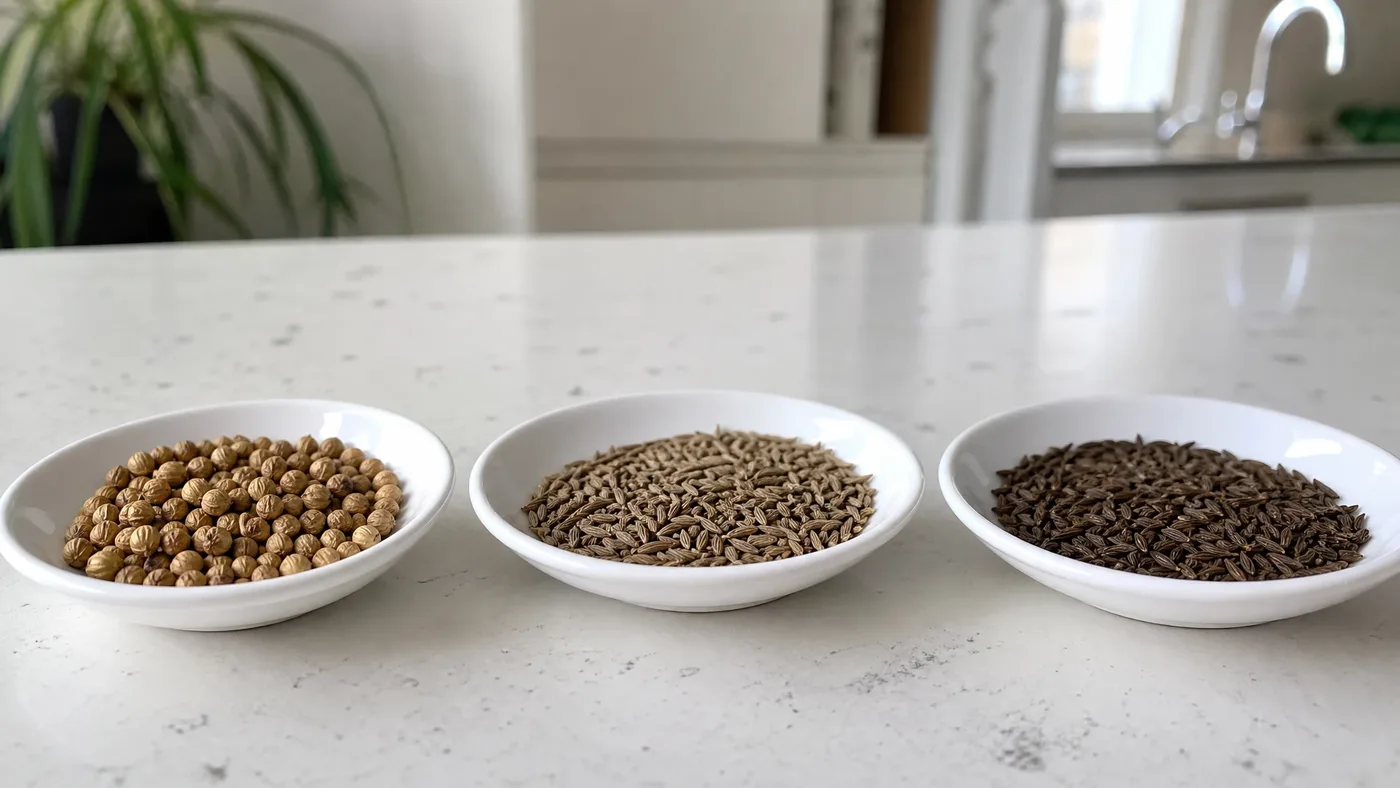
Coriander vs Cumin vs Caraway Oil: Three Different Chemistries
Coriander, cumin and caraway are all Apiaceae spice seeds, and a reader could be forgiven for assuming their oils are interchangeable. They are not: the published analyses put a different molecule in the lead for each. Our shop sells one of the three, coriander seed oil, which is linalool-led. This page sets the three side by side, using composition and safety papers, so you can tell which you actually want before you buy any of them.
Coriander Essential Oil
Our own Coriander Essential Oil, in sizes from 0.5 oz to bulk.
From $12.99
Shop Now →Three seeds, three lead molecules
The table uses figures from the papers we opened. Each row is a different study of a different plant part and sample set, so read the ranges as "what has been reported", not as a specification for any bottle. Your own bottle's Certificate of Analysis is the only number that applies to it (ours is published on our shop page).
| Oil (seed/fruit) | Lead constituent reported | Other major constituents reported | Source |
|---|---|---|---|
| Coriander | Linalool, 40.9 to 79.9% | Neryl acetate 2.3 to 14.2%, gamma-terpinene 0.1 to 13.6%, alpha-pinene 1.2 to 7.1% | Nejad Ebrahimi et al., 2010 (dried seeds, several Iranian accessions, GC-MS) |
| Cumin | Cuminaldehyde, mean 32.3% (29.8 to 34.3%) | Gamma-terpinene 20.0%, beta-pinene 11.2%, p-cymene 14.0% | EFSA FEEDAP Panel, 2022 (cumin fruit oil submitted as an animal-feed additive) |
| Caraway | Carvone and limonene, in a ratio that moves a lot | Carvone 48.53% with limonene 44.42% in one Romanian oil; limonene 61 to 83% in young wild fruits from Austrian meadows | Trifan et al., 2016; Chizzola, 2014 |
Two things in that table matter more than the headline names. First, coriander is the only one of the three whose lead molecule is an alcohol, linalool, rather than an aldehyde (cuminaldehyde) or a ketone (carvone) or a hydrocarbon (limonene). Reasoning from the chemistry, that is why coriander seed oil shares its lead alcohol with lavender (see our lavender comparison) rather than with its two spice-shelf cousins, though we have no sensory panel data and will not claim how any of them smell side by side. For our own oil the shop copy says warm, woody and softly spicy with a light floral edge, and that is the only scent description we stand behind.
Second, caraway is not one fixed recipe. A 2016 study that collected caraway seed oil in eight successive time slices during one hydrodistillation found limonene fell from 77% in the first fraction to 19% in the last while carvone climbed from 20% to 79% (Shiwakoti et al., 2016). Limonene comes over first, carvone later, so when a distiller stops the still changes the oil. A Serbian study of caraway fruits from three production areas over two years reported limonene and carvone together at 97.69 to 98.62% of the oil, with an average carvone to limonene ratio of 0.58 (Aćimović et al., 2014). The practical consequence is that "caraway oil" on two labels can be two different balances. Coriander seed oil moves too (the Iranian accessions span 40.9 to 79.9% linalool), which is the whole reason we point you to the Certificate of Analysis rather than to a generic profile. Our linalool article covers the lead molecule in detail.
The safety flag that separates cumin from the others
If one fact decides your purchase, it is this one. The EFSA panel that assessed cumin fruit oil in 2022 concluded the oil should be treated as irritating to skin and eyes and as a skin and respiratory sensitiser, and linked the sensitising risk to aldehydes, about 45% of the additive. It also states there is "some evidence for dermal phototoxicity of cumin oil" and notes the IFRA standard for cumin oil mentions phototoxicity too (EFSA, 2022). That opinion concerns feed use in animals, so it is a hazard assessment of the oil, not a skin-product guideline.
Robert Tisserand's article on phototoxicity adds a mechanism. Furanocoumarins are heavy molecules that mostly stay behind in the still, which is why distilled citrus oils are generally not phototoxic, but they "sometimes pass over during distillation", and the two oils he names are angelica root and cumin seed. He calls it a curiosity and says it is not clear why it happens (Tisserand Institute, undated). We did not find in the sources we opened a numeric dermal limit for cumin oil, so we do not give one. If you buy cumin oil for any skin use, ask the supplier for the limit it works to and treat sun exposure after application as a real question, not a footnote.
For coriander seed oil the sources we have opened make no equivalent statement, and we do not claim the oil is free of risk: our standards copy calls it easy to over-pour rather than genuinely risk-free. We cover its phototoxicity and sensitisation question separately in the phototoxicity and dilution article.
What we have to say about caraway
We did not fetch a dermal safety assessment for caraway oil, so we offer no skin guidance on it. What we can report is how the regulators handle the seed. The European Medicines Agency's committee on herbal medicines lists caraway fruit for "the relief of problems of the digestive system such as bloating and flatulence" on the basis of long-standing use, for adults and adolescents over 12, and the medicines are usually herbal tea to be drunk (EMA, Carvi fructus summary). The US National Center for Complementary and Integrative Health notes that the supporting evidence for peppermint oil in indigestion is for combination products with caraway oil (NCCIH, 2025). Both are oral products. They describe an ingested, regulated or studied preparation, and a bottle of aromatic oil sold for the diffuser or the carrier oil is a different category. Our oil is not for internal use and we do not suggest swallowing any essential oil. If you have digestive symptoms, a pharmacist or physician is the right person, and our peppermint comparison goes through that distinction.
Seed in the jar versus oil in the bottle
The culinary seed and the distilled oil are not the same material at different strengths. Cooking uses the whole seed. The oil is only the fraction that distils over, and, as the caraway fractions above show, the still decides which fraction that is. If the aroma you are after is the one from a kitchen, our culinary aroma article explains what carries over. If you want a warm, woody spice note that is not citrus, the closer comparison to coriander is cardamom, covered in our cardamom comparison.
Which one to buy, in order of the questions
- Do you want a skin or leave-on product? Cumin is the one with a documented phototoxicity flag and sensitiser classification in the sources above. Of the three, it needs the most supplier-specific guidance before skin use.
- Do you want the linalool-led, rounded spice note? That is coriander seed oil, and the only one of the three we sell. It is sold undiluted, so the dilution maths is yours: our shop page lists 0.5% to 2% in a carrier oil, roughly 3 to 12 drops per ounce (about 600 drops in an ounce at 20 drops per ml, so 0.5% is about 3 drops and 2% about 12). Patch test first and start at the low end.
- Do you want cumin or caraway? We do not sell either, so buy them from a supplier that publishes a batch analysis, and ask for the carvone to limonene balance for caraway and the cuminaldehyde figure for cumin.
Limits of this comparison
No blind sniff test exists behind this page, no skin trial of any of the three, and every composition figure above comes from a single study of a particular sample set. We sell neither cumin nor caraway, we have not tested competing oils, and nothing here is advice about a medical condition.
The simple summary: three seeds from one plant family give three different oils, and only one of them is in our shop.
Coriander Essential Oil
Coriander Essential Oil from our own shop, in sizes from 0.5 oz to bulk.
From $12.99
Shop Now →Sources & Further Reading
- Nejad Ebrahimi S, Hadian J, Ranjbar H, 2010. Essential oil compositions of different accessions of Coriandrum sativum L. from Iran. Nat Prod Res. pubmed.ncbi.nlm.nih.gov/20803372
- EFSA FEEDAP Panel, 2022. Safety and efficacy of a feed additive consisting of an essential oil from the fruit of Cuminum cyminum L. (cumin oil). EFSA Journal 20(12):e07690. pmc.ncbi.nlm.nih.gov/PMC9762120
- Trifan A et al., 2016. Antioxidant activity of essential oil from Carum carvi L. cultivated in North-Eastern Romania. Rev Med Chir Soc Med Nat Iasi. pubmed.ncbi.nlm.nih.gov/30152663
- Chizzola R, 2014. Composition of the essential oil of wild grown caraway in meadows of the Vienna region (Austria). Nat Prod Commun. pubmed.ncbi.nlm.nih.gov/24868889
- Shiwakoti S et al., 2016. Method for attaining caraway seed oil fractions with different composition. Chem Biodivers. pubmed.ncbi.nlm.nih.gov/27119969
- Aćimović MG et al., 2014. Evaluation of caraway essential oil from different production areas of Serbia. Horticultural Science (Prague) 41(3):122-130. hortsci.agriculturejournals.cz
- Tisserand Institute. Phototoxicity: essential oils, sun and safety. tisserandinstitute.org
- European Medicines Agency. Carvi fructus, herbal medicinal product summary. ema.europa.eu/carvi-fructus
- NCCIH, 2025. Peppermint oil. nccih.nih.gov/health/peppermint-oil