
Coriander vs Peppermint Oil for Digestion: Capsule vs Aroma
Peppermint oil has a body of digestive research and coriander oil has almost none, but that is not the real comparison, because the research is on a different kind of product. The peppermint trials tested enteric-coated capsules swallowed by adults with irritable bowel syndrome. Our coriander seed oil is an aromatic and cosmetic oil, it is not labelled for internal use, and we do not suggest swallowing any essential oil, so the honest answer to "which one for digestion" is that neither bottle of aromatic oil has been studied for it.
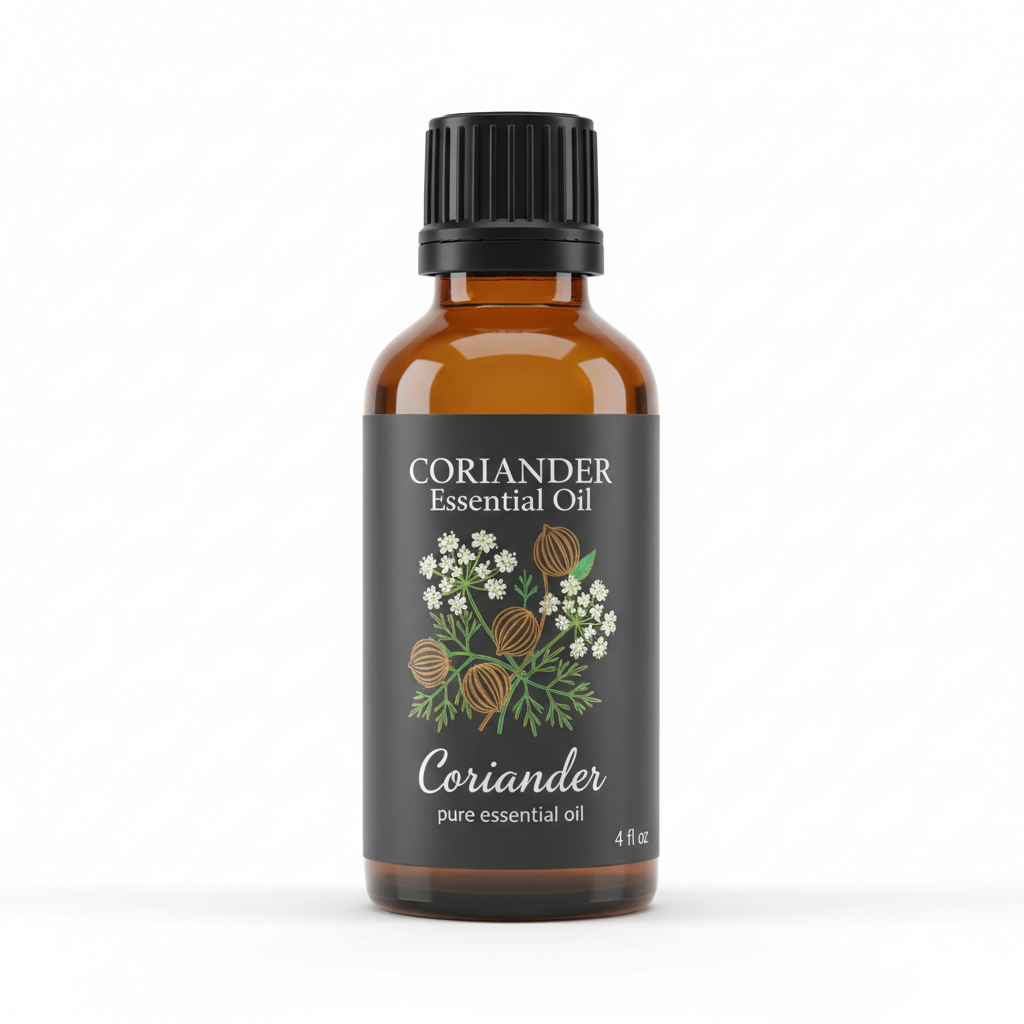
Coriander Essential Oil
Our own Coriander Essential Oil, in sizes from 0.5 oz to bulk.
From $12.99
Shop Now →What the peppermint trials actually tested
A 2019 meta-analysis pooled 12 randomised trials with 835 patients comparing enteric-coated peppermint oil capsules with placebo, over 2 to 12 weeks. For global IBS symptoms (7 trials, 253 vs 254 patients) the relative risk of improvement was 2.39 (95% CI 1.93 to 2.97); for abdominal pain (6 trials, 278 vs 278) it was 1.78 (95% CI 1.43 to 2.20). Adverse events were 9.3% with peppermint against 6.1% with placebo, a difference that was not statistically significant, and the events listed included heartburn, dry mouth, belching and rash (Alammar et al., BMC Complementary and Alternative Medicine, 2019). Two of the included trials were industry-funded and rated at high risk of bias, and one author of the meta-analysis is an associate editor of the journal.
A 2022 update looked at 10 trials with 1,030 patients and reached a more qualified answer. Peppermint beat placebo on global symptoms (relative risk of not improving 0.65, 95% CI 0.43 to 0.98) and abdominal pain (0.76, 95% CI 0.62 to 0.93), but adverse events were more common with peppermint (relative risk 1.57, 95% CI 1.04 to 2.37), the authors rated the quality of evidence as very low, and they noted recent studies had cast doubt on its role (Ingrosso et al., Alimentary Pharmacology and Therapeutics, 2022). The two meta-analyses therefore disagree on side effects, and on how convincing the whole body of trials is. We would not pick one as the winner; read both.
A press summary of the American College of Gastroenterology's 2021 IBS guideline quotes "Peppermint may be used to provide relief of global symptoms" (Healio, 2021). The grading of that recommendation was not visible in the sources we could open, because the guideline's full text is behind a paywall, so we do not state it. The point to carry forward is the format the trials used: capsules, taken by mouth, by adults with IBS, which is a different category from a bottle of aromatic oil.
What regulators say about peppermint oil, by route
The European Medicines Agency's herbal committee separates peppermint oil by how it is used and by age. By mouth, for minor stomach cramps, gas and abdominal pain, "especially in irritable bowel syndrome", on the basis of well-established use, not for children under 8. On the skin of the forehead and temples, for mild headache, not for anyone under 18. On the skin for localised muscle pain and itching, and by inhalation or on the chest for cough and cold, on the basis of traditional use, not for children under 2 (EMA, Menthae piperitae aetheroleum). The US National Center for Complementary and Integrative Health adds that peppermint oil should not be applied to the face of infants or young children because the menthol, if inhaled, can cause serious problems, that oral side effects include heartburn, nausea, abdominal pain and dry mouth, and that peppermint oil taken alone may worsen indigestion in some people (NCCIH, May 2025).
That last point is the quiet reason enteric coating exists. NCCIH says the capsules are often coated to reduce the likelihood of heartburn. A reader who pours peppermint essential oil into a drink on the strength of the capsule trials is not using what was tested.
What exists for coriander
We looked for the coriander equivalent and did not find one at the same level. Our searches did not turn up an EMA herbal monograph for coriander fruit, which is the premise we expected to cite, so we make no statement about its regulatory status. The closest human trial we opened is a 2006 pilot of Carmint, a product containing total extracts of lemon balm (Melissa officinalis), spearmint (Mentha spicata) and coriander (Coriandrum sativum), in 32 adults with IBS over 8 weeks. Patients also took loperamide or psyllium depending on bowel pattern. At the end of treatment, the Carmint group scored lower than placebo for abdominal pain severity (P=0.016) and frequency (P=0.001), and for bloating severity (P=0.02) and frequency (P=0.002) (Vejdani et al., Digestive Diseases and Sciences, 2006). The authors called it a pilot. It cannot tell you what coriander contributed, since three plants' extracts were combined, and extracts are not essential oil. A 2025 review of coriander's chemistry and pharmacology lists many reported activities but its abstract gives no human efficacy conclusions (Chaurasia and Bharati, Food Chemistry, 2025). Applying any of it to a bottle of coriander seed essential oil is an inference we do not make.
The inhaled and skin question
People often assume that if swallowing is off the table, smelling or rubbing in the oil must be a milder version of the same thing. The meta-analyses above do not mention inhalation or aroma in the passages we read, so they provide no support for it. NCCIH says inhaled peppermint is possibly safe but that there is not enough reliable information on its safety and side effects, and notes that inhalation has shown promise for chemotherapy-related nausea, which is a different problem from IBS. For coriander seed oil, we found no trial of inhalation or skin use for digestive symptoms. The simplest statement is that a mechanism for a swallowed capsule does not transfer to a diffuser, and we do not claim it does.
Who should see whom
- Recurring cramps, bloating or changes in bowel habit: see a physician. The ACG guideline recommends a positive diagnostic strategy rather than diagnosis by exclusion, with celiac serology and faecal calprotectin testing in people with diarrhoea symptoms (Lacy et al., American Journal of Gastroenterology, 2021). Aroma is not part of that work-up.
- Wanting to try peppermint capsules: ask a pharmacist or gastroenterologist about enteric-coated products, children's age limits and interactions. We sell no peppermint.
- Infants and young children: do not apply peppermint oil to the face (NCCIH). Our own oil is kept away from children, per our safety copy; see our children article.
- Swallowing any essential oil, including ours: do not. See our ingestion article for why.
Where our coriander seed oil fits
Our oil is for aroma and cosmetic use: our shop page gives 0.5% to 2% in a carrier oil, roughly 3 to 12 drops per ounce, with a patch test first. That is about scent, and we make no medical claims. Our digestion article covers the traditional kitchen and herbal uses in more detail, and the benefits article goes through what the research on this plant does and does not show.
Bottom line: peppermint has trial evidence for one oral capsule in one condition, coriander seed oil has none for any digestive use as an aromatic oil, and for symptoms you actually have, the right next step is a clinician, not either bottle.
Coriander Essential Oil
Coriander Essential Oil from our own shop, in sizes from 0.5 oz to bulk.
From $12.99
Shop Now →Sources & Further Reading
- Alammar N, Wang L, Saberi B, et al., 2019. The impact of peppermint oil on the irritable bowel syndrome: a meta-analysis of the pooled clinical data. BMC Complement Altern Med. pubmed.ncbi.nlm.nih.gov/30654773
- Ingrosso MR et al., 2022. Systematic review and meta-analysis: efficacy of peppermint oil in irritable bowel syndrome. Aliment Pharmacol Ther. pubmed.ncbi.nlm.nih.gov/35942669
- Lacy BE et al., 2021. ACG clinical guideline: management of irritable bowel syndrome. Am J Gastroenterol. pubmed.ncbi.nlm.nih.gov/33315591
- Healio, 2021. ACG develops guidelines for treatment of IBS. healio.com
- European Medicines Agency. Menthae piperitae aetheroleum, herbal medicinal product summary. ema.europa.eu/menthae-piperitae-aetheroleum
- NCCIH, 2025. Peppermint oil. nccih.nih.gov/health/peppermint-oil
- Vejdani R et al., 2006. The efficacy of an herbal medicine, Carmint, on the relief of abdominal pain and bloating in patients with irritable bowel syndrome: a pilot study. Dig Dis Sci. pubmed.ncbi.nlm.nih.gov/16868824
- Chaurasia PK, Bharati SL, 2025. Coriander: a holistic outlook on its chemistry and pharmacology. Food Chem. pubmed.ncbi.nlm.nih.gov/39719783