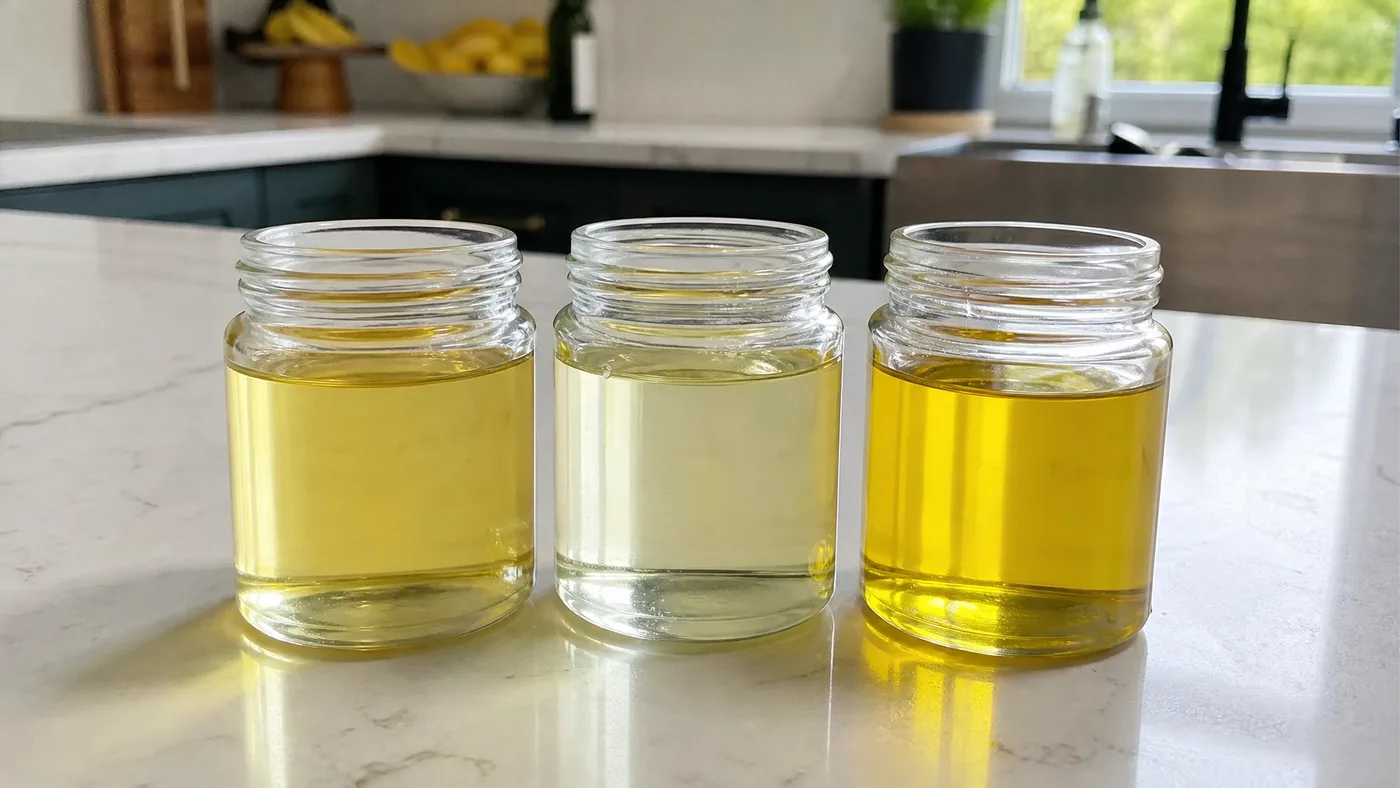
Best Carrier Oils for Coriander Seed Oil, by Use
The best carrier for coriander seed oil is the one that matches how long the blend will sit, who will wear it and what they are allergic to, and the evidence we found ranks carriers on those three things rather than on skin feel. We sell no carrier oils: our shop has the one coriander seed oil, sold undiluted, so the dilution maths and the carrier choice are both yours. Here is how to make both decisions on paper before you buy a bottle.
Coriander Essential Oil
Our own Coriander Essential Oil, in sizes from 0.5 oz to bulk.
From $12.99
Shop Now →Do the maths first, in volume
Our shop page gives 0.5% to 2% in a carrier, roughly 3 to 12 drops per ounce. The Tisserand Institute's dilution guide gives 1 to 3% for body oils and lotions and 0.5 to 1.2% for the face and other sensitive areas such as underarms. Where the two meet, the face band (0.5 to 1.2%) sits inside our range, and our 2% ceiling is a body-oil figure. The drop counts in the table are reasoning from those percentages and ordinary arithmetic. We have not made or tested these blends, so patch test any of them first.
Drops are the weak link. Tisserand Institute's drop-size review of three studies (1999, 2000, 2016) found 20 drops averaging 0.66 g, with drops per ml varying from about 20 to 40; its chart assumes 30.
| Batch (carrier plus oil) | Strength | Coriander oil by volume | Drops at 20/ml | Drops at 30/ml |
|---|---|---|---|---|
| 10 ml roll-on | 0.5% | 0.05 ml | 1 | 1.5 |
| 10 ml roll-on | 1% | 0.10 ml | 2 | 3 |
| 10 ml roll-on | 2% | 0.20 ml | 4 | 6 |
| 30 ml (about 1 oz) bottle | 1% | 0.30 ml | 6 | 9 |
Read the 0.5% roll-on row: one drop at the small drop size, a drop and a half at the large one. A 50% swing in strength from the dropper alone is the practical reason to measure small batches with a graduated pipette or syringe, and to scale up to 30 ml or more before counting drops.
Jojoba: the stability pick, with a different chemistry
Jojoba is a liquid wax ester, not a triglyceride; Arquette et al., J Cosmet Sci, 1998 describe it as esters of monounsaturated C18 to C24 acids and alcohols. In a 2026 comparison of rosehip, sunflower, olive and jojoba oils (Fagoaga et al., Antioxidants, 2026), jojoba had the longest Rancimat induction period at 373 K, ahead of olive, sunflower and rosehip, and the authors tied stability to polyunsaturated fatty acid levels. That is a lab oxidation test on those four oils, not a shelf-life guarantee. Reasoning from it, jojoba suits a blend you plan to keep for months, such as a roll-on in a bag. The same lab result says nothing about how it feels on any particular skin, and we are making no skin-feel claim.
Fractionated coconut: what the name actually means
Industrially, medium-chain triglycerides are made by esterifying caprylic (C8) and capric (C10) acids, per Heidt et al., Nutrients, 2026, a review of MCT production and regulation. Cosmetic labels use the name caprylic/capric triglyceride for this. We did not find a head-to-head oxidation test of it against the other carriers, so the claim you will see on supplier pages, that it keeps well, is a supplier claim for us. Reasoning from the Fagoaga finding that stability tracks fatty acid unsaturation, a carrier made of two saturated medium-chain acids has little to oxidize, but that is inference and not a measurement.
Sweet almond: decide on allergy before anything else
A 2026 narrative review of almond allergy (Laura et al., Nutrients, 2026) reports that sensitization is frequent but clinically confirmed allergy is uncommon; among sensitized people, oral food challenge positivity ranged from 4% to 33%, with severe reactions in 0.5 to 12.2% of those challenged. Those are food-ingestion data. A second 2026 review (O'Connor and Lio, J Clin Aesthet Dermatol, 2026) raises concern that food-derived ingredients in leave-on products may promote food allergy through broken skin, while noting many such ingredients show low allergy rates. Whether a particular refined almond oil carries enough protein to matter is something we could not source. If you or the person you are making it for has a tree nut allergy, ask an allergist before using any nut oil, or choose jojoba or a medium-chain triglyceride base.
Grapeseed and other polyunsaturated oils: the shelf-life trade
A 2026 systematic review of cold-pressed oils (Dash et al., Front Nutr, 2026) states that oils rich in mono- and polyunsaturated fatty acids are particularly susceptible to oxidation, and that quality and shelf life depend on raw material, moisture, storage and processing. We did not fetch a fatty acid table for grapeseed, so ask the supplier for the fatty acid profile and peroxide value instead of assuming. For a blend made fresh and finished in weeks, a more unsaturated oil is workable; for a bottle that sits, it is the weaker bet.
Why an oxidizing carrier matters more with this oil
Linalool, the main constituent of coriander seed oil, autoxidizes in air to hydroperoxides that are contact sensitizers. Patch-test clinics disagree on how often that bites. Schubert et al., Contact Dermatitis, 2023 tested 5,511 German patients with linalool hydroperoxides at 1% in petrolatum and found 8.8% positive, mostly weak, doubtful or irritant, and concluded the preparation itself was irritant with a risk of false positives. Botvid et al., Contact Dermatitis, 2026 tested 6,719 patients in Copenhagen over 2014 to 2025 and found 3.1% positive. Both are dermatitis-clinic populations, not the general public, and neither tested a coriander blend in a carrier. No study we found follows a linalool oil in a stored carrier over time. Reasoning from the chemistry, an old or rancid base plus a linalool-rich oil is not a combination we would choose, so buy small, date the blend and read the storage notes.
Matching carrier to use
- Roll-on to keep in a bag: jojoba or a medium-chain base on stability reasoning, at the lower strengths in the table. The recipe angle is in our roll-on piece.
- Body oil used up within a few weeks: any carrier you tolerate, within the body-oil band. See the massage oil piece.
- Face or underarms: the 0.5 to 1.2% band, and a patch test on the inner forearm first. A reaction or a history of eczema or fragrance allergy is a question for a dermatologist, not a carrier swap.
- Anyone with a nut allergy: skip almond, ask an allergist.
Our shop page lists sizes and a certificate of analysis for the oil itself; for carriers, buy from a supplier that gives you the fatty acid profile and a date, and keep the same discipline of testing a small batch on one patch of skin. Dilution and sun exposure are covered in the safety guide.
Coriander Essential Oil
Coriander Essential Oil from our own shop, in sizes from 0.5 oz to bulk.
From $12.99
Shop Now →Sources & Further Reading
- Tisserand Institute. Dilution of essential oils. tisserandinstitute.org/dilution-essential-oils
- Tisserand Institute. Drop size. tisserandinstitute.org/learn-more/drop-size
- Arquette DJ et al., 1998. Non-comedogenic and hypoallergenic properties of jojoba oil and hydrogenated jojoba oil. J Cosmet Sci 49:377-383. library.scconline.org/v049n06/33
- Fagoaga C et al., 2026. Oxidative stability and kinetics of oxidation of rosehip, sunflower, olive and jojoba oils. Antioxidants. pubmed/42193267
- Heidt C et al., 2026. Medium-chain triglycerides: scientific and regulatory perspectives. Nutrients. pubmed/41978079
- Laura T et al., 2026. Almond allergy in children and adults: a narrative review. Nutrients. pubmed/41830001
- O'Connor M, Lio P, 2026. Feeding the skin? Foods in personal care products and the risk of allergy. J Clin Aesthet Dermatol. pubmed/41890777
- Dash B et al., 2026. Cold pressed oils: a systematic review. Front Nutr. pubmed/42459801
- Schubert S et al., 2023. Patch testing hydroperoxides of limonene and linalool in consecutive patients, IVDK 2018-2020. Contact Dermatitis. pubmed/37177844
- Botvid S et al., 2026. Ten years of patch testing to hydroperoxides of limonene and linalool. Contact Dermatitis. pubmed/41638887