Coriander Massage Oil Recipe: Batch Maths for 30 to 120 ml
A coriander massage oil is one ingredient we sell and one we do not: the oil is ours, but the carrier, the bottle and the hands are yours. What we can do is the arithmetic. This page turns a percentage into millilitres for a 30, 60 or 120 ml batch, shows where our shop's 0.5% to 2% range and the Tisserand Institute's wider body-oil band disagree, and says where the recipe stops and a massage therapist starts. None of it has been made or tested by us.
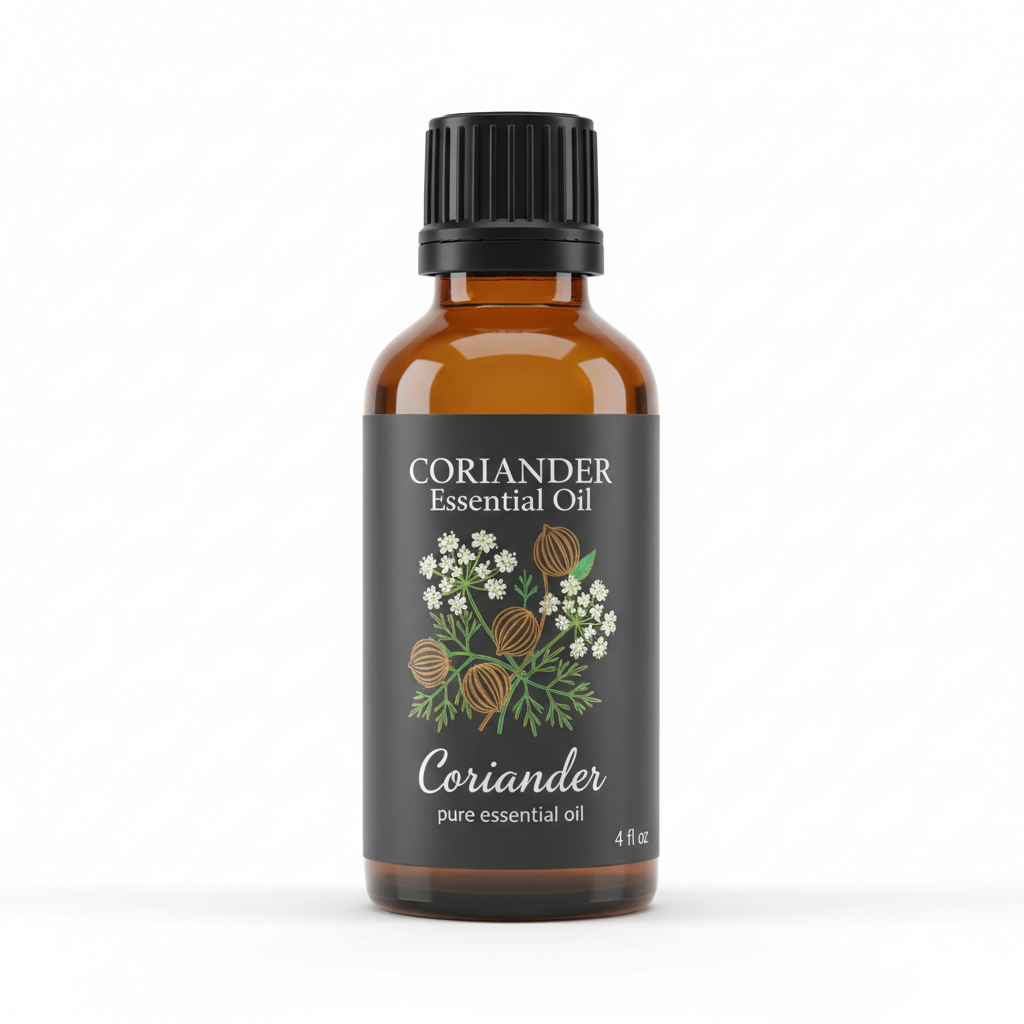
Coriander Essential Oil
Our own Coriander Essential Oil, in sizes from 0.5 oz to bulk.
From $12.99
Shop Now →Start with the batch, in millilitres
Drops are a poor unit at this size, and the problem grows with the bottle. The Tisserand Institute's review of three drop-size studies (1999, 2000, 2016) found about 20 to 40 drops per ml, and its chart assumes 30. Our shop copy's "roughly 3 to 12 drops per ounce" matches about 20 per ml. For a 120 ml batch at 2%, that difference is 48 drops against 72. So work in millilitres, using a 1 ml oral syringe or a graduated pipette from a pharmacy or craft supplier (we sell neither), and treat drops as a fallback.
| Batch of carrier | 0.5% | 1% | 2% | 3% (Tisserand upper band) |
|---|---|---|---|---|
| 30 ml | 0.15 ml | 0.30 ml | 0.60 ml | 0.90 ml |
| 60 ml | 0.30 ml | 0.60 ml | 1.2 ml | 1.8 ml |
| 120 ml | 0.60 ml | 1.2 ml | 2.4 ml | 3.6 ml |
The figures are volume of oil per batch (strictly the oil takes a little room in the bottle, which changes the percentage by under 3% of itself and is not worth correcting). In drops, 1% of 30 ml is 6 drops at 20 per ml and 9 at 30 per ml; 2% of 120 ml is 48 or 72.
Which column? We stop at 2%, and here is why
The Tisserand Institute guide gives 1% to 3% for body oils and lotions, noting aromatherapists have used that range for body massage for more than 50 years, and 0.2% to 1% for impaired or reactive skin. Our shop copy says 0.5% to 2%, with the low end for scented body oils. Those two overlap at 1% to 2%, and they disagree above it. We would not recommend the 3% column for a coriander seed oil blend, for a reason that is reasoning, not a finding: a massage oil goes on a larger area than a roller, is left on, and is often reapplied, so the total exposure per session is higher at any given percentage. We know of no study that tested coriander seed oil in a massage oil at any strength, so neither range was set for it.
There is one study-based reason to stay low with a linalool-rich oil. In Audrain et al., British Journal of Dermatology, 2014, 4,731 patients at 13 UK dermatology departments were patch tested, and 5.9% reacted to linalool hydroperoxides (1% in petrolatum). Those were clinic patients, and the test substance was oxidised linalool, not coriander oil, so applying it to our oil is an inference. Our shop describes the oil as linalool-rich seed oil; the practical consequence is to make oxidised oil less likely (fresh carrier, small batches) and to patch test every new batch.
Three worked batches
- Trial batch, 30 ml at 1%. 0.3 ml coriander oil into 30 ml carrier. This is the version for finding out whether you tolerate it and like the smell. At 1% it also sits inside both ranges.
- Back and shoulders, 60 ml at 1%. 0.6 ml into 60 ml. A body-sized batch at a level inside both sources.
- Full-body, 120 ml at 1.5%. 1.8 ml into 120 ml. Midway between 1% and 2%; if the smell seems faint, raise the percentage before the dose per session, and stop at our 2%, which is 2.4 ml.
If you add a second essential oil, the percentages add. A 60 ml batch with 0.6 ml coriander and 0.6 ml of another oil is 2% total, not 1% each. For a pairing that involves a citrus, read the roller blend post, where we work out why bergamot has a 0.4% ceiling that a massage oil can exceed with a single careless drop; the dilution and phototoxicity post holds the safety chart and we do not repeat it.
Making a batch, step by step
- Choose the percentage first and write it down, then read the oil volume off the table.
- Measure the carrier into a clean, dry bottle. Water in the bottle spoils a carrier oil faster; that is reasoning from basic kitchen hygiene, not a tested figure.
- Draw the coriander oil into a syringe, add it to the carrier, and cap the bottle.
- Turn the bottle gently end to end for a minute so the two oils mix evenly. An uneven mix means the first pump is stronger than the percentage on the label.
- Label it with the percentage, the batch size and the date, then patch test before using the whole bottle.
Because we have not made this recipe, the first batch is the test. Keep it small enough that you would not mind pouring it out if the smell is wrong or your skin objects.
The carrier, the bottle and the towel
We sell no carrier oils. Our carrier oil guide compares them; here we only flag the allergy point. If anyone being massaged has a nut or seed allergy, the carrier is as relevant as the essential oil, and which refined or unrefined oil is acceptable is a question for their allergist, not a recipe page. We have not sourced the refining question here and will not guess at it.
Fabric is plain practical reasoning: a carrier oil left on sheets and towels does not wash out in one cycle in every case, so use towels you can afford to stain. Keep the oil blend in a tightly capped bottle in a cool, dark place, as our shop copy advises for the undiluted oil (2 to 3 years). We have no figure for how long the blend keeps; it depends on the carrier's own date, and the linalool oxidation point above argues for batches you finish in weeks, not a year. Label the bottle with the date and the percentage. Keep it from the eyes, children and pets.
Where the recipe ends
This page is not a massage guide. Pressure, positioning, and what to do about pain, an injury, swollen legs or numbness are the work of a licensed massage therapist or your physician; we have none on staff, and the live muscle massage post covers what the literature does and does not say on that topic. Skip massage oil on broken, sunburnt or inflamed skin, and ask your physician first if you are pregnant (OB-GYN or midwife), have a diagnosed fragrance allergy (dermatologist), or are preparing it for a child (pediatrician). Our oil is for aromatic and cosmetic use only and is not labelled for internal use.
Patch test the finished blend on the inner forearm, covered, for 24 hours, and again whenever you make a new batch or change carrier. Start with the 30 ml, 1% version.
Coriander Essential Oil
Coriander Essential Oil from our own shop, in sizes from 0.5 oz to bulk.
From $12.99
Shop Now →Sources & Further Reading
- Tisserand Institute. How big is a drop? tisserandinstitute.org/learn-more/drop-size
- Tisserand Institute. Dilution for essential oils. tisserandinstitute.org/dilution-essential-oils
- Audrain H et al., 2014. Allergy to oxidized limonene and linalool is frequent in the U.K. Br J Dermatol. pubmed.ncbi.nlm.nih.gov/24702129