Coriander Roller Blend Recipes: Drop Maths for a 10 ml Bottle
A 10 ml roller bottle is a small container with a big rounding problem: one drop of essential oil is somewhere between 0.25% and 0.5% of it, depending on whose drop you count. This page works out the arithmetic for coriander seed oil at the 0.5% to 2% range on our shop page, builds four roller formulas from it, and explains why the bergamot pairing is the one to change. We have not made or tested any of these rollers. They are formulations worked out from published dilution figures and ordinary maths.
Coriander Essential Oil
Our own Coriander Essential Oil, in sizes from 0.5 oz to bulk.
From $12.99
Shop Now →Decide the percentage before you touch a drop
Our shop copy says to dilute our coriander seed oil to 0.5% to 2% in a carrier oil, which it puts at roughly 3 to 12 drops per ounce of carrier. That conversion quietly assumes about 20 drops per ml: an ounce is 29.57 ml, 0.5% of it is 0.148 ml, and 0.148 ml at 20 drops per ml is about 3 drops. The Tisserand Institute's drop-size review pooled three studies (1999, 2000 and 2016, covering 1, 25 and 23 oils, with 3 to 7 dropper styles) and found 20 drops averaging 0.66 g, with drops per ml ranging from about 20 to 40. Its own chart assumes 30. So our shop figure and the Tisserand chart disagree by half again, and neither is wrong: a drop is an imprecise unit.
For a 10 ml roller, the table shows what that disagreement does. Each cell is the percentage that one drop adds to a 10 ml bottle.
| Drops per ml | Volume of one drop | One drop in 10 ml | Drops for 1% | Drops for 2% |
|---|---|---|---|---|
| 20 (our shop copy) | 0.05 ml | 0.50% | 2 | 4 |
| 30 (Tisserand chart) | 0.033 ml | 0.33% | 3 | 6 |
| 40 (top of the studied range) | 0.025 ml | 0.25% | 4 | 8 |
Reasoning from that table, the practical consequence is that "4 drops" in a recipe can land anywhere from 1% to 2% depending on the dropper. Because our oil is sold undiluted, the dilution maths is yours, and the cleanest way to do it is to count the carrier by volume and pick a drop convention once. If you are at the cautious end, or the bottle goes on your neck, use the lower count. The same Tisserand guide puts facial and other sensitive-area products at 0.5% to 1.2% and body oils at 1% to 3%; our shop range of 0.5% to 2% sits inside that, and for a roller we would stay in the lower half of it.
Four roller formulas, in drops and in percent
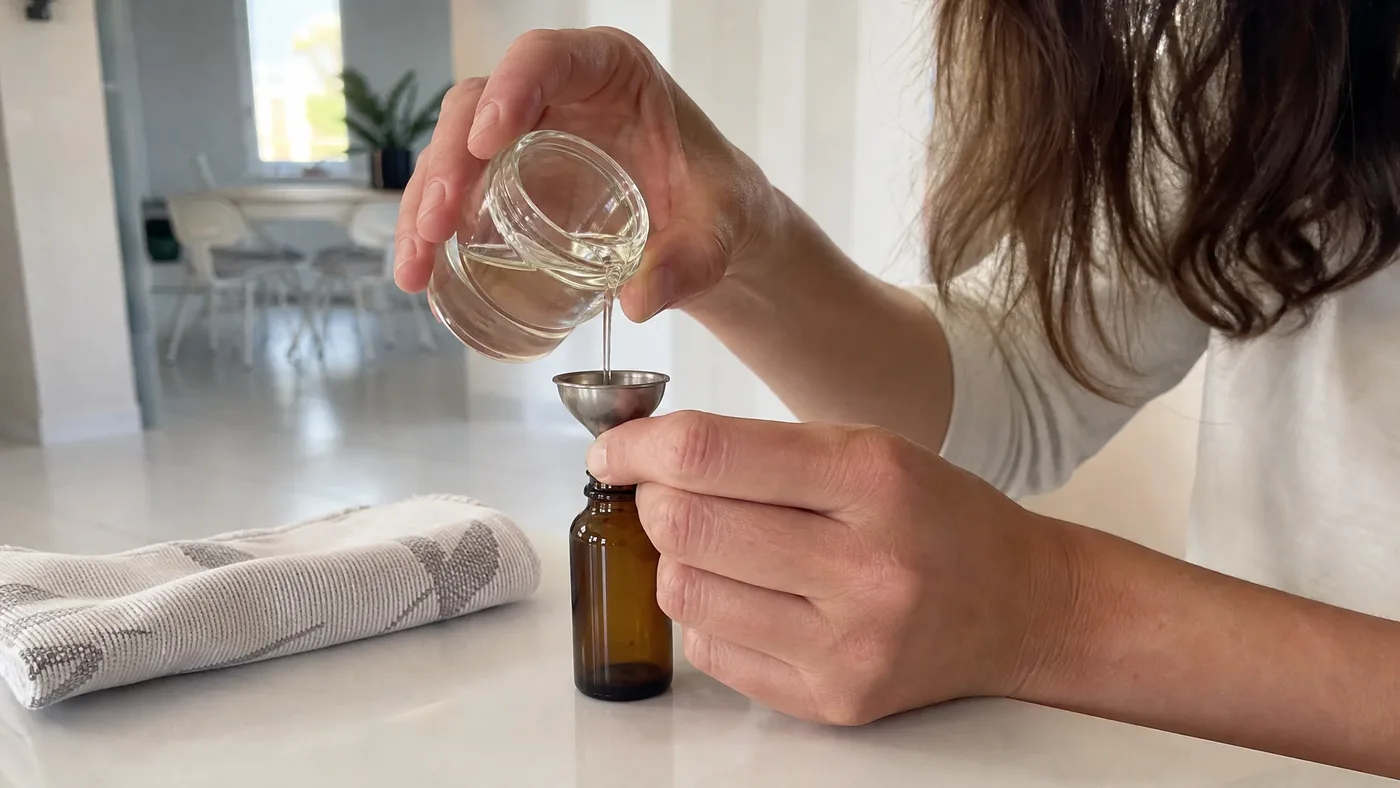
Each formula assumes a 10 ml roller filled to the shoulder with a carrier oil you buy elsewhere (we sell no carriers, rollers or droppers; our carrier oil guide covers the choice). Drops are at 20 per ml, with the 30-per-ml equivalent beside them, so the percentage holds whichever bottle you own. The total essential oil is what counts, not the coriander alone.
- Coriander alone, 1%. 2 drops of coriander seed oil (3 at 30 per ml). Total 1%. This is the formula for finding out whether you like the smell and whether your skin objects, before anything else is in the bottle.
- Coriander and sweet orange, 1.5%. 1 drop coriander plus 2 drops sweet orange at 20 per ml: 3 drops total, 0.5% coriander and 1% orange (at 30 per ml the same 3 drops come to 1%, so the blend is lighter). Sweet orange is on our shop page as a pairing; we have not smelled this one.
- Coriander and cypress, 1%. 1 drop each at 20 per ml (0.5% each). This keeps the total low because two oils at the top of the range is 4%, double our ceiling.
- Coriander and black pepper, 1%. 1 drop coriander, 1 drop black pepper at 20 per ml. Black pepper is the pairing most likely to feel warm on skin; we have no source on its skin behaviour at this level, so treat the 1% as a ceiling, not a target.
The bergamot problem
Bergamot is on our shop page as a pairing, and the live coriander and bergamot post covers the aroma. The roller arithmetic is a different matter. In his Tisserand Institute article on phototoxicity, Robert Tisserand states that bergamot oil should be limited to 0.4% in the final product for skin exposed to sunshine, with wash-off products exempt, and gives a bergapten limit of 15 ppm (0.0015%). He also writes that distilled citrus oils are not considered phototoxic because they carry very few furanocoumarins.
Now the drop count. One drop of expressed bergamot in a 10 ml roller is 0.5% at 20 drops per ml, over the limit; at 30 drops per ml it is 0.33%, just under; at 40, 0.25%. The limit is on the bergamot alone, so even a "safe" drop leaves almost no room. Reasoning from that, a one-drop-in-ten-millilitres bergamot roller worn on a sunny wrist is a gamble on your dropper. Our position: leave bergamot out of a leave-on roller unless you know what is in your bergamot (its supplier documentation should say how it was made and how much bergapten it contains) and do the maths from its own figures. Our phototoxicity and dilution post covers where coriander itself stands; we do not repeat it here. Jasmine we have left out of the formulas: we found no primary source we could check on the absolute versus the sambac extract and their sensitiser profiles, so we will not guess.
Why a linalool-rich roller ages differently
Our shop copy calls our oil linalool-rich seed oil. Linalool is the reason the label matters. In Audrain et al., British Journal of Dermatology, 2014, 4,731 consecutive patients at 13 UK dermatology departments were patch tested, and 5.9% reacted to linalool hydroperoxides (1.0% in petrolatum), against 0.2% reacting to the stabilised, non-oxidised terpenes alone; 7.3% had irritant reactions. These were patients already referred to dermatology clinics, not the general public, and the test material was oxidised linalool, not coriander oil. The inference to a bottled seed oil is ours: linalool oxidises with air, so a roller that has been opened and rolled for months is a different exposure from a fresh one.
A second paper points in the same direction for blends. Hagvall et al., Contact Dermatitis, 2008 exposed lavender oil to air and found its terpenes oxidised at similar rates, with skin-sensitising potency in mice rising with air exposure; the authors concluded lavender oil has no natural protection against autoxidation. Lavender is on our shop pairing list. Reasoning from both papers, a lavender and coriander roller stacks two linalool-containing oils, which is a reason to keep the total at 1% and to make small batches.
- Fill the bottle with a fresh carrier oil and cap it; a half-empty roller holds more air.
- Write the date and the percentage on the label.
- Our shop copy gives 2 to 3 years for the undiluted oil in a cool, dark place, tightly capped. The diluted roller is a different product with no shelf figure from us; replace it by the carrier oil's own date, and sooner if it smells sharp or different.
Patch test, and who should skip a roller
Put a drop of the finished roller on the inner forearm, cover it, and leave it 24 hours; stop at any redness or itching. A patch test on one arm is a screen, not a guarantee. Skip a roller on broken or inflamed skin, and if you have a diagnosed fragrance allergy, ask your dermatologist whether to use any scented product. Keep the roller away from the eyes, children and pets, as our shop copy says. If you are pregnant or breastfeeding, ask your OB-GYN or midwife before using any essential oil; for a child, your pediatrician. Our oil is for aromatic and cosmetic use, never for internal use. Side effects and who reacts are covered in our side effects post, and the larger-surface version of this maths is in the massage oil recipe.
A roller is a good way to use a small amount of a strong oil, provided you count in percent and not in drops. Pick 1% to begin, write it on the bottle, and change one oil at a time.
Coriander Essential Oil
Coriander Essential Oil from our own shop, in sizes from 0.5 oz to bulk.
From $12.99
Shop Now →Sources & Further Reading
- Tisserand Institute. How big is a drop? tisserandinstitute.org/learn-more/drop-size
- Tisserand Institute. Dilution for essential oils. tisserandinstitute.org/dilution-essential-oils
- Tisserand R. Phototoxicity: essential oils, sun and safety, Tisserand Institute. tisserandinstitute.org/phototoxicity-essential-oils-sun-and-safety
- Audrain H et al., 2014. Allergy to oxidized limonene and linalool is frequent in the U.K. Br J Dermatol. pubmed.ncbi.nlm.nih.gov/24702129
- Hagvall L et al., 2008. Lavender oil lacks natural protection against autoxidation, forming strong contact allergens on air exposure. Contact Dermatitis. pubmed.ncbi.nlm.nih.gov/18759894