
Coriander Essential Oil and Pets: What the Sources Say
We cannot tell you coriander seed oil is fine around a pet, and we found no study that could. What exists is a cat-specific metabolic limit, a feed-additive assessment that singles cats out, and general veterinary advice about diffusers and skin contact. Our shop copy says to keep the oil away from children and pets, and the rest of this piece explains what stands behind that sentence.
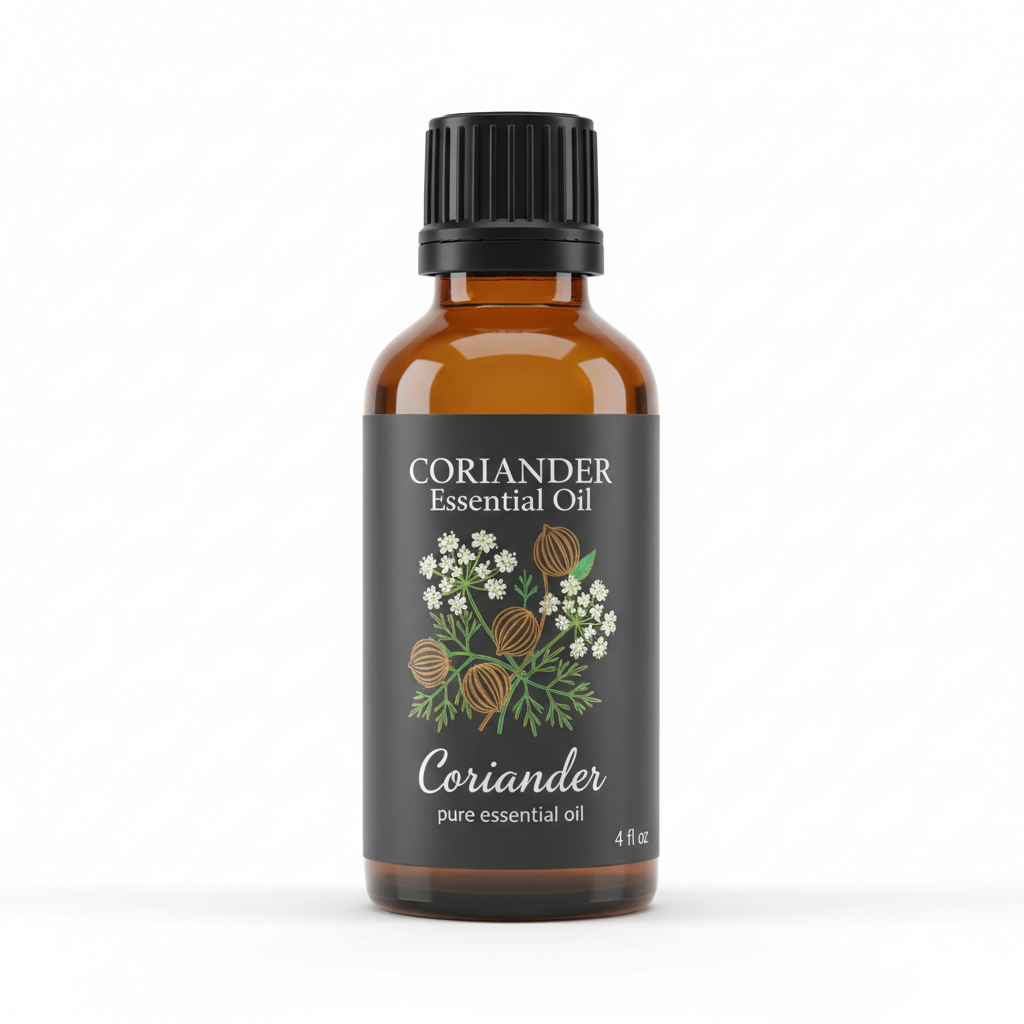
Coriander Essential Oil
Our own Coriander Essential Oil, in sizes from 0.5 oz to bulk.
From $12.99
Shop Now →The ASPCA entry is about the plant, not the bottle
The ASPCA lists cilantro (Coriandrum sativum) as non-toxic to dogs, cats and horses. That is a statement about the leafy herb, the thing a pet might nibble in a garden. It does not describe a distilled oil. Distillation concentrates the volatile fraction of the seed into a liquid that is mostly linalool, and a plant being non-toxic says nothing about that concentrate. When a pet-safety blog quotes the ASPCA plant list as if it covered the oil, it has swapped one product for another.
Why cats come first
Cats carry disabled copies of a detoxifying enzyme gene, UGT1A6. Shrestha et al., PLoS One, 2011 sequenced the gene in 18 felid species and 22 other carnivore taxa, and every felid examined had disabling mutations. The authors estimate the defect became fixed 35 to 11 million years ago, and they predict cats are poor at glucuronidating phenolic compounds. That is a gene study, not an essential oil study, and it does not say which oil constituents a cat can or cannot clear.
It does line up with how regulators treat coriander oil specifically. In its 2023 assessment of coriander fruit oil as a feed additive, the European Food Safety Authority (EFSA FEEDAP Panel, EFSA Journal, 2023) set the cat limit at 14 mg per kg of complete feed, the lowest in its table, against 30 mg/kg for dogs. The panel's stated reason was cats' low capacity for glucuronidation, so it demanded a wider margin of exposure (500 rather than 100). At the proposed 30 mg/kg, the cat margin came out at 233, which failed that stricter test. The same opinion calls coriander oil an irritant to skin and eyes and a dermal and respiratory sensitiser.
Read that for what it is. It concerns oil swallowed in food, in a regulatory risk model, using a fruit oil of a defined composition. It is not a diffuser limit and not a skin limit. Reasoning from it, the practical consequence is narrow: a regulator that examined coriander oil and cats together concluded that cats needed more margin than dogs, and no one has published the equivalent number for air or skin.
Diffusers, fur and grooming
The Merck Veterinary Manual separates diffuser types. Passive diffusers mainly cause respiratory irritation unless tipped over. Active (nebulizing or ultrasonic) diffusers "emit microdroplets or particles of oil into the air," which can settle on fur and be absorbed or swallowed when the animal grooms. The manual says never to apply concentrated essential oils directly to pets, and advises keeping pets out of a room while a diffuser runs, ventilating afterward and running diffusers for under 30 minutes. Pet Poison Helpline ranks risk by route: oral highest, then dermal, then respiratory, and says cats and birds are at the greatest risk of essential oil toxicosis.
Our oil is sold undiluted. A drop on a pet's coat, or a spill on a counter a cat walks across, is a concentrated-oil event, and the diluted-blend advice on our diffusing guide does not apply to it. Store the bottle where a pet cannot knock it over; our storage notes cover the cool, dark, tightly capped conditions anyway.
What is not known
- No toxicity study of coriander seed oil in cats or dogs by inhalation or skin turned up in our search of the veterinary and PubMed literature. Absence of a study is not evidence of low risk.
- No case series we could verify names coriander oil. The best-documented essential oil in pets is tea tree, which the Merck manual calls the most commonly reported intoxicant, and that tells you little about a linalool-led seed oil.
- Birds are named by Pet Poison Helpline as high risk. We found nothing coriander-specific for them either.
- Dogs are less restricted in the EFSA table, but that is a feed figure, not permission to diffuse.
Flea and tick advice is a separate trap
Essential oils are often pitched as natural flea control. A 2026 critical review (Bava et al., Antibiotics, 2026) found in vitro insecticidal activity mainly for phenol-rich oils (thymol, carvacrol, eugenol, cinnamaldehyde), reported that translation to reliable field performance is hampered by volatility and variability, and called for rigorous field studies to confirm safety and efficacy. Coriander seed oil is linalool-led, not phenol-led, and is not among the oils that review highlights. Putting any oil on an animal's coat for fleas is a veterinary question, not a shop question.
A practical order of decisions
- Cat living in the same airspace: leave the diffuser out. Reasoning from the Merck and Pet Poison Helpline material above, plus the lack of any coriander-specific data, this is the cautious default, and a veterinarian can tell you whether your cat's circumstances change it.
- Dog only, or a closed room the animal cannot enter: Merck's conditions are short runs (under 30 minutes), ventilation afterward and diluted rather than concentrated oils. Ours arrives concentrated, and our shop page says a little goes a long way in a diffuser, so the drop count is yours to keep low.
- Skin and hair products you make: reasoning from Merck's grooming point, residue on your hands, hair or clothing can reach a pet that is held or licks you. Wash up before handling the animal, and keep scented body oils off areas a pet will lick.
- Anything meant for the animal itself: not from us. We sell one aromatic oil and it is not labelled for pets.
If a pet has been exposed
Both Pet Poison Helpline and the Merck manual say not to induce vomiting, because of aspiration risk. Pet Poison Helpline recommends fresh air after inhalation and bathing with liquid dish detergent after skin contact, and lists a 24/7 line at (855) 764-7661. Call your veterinarian or an animal poison service first and let them decide; a pet showing vomiting, drooling, wobbliness or breathing trouble needs a clinic, not an internet article. Questions about whether a specific pet with liver, kidney or respiratory disease can be around any scent belong to a veterinarian too.
For a household with a cat, the plain reading is to leave the diffuser out of shared rooms, keep our oil closed and out of reach, and ask your veterinarian before changing that. If you want the skin-side picture for people, our dilution and safety guide and the side-effects piece cover it.
Coriander Essential Oil
Coriander Essential Oil from our own shop, in sizes from 0.5 oz to bulk.
From $12.99
Shop Now →Sources & Further Reading
- ASPCA. Cilantro (Coriandrum sativum), toxic and non-toxic plants. aspca.org/cilantro
- Shrestha B et al., 2011. Evolution of a major drug metabolizing enzyme defect in the domestic cat and other Felidae. PLoS One 6(3):e18046. PMC3065456
- EFSA FEEDAP Panel, 2023. Safety and efficacy of a feed additive consisting of an essential oil obtained from the fruit of Coriandrum sativum L. (coriander oil). EFSA Journal. PMC10613936
- Merck Veterinary Manual. Toxicoses from essential oils in animals. merckvetmanual.com
- Bava R et al., 2026. Essential oils for flea and tick control in companion animals: a critical review. Antibiotics. pubmed/41892473
- Pet Poison Helpline. Essential oils. petpoisonhelpline.com/blog/essential-oils