
Coriander Essential Oil and Pregnancy: What the Guidance Says
Eating coriander in food and putting concentrated coriander seed oil on your skin or in your air are two separate questions, and the evidence for the second one during pregnancy is thin. We sell the oil for aroma and cosmetic use, so we are not the right source for a yes or no. Below is what the pregnancy guidance we could read actually says, with its numbers, and a list of questions for the person who is.
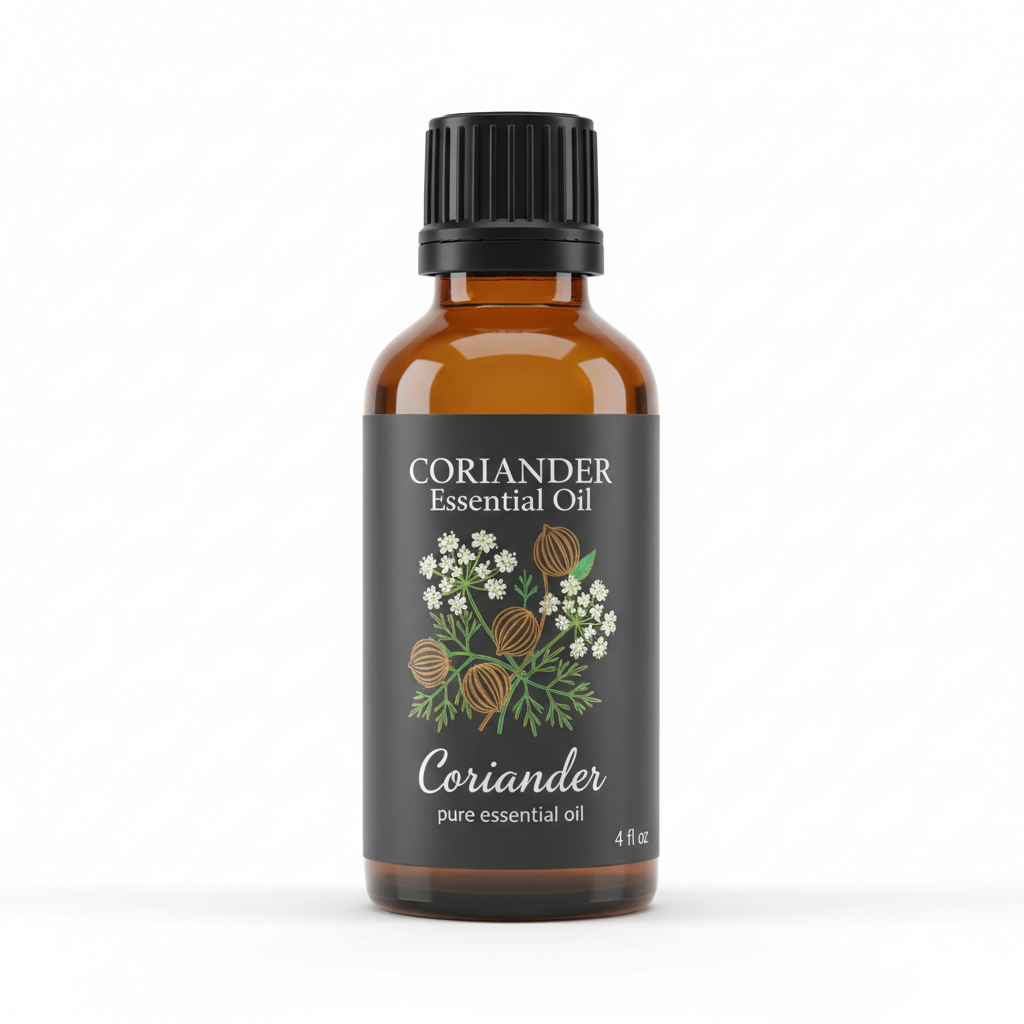
Coriander Essential Oil
Our own Coriander Essential Oil, in sizes from 0.5 oz to bulk.
From $12.99
Shop Now →What we could and could not find
We looked for a human pregnancy or breastfeeding study on coriander essential oil and found none. We searched for a European Medicines Agency herbal monograph on coriander fruit and found only monographs for other fruits of the same plant family, so we make no claim about what EMA says on coriander. We could not open the LactMed entry for coriander (the NCBI page was blocked behind a verification check), so we do not quote it. Where a source is missing, this page says so rather than filling the gap.
What we did read falls into three groups: pregnancy guidance for aromatherapy in general, data on linalool (the main molecule in our seed oil), and the safety assessment of coriander oil done for animal feed.
Guidance that gives numbers
The most specific document we found is an NHS Lanarkshire aromatherapy guideline (version 2, approved 13 August 2025), written for registered midwives who have completed a two-day accredited aromatherapy course. It sets blends at 1%, or a maximum of 1.5%, in pregnancy, and 2% in labour and after birth. It lists contraindications that include epilepsy (an absolute one), major cardiac, renal or hepatic disease, severe asthma, hypertension or pre-eclampsia, anticoagulant use, multiple pregnancy, and skin allergies. It says not to ingest essential oils, to keep them away from children and babies, and that aromatherapy is not to be used for neonates. It does not mention coriander.
Two things follow, labelled as my reasoning. First, a hospital guideline restricts use to trained staff with a checklist, which is a different setting from a person reading a bottle at home. Second, the 2% ceiling for labour is the same as the top of our shop's 0.5% to 2% range, and the pregnancy figures are lower than that top.
The conversion, using the 0.05 mL drop that our own 3-to-12-drops-per-ounce range implies: one ounce of carrier is 29.57 mL, so 1% is about 0.30 mL (6 drops) and 1.5% about 0.44 mL (9 drops). The guideline's own table for a 10 mL carrier gives 2 drops at 1%, which matches. This is arithmetic on a hospital's number, not a recommended recipe for coriander, and we have not tested any blend.
The Tisserand Institute gives no percentage but says anyone who is pregnant should seek advice from a doctor or suitable practitioner before using pure essential oils. Both sources point the same direction: ask someone qualified first.
What is known about the molecule
Linalool leads in coriander fruit (seed) oil: 60 to 73% in 11 Portuguese fruit samples (Machado et al., Plants, 2023), and 65 to 78% by specification in the oil assessed by EFSA in 2023. The most relevant animal study we found gave pure linalool by gavage to pregnant Sprague-Dawley rats (25 per group) on gestational days 7 to 17 at 250, 500 or 1,000 mg/kg a day. The authors, from a fragrance-industry research institute, reported a maternal no-observed-adverse-effect level of 500 mg/kg/day and a developmental one of at least 1,000 mg/kg/day, with no fetal alterations at any dose (Politano et al., Int J Toxicol, 2008).
What that does not show: it used isolated linalool, swallowed by rats, not coriander oil, not skin application, not inhalation, and not people. Applying it to a diffused or massage-blended seed oil is an inference. The oil also contains other things: EFSA's specification allows 3 to 6% camphor, and EFSA's panel says coriander oil should be considered an irritant to skin and eyes and a skin and respiratory sensitiser. That opinion was written for feed, with no user-specific studies submitted, so it describes a hazard classification, not pregnancy data.
There is also the ordinary skin issue. Linalool that has aged in air forms hydroperoxides that are contact allergens (see the side-effects post), and a skin reaction is not something to add to a pregnancy. Our sibling post on linalool covers the chemistry.
Food amounts versus a bottle
The reassurance people carry over from the spice rack does not transfer cleanly. EFSA's opinion quotes an estimated consumer intake of coriander oil of 0.049 mg per kg of body weight per day, which for a 70 kg adult is about 3.4 mg. Reasoning from our own drop size (0.05 mL, likely 40 to 50 mg by my assumed density), one drop is roughly ten times that. At the pharmacopoeial floor of 3 mL of oil per kg of dried fruit, one drop also equals the oil from about 16.7 g of seed. Dietary exposure and a bottle are different scales, and nobody has published a pregnancy study at either scale for this oil.
Diffusing versus skin
The two routes raise different questions. Skin raises dilution, area and allergy. Air raises how long you sit in it and who else is in the room. We found no coriander-specific inhalation data in pregnancy, so we will not rank them. The Lanarkshire guideline treats shared air as a real consideration: it requires door signs and single-occupancy rooms when oils are in use so that other patients and staff can avoid them, and it cautions pregnant staff about oils that stimulate the uterus. It names clary sage as an example, not coriander. Our shop copy says a little goes a long way in a diffuser; for a pregnant person, the question for your midwife is whether to use one at all.
Who should skip this decision on their own
- Anyone with epilepsy, asthma, hypertension, a bleeding history or on anticoagulants: the Lanarkshire list above names these; your clinician decides.
- Anyone who has reacted to fragrance, spice or celery-family foods before.
- Anyone tempted to swallow the oil to "get it in": we do not sell it for that (why).
Questions to bring to your OB-GYN, midwife or pharmacist
- Is there any reason, given my history and trimester, to avoid scented oils on my skin or in a diffuser entirely?
- If yes to some use, what dilution ceiling do you want me to stay under, and for how large an area of skin?
- Should I avoid it during the first trimester specifically?
- We are breastfeeding or plan to: is there guidance on oils on skin near the baby?
- Which symptoms of reaction should make me stop and call you?
If you only want the scent, fragrance-free time in the room costs nothing. If you do use our oil afterward, it is sold undiluted, so the dilution maths and the patch test are yours. We sell aromatic oil, not medical advice, and an obstetric professional is the one to decide this with you.
Coriander Essential Oil
Coriander Essential Oil from our own shop, in sizes from 0.5 oz to bulk.
From $12.99
Shop Now →Sources & Further Reading
- NHS Lanarkshire, 2025. Aromatherapy guideline, version 2. rightdecisions.scot.nhs.uk/aromatherapy.pdf
- Tisserand Institute. Safety guidelines. tisserandinstitute.org/safety/safety-guidelines
- Politano et al., 2008. Evaluation of the developmental toxicity of linalool in rats. pubmed.ncbi.nlm.nih.gov/18404542
- EFSA FEEDAP Panel, 2023. Safety and efficacy of a feed additive consisting of an essential oil obtained from the fruit of Coriandrum sativum L. pmc.ncbi.nlm.nih.gov/PMC10613936
- Machado et al., 2023. Chemical Variability of the Essential Oils from Two Portuguese Apiaceae. pubmed.ncbi.nlm.nih.gov/37514362