Coriander Oil for Sore Muscles: Massage or the Oil?
If your shoulders feel better after a massage with coriander oil, you cannot tell whether the credit belongs to the oil, the carrier oil, the hands or the fifteen minutes of sitting still. Trials that try to separate those pieces are the best guide we have, and none of them used coriander. Our coriander seed oil is for aroma and cosmetic use, we make no claim about muscles or pain, and the practical question is how to use it on skin without irritating yours.
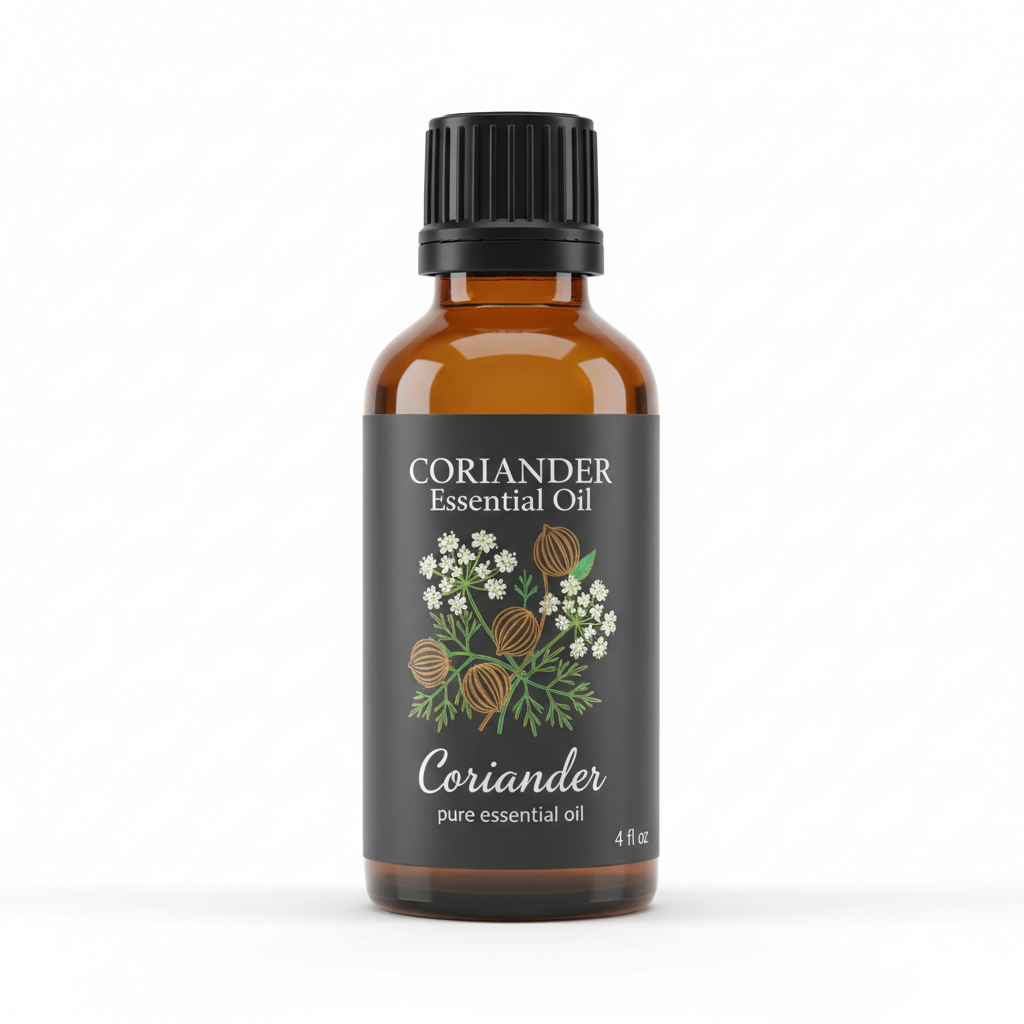
Coriander Essential Oil
Our own Coriander Essential Oil, in sizes from 0.5 oz to bulk.
From $12.99
Shop Now →A trial design that shows the problem
A 2026 randomized trial in intensive care nurses gave 108 people a nightly massage for 4 weeks in one of three arms: chamomile-lavender oil, vetiver oil, or a placebo of jojoba oil (Burkev et al., Nursing in Critical Care, 2026). Fatigue and sleep scores improved over time in every arm, including the jojoba one, with group effects on two of the measures. The outcomes were fatigue and sleep, not muscle soreness, but the structure is the lesson: when everyone is massaged, everyone improves, and the question becomes whether the essential oil adds anything beyond a carrier oil. A trial with no massage-only or no-touch arm cannot answer the larger question at all.
What the oil-versus-massage evidence looks like
The best-known example with pain as the outcome used lavender, not coriander. In a single-blinded randomized trial in people with knee osteoarthritis, lavender oil at a 3% dilution in massage was compared with plain almond oil massage and with no intervention; the lavender group scored better than the no-intervention group immediately and still at 1 week, and by 4 weeks all three groups had the same scores (Nasiri and Mahmodi, Complementary Therapies in Clinical Practice, 2018; see also the Tisserand Institute's summary). Two honest readings: the effect was temporary, and the design does not tell you which of three ingredients (the lavender aroma, the oil's constituents on skin, or the massage) did the work. The PubMed record and the Tisserand write-up give different group sizes, so we quote no sample size.
A systematic review of non-drug pain approaches within nursing practice (22 studies from 2,385 screened) found massage therapy among the interventions with the most support (van Veen et al., Palliative Care and Social Practice, 2024). That review is about massage as a technique. Taken together, the position we hold is this: massage has the evidence; adding an essential oil has thin evidence for a few oils, and none for coriander.
What exists for coriander oil itself
One rodent paper stands out. Rojas-Armas et al., Veterinary World, 2025 steam-distilled coriander seeds from Peru (linalool 59.8%) and tested the oil in rodents at 200 mg/kg. It reported a 51.35% reduction in paw swelling at 4 hours and lower IL-1β and IL-6; linalool alone gave a 93.8% reduction in writhing responses, which the authors compared with tramadol. The abstract does not state the route, the group sizes or the doses beyond 200 mg/kg, and the funder was the authors' university. Four limits matter to a massage buyer:
- Carrageenan swelling and acetic-acid writhing are acute inflammatory and reflex tests in animals, not delayed-onset soreness after exercise.
- The effect was credited to linalool; whether skin absorbs it from a 1% to 2% blend is not addressed.
- The dose is per kilogram of animal and cannot be turned into a drop count.
- A Peruvian oil is one sample. Our oil's composition is on its Certificate of Analysis, and any given lot may differ.
We found no human trial of coriander seed oil, topical or inhaled, for muscle soreness or pain. The search was a Europe PMC query for coriander with analgesic, antinociceptive or anti-inflammatory terms and mice or rats, which returned 784 records dominated by reviews, agronomy and in vitro work; we did not find a human massage trial among the first 20.
The dilution maths, since our oil arrives undiluted
Our shop copy gives 0.5% to 2% in a carrier oil, roughly 3 to 12 drops per ounce. Those two figures imply about 20 drops per milliliter (1 fluid ounce is about 29.6 ml, so 0.5% is about 0.15 ml, or 3 drops, and 2% is about 0.59 ml, or 12 drops). Drop size varies, and the Tisserand Institute says plainly that conversion rates using drops "are always approximate, because no two drops of essential oil are the same" (Tisserand Institute, dilution). It lists a range of 1% to 3% for body oils and lotions and 0.2% to 1% for sensitive or impaired skin, and 3% to 10% for pain and "feel good" rollerballs. Reasoning from those figures, the practical consequence: the numbers are in a ratio, so a 10 ml bottle at 1% needs 0.1 ml, which is about 2 drops, and the error from a wrongly sized drop is proportionally large in a small bottle. Percentages by weight on a small scale are easier to get right.
We stay at 2% or below because we have no coriander skin data to support more. We looked for any: a Europe PMC search for coriander with fragrance-ingredient, sensitization and contact dermatitis terms returned, in its first 15 records, no skin-sensitization study of coriander seed oil. The recipe itself is not here, because our massage oil recipe article covers it and flags that we have not tested it. Which carrier to buy is in the carrier oil guide; we sell none. Do a patch test on a small patch of inner forearm first, keep it away from eyes, and see the side effects article for reactions.
When sore means something else
Normal post-workout stiffness and an injury are different problems. The NHS lists these as reasons to contact NHS 111 or an urgent treatment centre after a sprain or strain: very bad or worsening pain, being unable to put weight on it or walk more than a few steps, a large or worsening swelling or bruising, severe stiffness, or a high temperature or feeling shivery. It lists a cracking sound at injury, a changed shape, numbness, tingling, or blue, grey or cold skin as urgent. It also says to avoid heat, alcohol and massage for the first couple of days after a strain, and to see a GP if it is not improving after a few days of self-care (NHS, sprains and strains). We have no massage therapist on staff; for technique, pressure and what to do about an injured area, see a licensed massage therapist, physiotherapist or physician.
If you want our oil in a massage blend, do it for the warm, woody, softly spicy seed scent, with the dilution maths worked out first. We would rather tell you the oil has no human pain data than let a pleasant smell stand in for one.
Coriander Essential Oil
Coriander Essential Oil from our own shop, in sizes from 0.5 oz to bulk.
From $12.99
Shop Now →Sources & Further Reading
- Burkev FG et al., 2026. Aromatherapy, fatigue and sleep quality in intensive care nurses: randomised placebo-controlled trial. pubmed.ncbi.nlm.nih.gov/42630137
- Nasiri A, Mahmodi MA, 2018. Aromatherapy massage with lavender essential oil and disability in activities of daily living (knee osteoarthritis). pubmed.ncbi.nlm.nih.gov/29389470
- Tisserand Institute. Lavender massage for knee osteoarthritis (summary of the trial). tisserandinstitute.org/lavender-massage-osteoarthritis
- van Veen S et al., 2024. Non-pharmacological interventions in the nursing scope for pain relief in palliative care: systematic review. pubmed.ncbi.nlm.nih.gov/38223744
- Rojas-Armas JP et al., 2025. Linalool-rich Coriandrum sativum essential oil in rodent models. pubmed.ncbi.nlm.nih.gov/41113205
- Tisserand Institute. Dilution for essential oils. tisserandinstitute.org/dilution-essential-oils
- NHS. Sprains and strains. nhs.uk/conditions/sprains-and-strains