
Coriander Oil for Digestion: Spice, Extract or Aroma?
The belief that coriander is "good for digestion" is about a kitchen spice and oral herbal preparations of the seed. It is not about a bottle of essential oil used for aroma, and that is the bottle we sell. Our coriander seed oil is for aroma and cosmetic use, it is not labelled for internal use, and nobody should swallow it to settle a stomach. Below is what the digestive reputation actually rests on, what no trial has tested, and which symptoms mean you should be talking to a clinician rather than shopping.
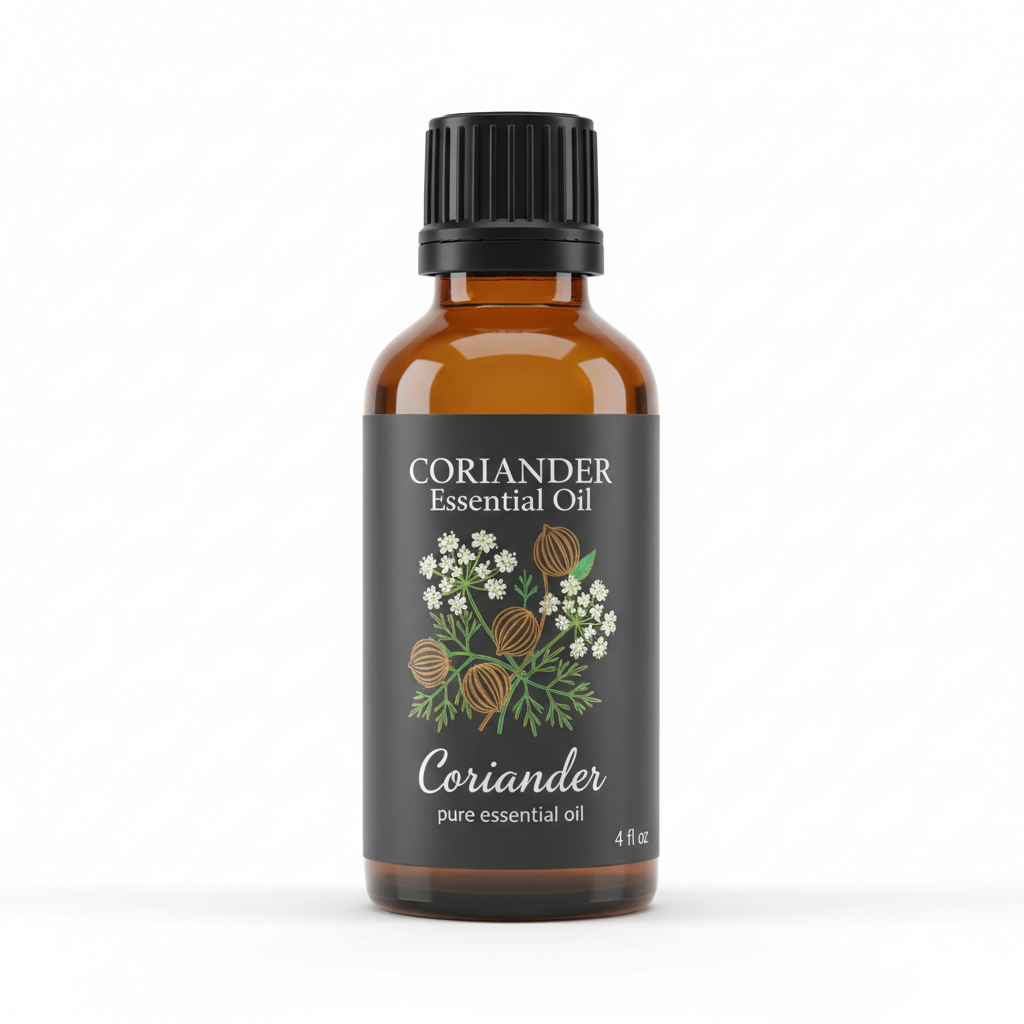
Coriander Essential Oil
Our own Coriander Essential Oil, in sizes from 0.5 oz to bulk.
From $12.99
Shop Now →Three different things share the word "coriander"
When a page says coriander helps digestion, check which of these it means.
- The seed (technically the fruit) as food or tea. A German dermatology encyclopedia, a secondary source, lists coriander fruit under the old German Commission E monograph for "dyspeptic complaints, loss of appetite," and lists the EU herbal committee (HMPC) status as "not processed" (Altmeyer's Encyclopedia, Coriandri fructus). Our attempt to open an EMA monograph page for coriander fruit returned not found, so we cannot give you EMA wording and will not pretend to. This is a traditional oral use, by that source's account.
- An extract inside a multi-herb product. This is where the only human trial we found sits (below).
- The essential oil. The oil is the volatile fraction distilled from the seed, and the same encyclopedia lists linalool as its main component, followed by camphor, gamma-terpinene, alpha-pinene and geranyl acetate. It is a concentrate, and it is the thing in our bottle.
The first is a food question. The second is a pharmacy question. The third, the only one we sell, has the thinnest digestive evidence of the three.
The one human trial, read closely
Vejdani et al., Digestive Diseases and Sciences, 2006 tested Carmint, a total extract of lemon balm (Melissa officinalis), spearmint (Mentha spicata) and coriander (Coriandrum sativum). The pilot enrolled 32 adults with irritable bowel syndrome (IBS), randomized them to Carmint or placebo for 8 weeks, and gave each group loperamide or psyllium depending on their usual bowel pattern. Pain severity and frequency, and bloating severity and frequency, were lower with Carmint than placebo at the end (p values of 0.016, 0.001, 0.02 and 0.002). The authors called it a small pilot needing larger trials. Four things to hold onto:
- It was an oral extract. Nothing was inhaled or rubbed on.
- Coriander was one of three herbs, so the result cannot be credited to coriander alone.
- Everyone also took loperamide or psyllium.
- The PubMed record we read does not state funding, and 32 people is a small number.
A 2023 mouse study is the only other digestive-adjacent coriander oil paper we met: Mousavi et al., Frontiers in Microbiology, 2023 gave coriander essential oil by mouth to mice for a week before infecting them with Campylobacter jejuni and reported milder disease. Oral dosing in infected, genetically altered mice says nothing about aroma.
What we searched for, and what we did not find
The question a buyer of our oil actually has is whether inhaling coriander seed oil, or rubbing it diluted on the abdomen, does anything for digestion. On 2026-10-23 we ran this Europe PMC query: coriander AND "essential oil" AND (digestion OR abdominal OR bloating OR dyspepsia OR "irritable bowel" OR constipation) AND (inhalation OR massage OR topical OR aromatherapy). It returned 117 records. We read the titles of the first 25, which were reviews, rodent work and lab characterization; none was a human trial of inhaled or topical coriander oil. A narrower query for coriander AND (infantile colic OR functional dyspepsia OR "irritable bowel") limited to randomized controlled trials returned zero records. A title search is not proof that nothing exists, and we did not read past record 25 of the first query, so the accurate statement is that we found none.
The massage trials that do exist used other oils
Abdominal massage on its own has some support for constipation: a meta-analysis of 23 studies and 1,431 adults reported more weekly bowel movements and shorter transit time, with high heterogeneity (I² of 82% for frequency), and an aromatherapy subgroup that showed a larger effect on frequency (Huang et al., International Journal of Nursing Studies, 2025). The aromatherapy example we read in detail used ginger and lavender oil in 40 nursing-home residents, with a no-intervention control and no sham, so the result cannot separate the oils from the attention and the massage (Aydinli and Karadag, Explore, 2023). Reasoning from those designs, the practical consequence is that if abdominal massage helps, a bottle of coriander oil adds an untested variable on top of a technique you can do with plain carrier oil. We sell no carrier oils; for what to use, see our carrier oil guide.
Decide: what to do with a stomach complaint
- Symptoms for more than 4 weeks. The NHS tells people who think they might have IBS and have had symptoms for over 4 weeks to see a GP (NHS, IBS symptoms). In the US the equivalent is a primary care physician or gastroenterologist.
- Urgent signs. The same NHS page lists losing a lot of weight for no reason, bleeding from the bottom or bloody diarrhoea, a hard lump or swelling in the tummy, and shortness of breath with palpitations and unusual paleness as reasons to seek an urgent appointment. No aromatic oil is a response to those.
- Food and tea questions. Cooking with the spice is a kitchen matter; our kitchen and gin article covers the culinary side. A pharmacist can say whether an herbal product interacts with your medicines.
- Comparing it with other oils. People often ask how coriander compares with peppermint; that is the subject of our comparison. We do not sell peppermint.
- Swallowing the oil. No. Our oil is not labelled for internal use; the reasons are in the ingestion article.
Who should skip this idea entirely
Anyone with persistent or worsening digestive symptoms, anyone who is pregnant, and anyone buying for a baby with colic should talk to a physician, OB-GYN or midwife, or pediatrician before trying any botanical product. A diluted oil on skin carries irritation and sensitization risks, so a patch test comes first (our shop copy says 0.5% to 2%, roughly 3 to 12 drops per ounce of carrier, and to keep the oil from eyes, children and pets).
If you buy our coriander seed oil, buy it for what it is: a warm, woody, softly spicy seed aroma with a rounded sweetness. We do not know of a trial showing it does anything for digestion, and we are not going to suggest otherwise.
Coriander Essential Oil
Coriander Essential Oil from our own shop, in sizes from 0.5 oz to bulk.
From $12.99
Shop Now →Sources & Further Reading
- Altmeyer's Encyclopedia, n.d. Coriandri fructus (HMPC and Commission E status, constituents). altmeyers.org/coriandri-fructus-156099
- Vejdani R et al., 2006. The efficacy of an herbal medicine, Carmint, in irritable bowel syndrome (pilot). pubmed.ncbi.nlm.nih.gov/16868824
- Mousavi S et al., 2023. Lemon and coriander essential oil in mice with acute campylobacteriosis. pubmed.ncbi.nlm.nih.gov/37065112
- Huang et al., 2025. Abdominal massage on chronic constipation in adults: systematic review and meta-analysis. pubmed.ncbi.nlm.nih.gov/39531948
- Aydinli and Karadag, 2023. Abdominal massage with ginger and lavender oil for elderly with constipation: randomized controlled trial. pubmed.ncbi.nlm.nih.gov/36058824
- NHS, n.d. Irritable bowel syndrome: symptoms and when to see a GP. nhs.uk/conditions/irritable-bowel-syndrome-ibs/symptoms