
Coriander Essential Oil Benefits: What the Studies Tested
Searching for the benefits of coriander essential oil returns a long list of claims, and almost none of the studies behind them used what we sell: a bottled seed oil, sold for aroma and cosmetic use. This page sorts the research by what was actually tested (which plant part, which preparation, which animal or cell line, which route), grades each area with a rubric we made up and explain below, and says plainly where our oil is not the answer. The short verdict: the evidence is real but mostly preclinical, and none of it amounts to a benefit claim we can make for an aromatic product.
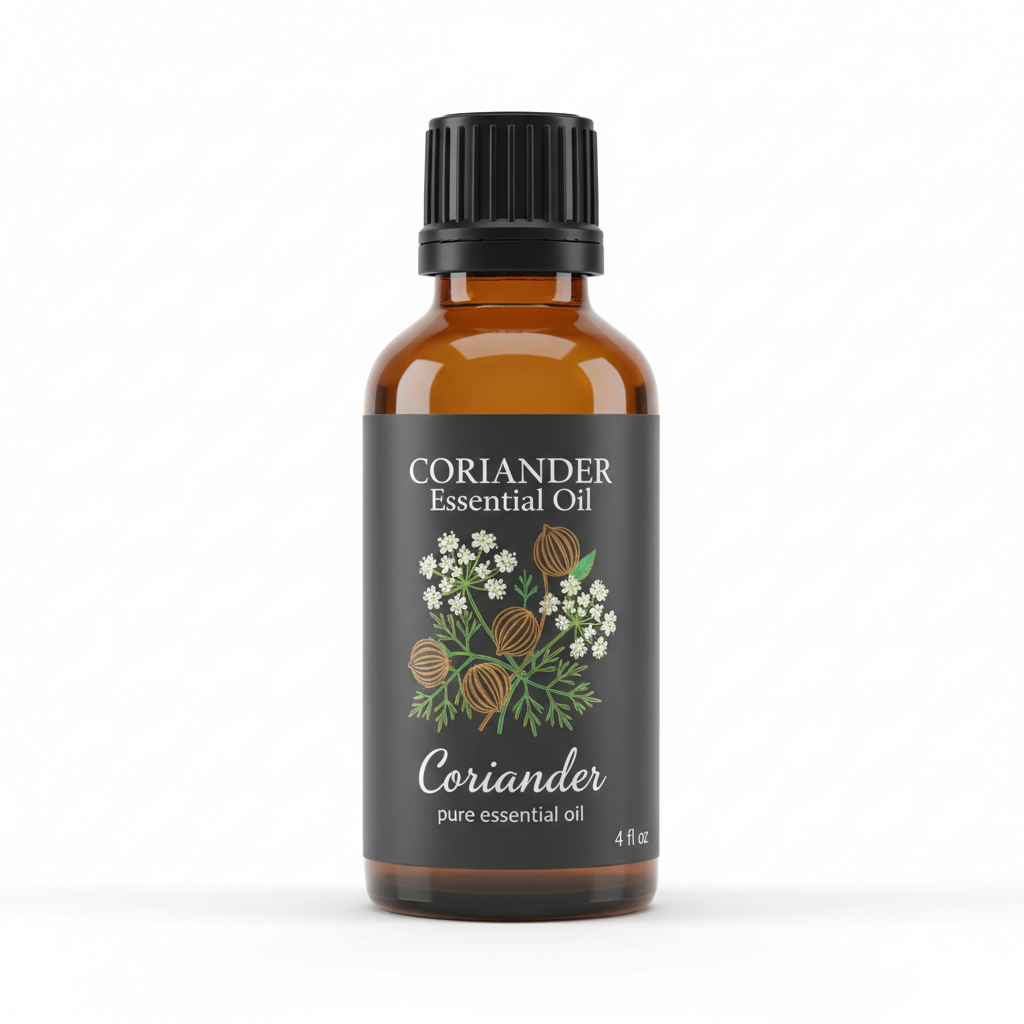
Coriander Essential Oil
Our own Coriander Essential Oil, in sizes from 0.5 oz to bulk.
From $12.99
Shop Now →The grading rubric, and why we made one
Review papers lump together seed oil, leaf oil, solvent extracts, powdered seed and isolated linalool, then summarise them as "coriander." That blurs a distinction that matters to a buyer. Our oil is distilled from the seed (the fruit) and is linalool-led; leaf (cilantro) oil is a different material, covered in our seed versus leaf comparison. So each row below is graded on how close the study sits to someone using a bottle of seed oil for aroma or on skin:
- Grade A: a human trial of the same kind of product (seed essential oil), used the same way (inhaled or diluted on skin).
- Grade B: a human trial, but of a different preparation or route (a seed powder eaten as food, a multi-herb oral extract).
- Grade C: animal work, including seed essential oil given to rodents.
- Grade D: cell or chemical assays in a dish.
- Grade E: nothing we could find.
The grades describe distance from our product, not whether the study was well done. Searching Europe PMC on 2026-10-23, we found no Grade A study for any area in the table.
The evidence map
| Area | What was tested | What was reported | Grade |
|---|---|---|---|
| Digestion | Carmint, an oral extract of lemon balm, spearmint and coriander, 32 adults with irritable bowel syndrome, 8 weeks | Lower pain and bloating scores than placebo, in a small pilot | B (multi-herb, oral) |
| Anxiety-like behaviour | Coriander fruit hydroalcoholic extract, mice, 50 to 200 mg/kg; seed aqueous extract injected into the abdomen, mice | Effects at 100 and 200 mg/kg in one study; at 100 mg/kg in the other | C |
| Sedation | Inhaled linalool alone (1% and 3% in chamber air), mice, 60 minutes | Longer sleep time after a sedative drug, lower body temperature | C (one constituent, not the oil) |
| Pain and inflammation | Peruvian coriander seed essential oil, 59.8% linalool, rodents, 200 mg/kg | Fewer writhing responses, less paw swelling, lower IL-1β and IL-6 | C |
| Antioxidant and inflammatory signals | Jordanian coriander seed oil on mouse macrophage cells | Lower nitric oxide and TNF-α at 0.16 to 0.3 mg/mL, radical scavenging in a chemical assay | D |
| Antibacterial | Seed oils from nine Iranian and Iraqi populations | Inhibited bacteria only at full strength; S. aureus the most sensitive | D |
| Blood glucose and lipids | Coriander seed powder, 40 adults with type 2 diabetes, 6 weeks, randomized placebo-controlled | Reported improved fasting glucose, insulin resistance and lipids | B (food-form powder, not oil) |
Reading the rows that people quote most
Digestion: an oral herbal reputation
The digestive claim is the oldest. A German dermatology encyclopedia (a secondary source) lists coriander fruit under the old German Commission E monograph for "dyspeptic complaints, loss of appetite," and lists the EU herbal committee (HMPC) status as "not processed" (Altmeyer's Encyclopedia, Coriandri fructus). Our attempt to open an EMA monograph page for coriander fruit returned not found, so we are not citing one; if you have seen the claim "EMA-approved for digestion," we could not confirm it. The one human trial we found with coriander in it is Vejdani et al., Digestive Diseases and Sciences, 2006: 32 adults, randomized, placebo-controlled, 8 weeks, and the product was a three-herb oral extract taken alongside loperamide or psyllium. It cannot isolate coriander, and nobody inhaled or rubbed anything on. Full treatment of this in our digestion article.
Anxiety and sleep: mice, and one molecule
Two mouse studies used coriander seed preparations: Mahendra and Bisht, Indian Journal of Pharmacology, 2011 (hydroalcoholic fruit extract, four behavioural models, diazepam comparator, effect at 100 and 200 mg/kg and none at 50) and Emamghoreishi et al., Journal of Ethnopharmacology, 2005 (aqueous seed extract injected intraperitoneally, effect on the elevated plus-maze at 100 mg/kg, with reduced activity and coordination at lower doses too). Neither used essential oil. The inhalation work, Linck et al., Phytomedicine, 2009, used linalool alone. Treating that as evidence about our oil is an inference: linalool leads the seed oil, but the oil carries other compounds too. The longer walk-through is in the anxiety and sleep article.
Pain and inflammation: the strongest-sounding result, and why it is still Grade C
Rojas-Armas et al., Veterinary World, 2025 steam-distilled coriander seeds from Peru (linalool 59.8%, then alpha-pinene, camphor and gamma-terpinene) and tested the oil in rodents at 200 mg/kg. It reported a 51.35% reduction in paw swelling at 4 hours and lower IL-1β and IL-6; linalool alone scored 93.8% fewer writhing responses, which the authors compared with tramadol. The abstract does not state the route of administration or group sizes, and the work was funded by the authors' university. A rodent dose in mg/kg does not translate into a drop on skin, and the writhing test measures a reflex, not a sore muscle. We take it up in the muscle massage article.
Antioxidant, antibacterial, "detox"
Dish results such as Omar et al., PLoS One, 2024 describe cells and chemistry, not people. The antibacterial seed-oil work in Talebi et al., Food Science & Nutrition, 2024 found inhibition only with undiluted oil, which is not a concentration anyone should put on skin; see the antimicrobial research article. The metal "detox" idea is a separate topic, handled in its own article.
What the reviews add, and what they do not
The broad review Laribi et al., Fitoterapia, 2015 (literature from 2000 to 2014) lists antimicrobial, antioxidant, hypoglycemic, hypolipidemic, anxiolytic, analgesic, anti-inflammatory, anticonvulsant and other activity for coriander seed and herb preparations, and says its authors found no reports on reactive airway disease. A later review, Hosseini et al., Avicenna Journal of Phytomedicine, 2021, covers the neuro-pharmacology of coriander and linalool. Both are summaries of mostly preclinical work. A list of "activities" in a review is a list of things reported in assays and animals; it is not a list of things a bottle will do.
Where our oil fits, and where it does not
Our oil is a distilled coriander seed oil, sold as botanical grade with a Certificate of Analysis on the shop page. It is for aroma and cosmetic use, it is not labelled for internal use or any treatment purpose, and it ships undiluted, so the dilution maths is yours. Our shop page gives 0.5% to 2% in a carrier oil, roughly 3 to 12 drops per ounce, with a patch test first and the oil kept away from eyes, children and pets. The Tisserand Institute's dilution guide gives wider ranges by product type (1% to 3% for body oils and lotions, 0.2% to 1% for sensitive or impaired skin) and warns that drop conversions are always approximate (Tisserand Institute, dilution guidance). We stay at the lower numbers because we have no coriander-specific skin data to justify more.
Who should look elsewhere: anyone with a digestive, sleep, mood, pain or blood-sugar problem should see a physician or pharmacist, and the studies above do not change that. Nobody should swallow the bottle; the question is covered in our ingestion article. NCCIH says of aromatherapy and insomnia that "we don't know whether it's helpful because little rigorous research has been done" (NCCIH, Aromatherapy). That sentence is not about coriander specifically, but it is the right default.
So the honest summary of "benefits" is smaller than the search results suggest: a pleasant warm, woody, softly spicy seed aroma, a linalool-rich oil with preclinical research behind it, and no human outcome data for the way we sell it.
Coriander Essential Oil
Coriander Essential Oil from our own shop, in sizes from 0.5 oz to bulk.
From $12.99
Shop Now →Sources & Further Reading
- Altmeyer's Encyclopedia, n.d. Coriandri fructus (HMPC and Commission E status). altmeyers.org/coriandri-fructus-156099
- Vejdani R et al., 2006. The efficacy of an herbal medicine, Carmint, in irritable bowel syndrome (pilot). pubmed.ncbi.nlm.nih.gov/16868824
- Mahendra P, Bisht S, 2011. Anti-anxiety activity of Coriandrum sativum in different experimental anxiety models. pubmed.ncbi.nlm.nih.gov/22022003
- Emamghoreishi M et al., 2005. Coriandrum sativum: evaluation of its anxiolytic effect in the elevated plus-maze. pubmed.ncbi.nlm.nih.gov/15619553
- Linck VM et al., 2009. Inhaled linalool-induced sedation in mice. pubmed.ncbi.nlm.nih.gov/18824339
- Rojas-Armas JP et al., 2025. Linalool-rich Coriandrum sativum essential oil in rodent models. pubmed.ncbi.nlm.nih.gov/41113205
- Omar A et al., 2024. Jordanian coriander seed essential oil on RAW 264.7 macrophages. pubmed.ncbi.nlm.nih.gov/39106253
- Talebi SM et al., 2024. Composition and antimicrobial activity of coriander seed essential oils from different populations. pubmed.ncbi.nlm.nih.gov/38873442
- Zamany S et al., 2025. Coriander seed powder, serum lipids and glycemic markers in type 2 diabetes (randomized trial). pubmed.ncbi.nlm.nih.gov/41492428
- Laribi B et al., 2015. Coriander (Coriandrum sativum L.) and its bioactive constituents. pubmed.ncbi.nlm.nih.gov/25776008
- Hosseini M et al., 2021. Neuroprotective effects of Coriandrum sativum and its constituent, linalool: a review. pubmed.ncbi.nlm.nih.gov/34745916
- Tisserand Institute. Dilution for essential oils. tisserandinstitute.org/dilution-essential-oils
- NCCIH. Aromatherapy. nccih.nih.gov/health/aromatherapy