Linalool in Coriander Oil: What It Is and Why It Matters
Open a bottle of coriander seed oil and most of what you smell is one molecule. Linalool is the backbone of the oil, a lightly floral, woody alcohol that also turns up in lavender and many other plants. It is worth getting to know, because it explains the smooth character of the scent and also why a little care with storage pays off.
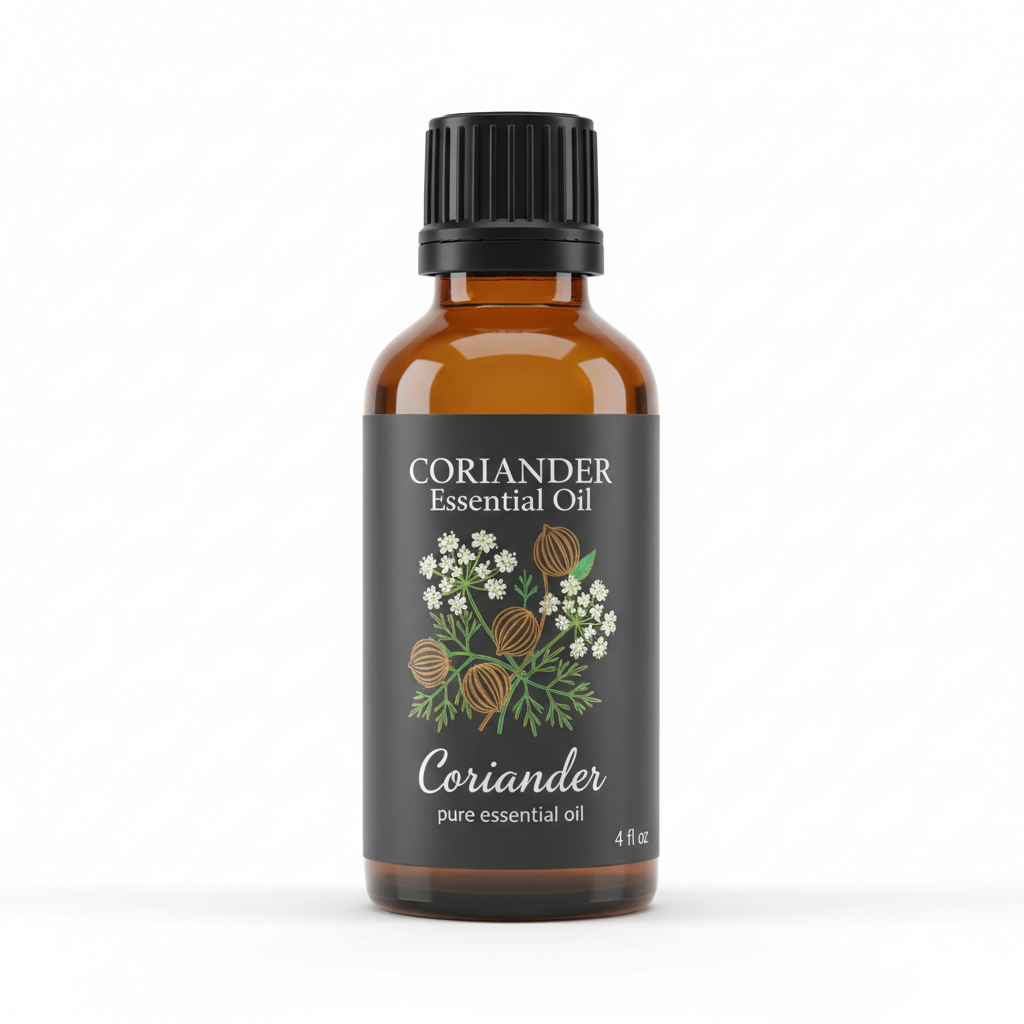
Coriander Essential Oil
Our own Coriander Essential Oil, in sizes from 0.5 oz to bulk.
From $12.99
Shop Now →You do not need to be a chemist to enjoy this oil, and the only thing we ask is that you pick up a few simple habits. We think of linalool as the oil's personality, and the more you know about it, the better you can look after the bottle.
Linalool-rich is a range, not a number
We describe our oil as linalool-rich, and that is how seed oils are generally described. The figure itself moves around. Dried seeds from Iranian accessions gave oils with 40.9 to 79.9% linalool, nearly all above 60% (Nejad Ebrahimi et al., 2010), and eleven Portuguese fruit oils sat at 60 to 73% (Machado et al., 2023). Ripeness matters a great deal: in one study, immature fruit gave about 11% linalool and mature fruit nearly 88% (Msaada et al., 2007).
The practical lesson is that one linalool figure means little without the report behind it. We do not quote a percentage for our oil. The Certificate of Analysis we publish for one batch lists density and refractive index; if you want a GC-MS profile for a lot, ask us in writing through the contact page before ordering.
Why one oil can read two ways
A tidy example comes from the European Food Safety Authority. For the same five batches of coriander oil, gas chromatography with a flame detector gave a mean linalool of 71.7%, while GC-MS gave 58.72% (EFSA FEEDAP Panel, 2023). Nothing about the oil changed. The Tisserand Institute explains that the flame detector is generally favoured for relative amounts and that area percent is "a practical, commonly accepted approximation, but an approximation nonetheless" (St-Gelais, Tisserand Institute).
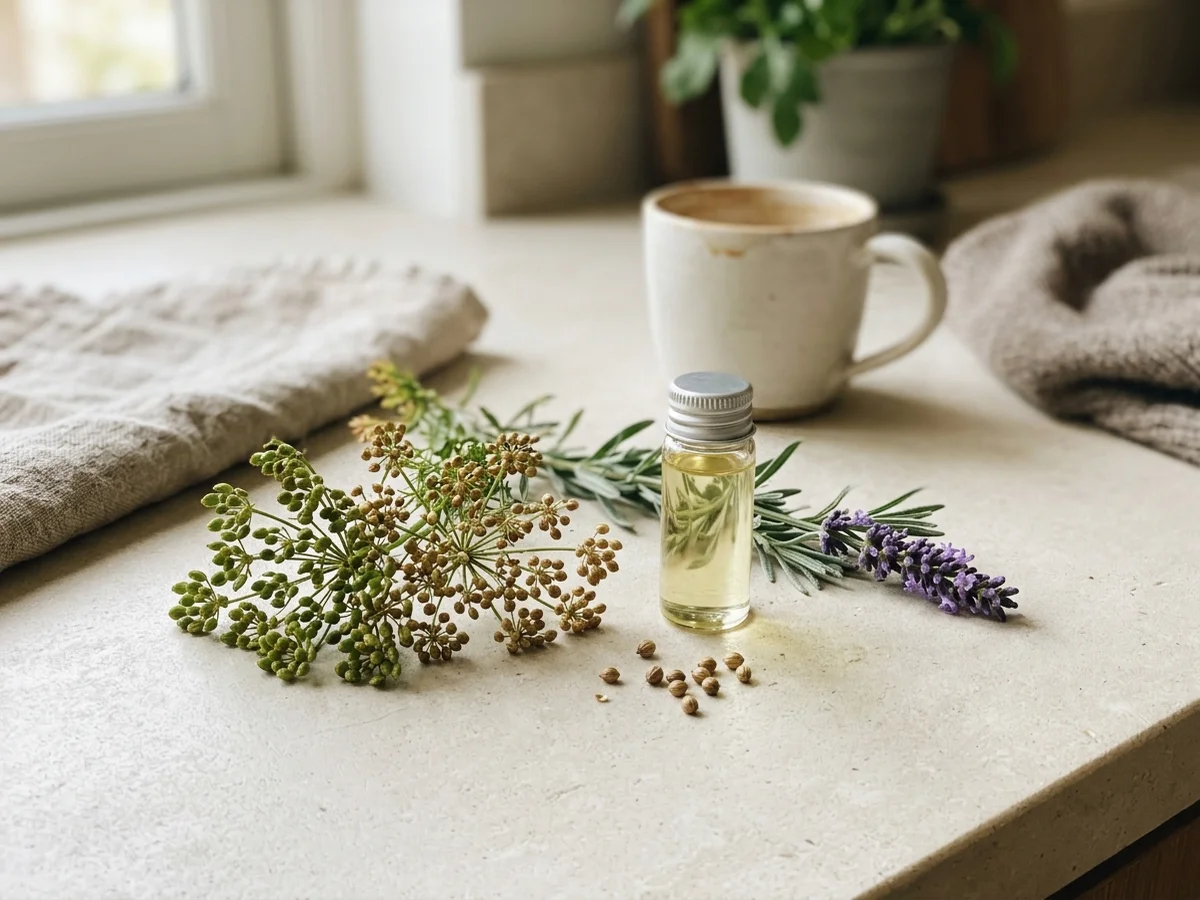
So when two sellers quote two numbers, ask which method produced each before deciding one oil is richer. Our GC/MS checklist walks through a report line by line.
Left-handed and right-handed linalool
Linalool comes in two mirror-image forms. One is described as herbaceous and named coriandrol, the other as lavender-like and named licareol, and the lavender-like form is the more common in nature (Mohamed et al., 2020). It is tempting to say that explains why coriander and lavender smell different. We did not find a measured ratio for a coriander seed oil in anything we read, so that remains a neat idea rather than an established fact. Lavender also carries a good share of linalyl acetate, around a quarter in one recent sample, which coriander seed oil does not lead with (Yas et al., 2026). Our coriander versus lavender comparison sets the two side by side.
What it smells like in everyday terms
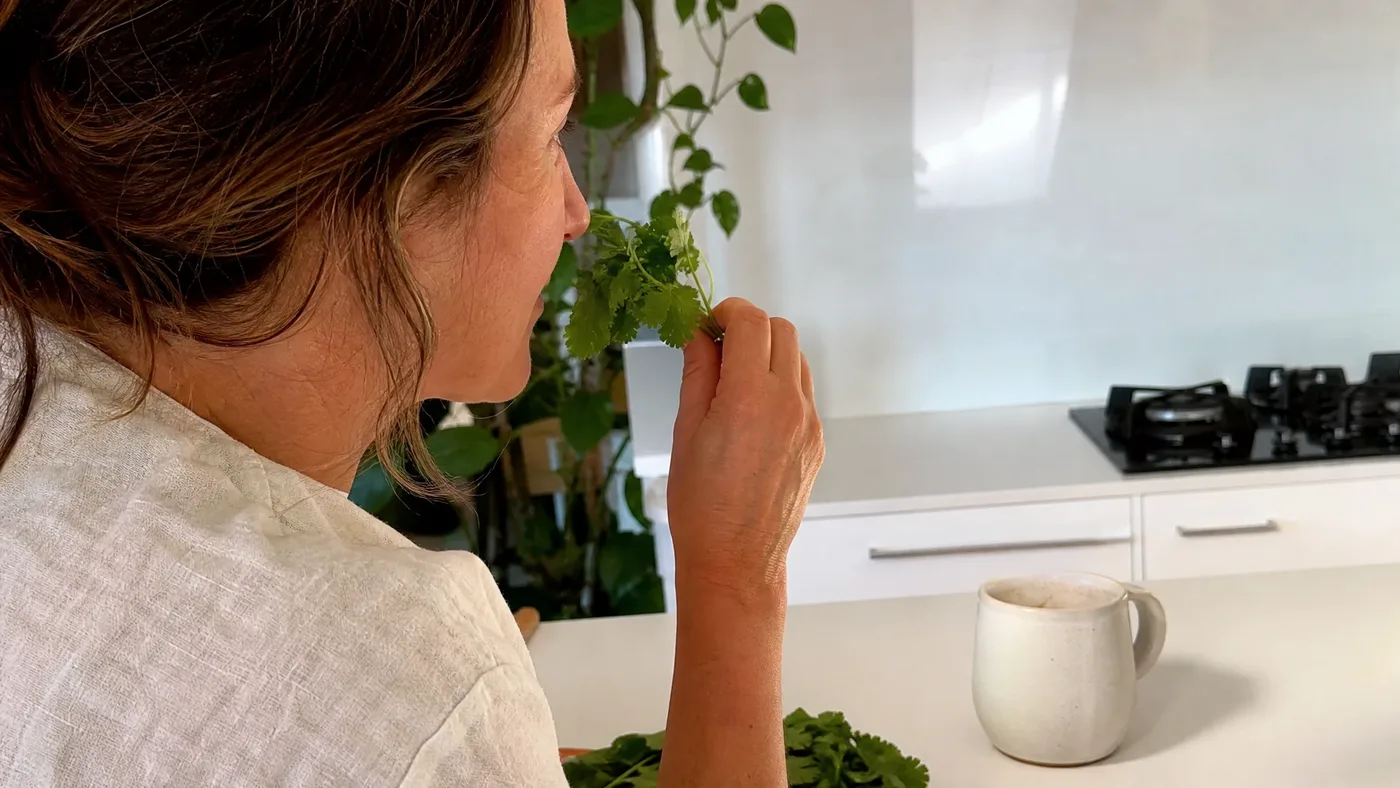
Try describing the scent without any chemistry words. Most people reach for words like floral, soft, woody, a little sweet and a little spicy. If you have smelled lavender or certain fresh flowers, you already know the family. On coriander seed oil, that floral softness is held in check by warmth, which is why the oil feels grounded instead of perfumey. Keep a card with a few of your own words for it beside the bottle, and see whether they change as the oil sits open on a strip.
What air does to it
Here is the part that changes how you treat the bottle. Linalool itself is a weak allergen or none at all, but it reacts with oxygen, and its oxidation products can cause contact allergy. In a study of 3,418 dermatitis patients, deliberately oxidised linalool gave positive patch tests in 0.83% of people at a 2% test strength, rising to 7.2% at 11% (Bared Christensson et al., 2010). A Danish registry of 6,719 patients found 3.1% positive to linalool hydroperoxides, and the authors judged 1.0% the best test concentration (Botvid et al., 2026).
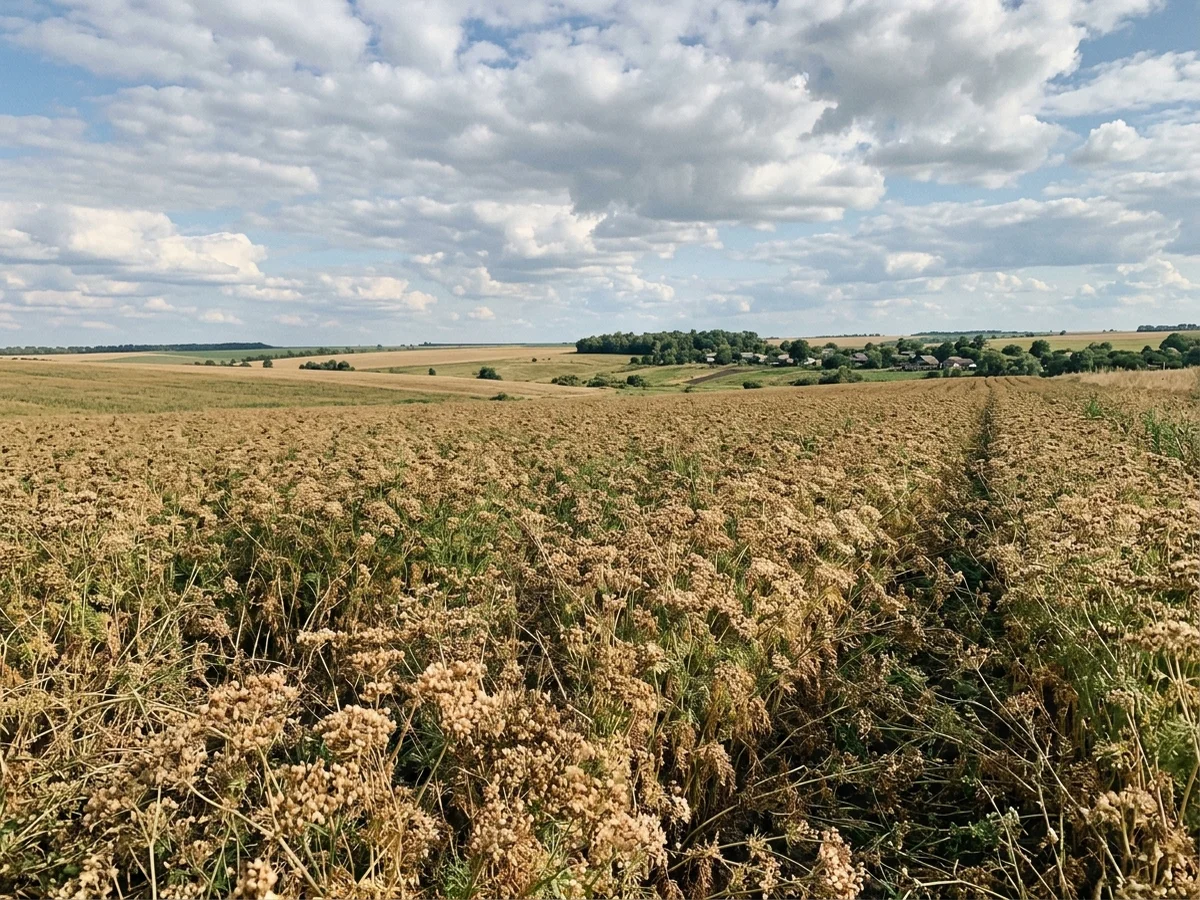
Keep those in proportion. The people were dermatitis patients, the material was oxidised linalool rather than coriander oil, and a closed patch is a stronger exposure than a diluted oil. What the studies do give us is a sound reason for habits we recommend anyway: keep the cap tight, store the bottle cool and dark, and dilute to 0.5% to 2% in a carrier with a patch test first.
A little arithmetic shows where to put your effort. Say 5 ml of oil sits in a 30 ml bottle, at an assumed 60% linalool (a figure inside the published ranges, not ours). The air above it holds enough oxygen to react with at most about 1.3% of the linalool; with only 1 ml left, that rises to about 7.5%. Reasoning from that, a nearly empty bottle is the one to use up or decant into a smaller one.
Habits that follow from all this
Everything above comes down to a short list you can keep on a sticky note by the shelf. Close the cap right after you pour. Keep the bottle somewhere cool and out of the light. Write the opening date on it. Use older bottles first. When the oil gets low, move it into a smaller bottle with less air above it.
None of it takes more than a minute. We like it because it is the kind of care that costs nothing and means the bottle you open next spring smells the way it did when you first uncapped it.
Knowing one molecule this well makes everything about the oil easier to read, from a lab report to the way it smells after a few months on the shelf.
Coriander Essential Oil
Coriander Essential Oil from our own shop, in sizes from 0.5 oz to bulk.
From $12.99
Shop Now →Sources & Further Reading
- Nejad Ebrahimi S et al., 2010. Essential oil composition of Iranian coriander accessions. pubmed.ncbi.nlm.nih.gov/20803372
- Machado et al., 2023. Coriander from Portugal: fruits and aerial parts. Plants 12(14):2749. pubmed.ncbi.nlm.nih.gov/37514362
- Msaada et al., 2007. Variation of coriander fruit essential oil with maturity. Food Chemistry 102(4). doi.org/10.1016/j.foodchem.2006.06.046
- EFSA FEEDAP Panel, 2023. Safety and efficacy of coriander oil as a feed flavouring. pmc.ncbi.nlm.nih.gov/PMC10613936
- St-Gelais A, Tisserand Institute. Highs and lows of GC-MS in essential oil analysis. tisserandinstitute.org
- Mohamed et al., 2020. Linalool enantiomers. Biomolecules 10(11):1488. pmc.ncbi.nlm.nih.gov/PMC7693927
- Yas et al., 2026. Lavandula angustifolia composition. Chem Biodivers 23(5). pubmed.ncbi.nlm.nih.gov/42087407
- Bared Christensson et al., 2010. Linalool, a significant contact sensitizer after air exposure. Contact Dermatitis. pubmed.ncbi.nlm.nih.gov/20136877
- Botvid et al., 2026. Patch testing with linalool and limonene hydroperoxides. Contact Dermatitis 94(5). pubmed.ncbi.nlm.nih.gov/41638887