What Does Coriander Seed Oil Smell Like?
The surprise comes the moment the cap is off. Anyone expecting the bright, green bite of fresh cilantro gets something warmer and rounder instead: woody, softly spicy, with a sweetness underneath and a light floral edge. That is the seed talking, and it is a different plant smell altogether from the leaf.
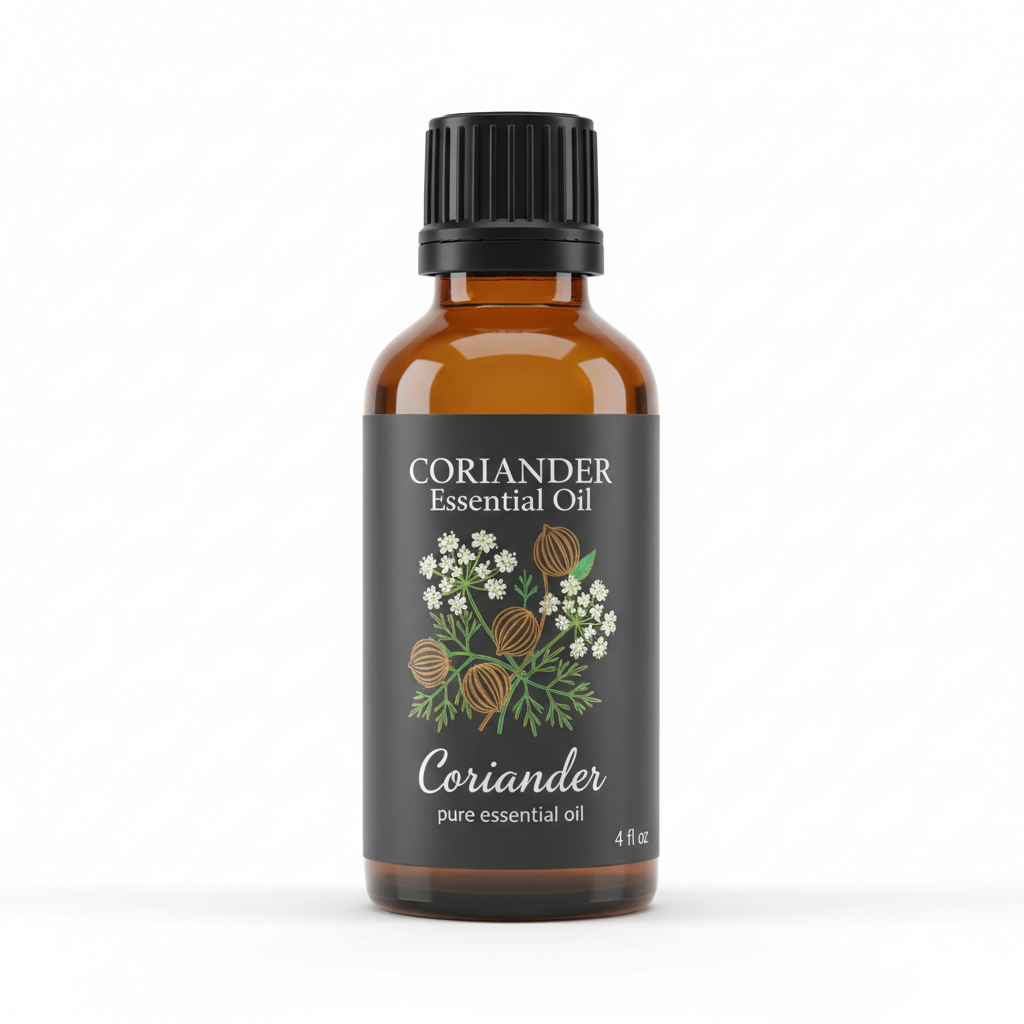
Coriander Essential Oil
Our own Coriander Essential Oil, in sizes from 0.5 oz to bulk.
From $12.99
Shop Now →How we describe it
Our description of the oil is warm, woody and softly spicy, with a rounded sweetness and a light floral edge, and a faint background of citrus peel and fresh bread spice. In perfumery terms we place it as a middle note, which means it sits in the heart of a blend and does not rush off the top. A little goes a long way in a diffuser.
The Certificate of Analysis we publish for one batch lists the smell standard as "Sweet, Herbal, Warm" and the result as "Complies". Everyone reaches for slightly different words for the same mixture: woody to one nose is herbal to another. European regulators settle on "characteristic and spicy odour" for coriander fruit oil (EFSA FEEDAP Panel, 2023). If you need an exact match for a product, the most reliable judge is your own nose.
Putting words to it
Scent is hard to describe, and most of us run out of words fast. It helps to borrow from the kitchen. Close your eyes after the first sniff and ask what it reminds you of: a warm slice of toast, orange peel, a polished wooden spoon, the inside of a spice drawer? Those are all fair descriptions, and you'll notice that other people land on different ones. One person hears bread, another hears flowers, and both are right.
A trick that helps is to describe it in three parts. First comes what greets you at once, then what sits in the middle after a minute, and then what is left on the strip an hour later. Write down one word for each. After a few oils you will have a private vocabulary, and the words you choose for coriander will say as much about your nose as about the oil.
Seed and leaf, two families of molecules
The difference is chemical. Portuguese fruit oils were 60 to 73% linalool, while the leafy plant gave oils dominated by aldehydes, 2-trans-decenal and n-decanal (Machado et al., 2023). A second study found the same split, with fruits at 73 to 78% linalool (Povoa et al., 2024). To a nose, those read as two different plants. Our seed versus leaf comparison goes deeper, and if the soapy-cilantro reaction is on your mind, see why coriander tastes like soap to some people.
It is worth knowing that a molecule can shape a smell without being the biggest number on the page. In a study of two Bavarian gins, linalool had the highest odour activity in both, ahead of limonene, cineole, estragole and anethole (Buck et al., 2020). Linalool is a strong aroma contributor, which fits with how much of the oil's character it carries.
Why one bottle can smell a little different from the next
Seed oils shift with the plant and the process. Fruit picked at three ripeness stages gave very different oils, from nearly half geranyl acetate when immature to about 88% linalool when mature (Msaada et al., 2007). Time in the still matters too, with light, piney compounds coming off early and heavier ones later (Zheljazkov et al., 2014). So a new bottle will not necessarily match an older one. If lot-to-lot consistency matters for your product, ask us in writing through the contact page about the lot you are buying.
Where it tends to belong
Because it is a middle note with a warm, rounded character, coriander seed oil suits places where you want a scent that feels settled rather than sparkling. Think of a kitchen-leaning diffuser blend with citrus peel, a wood-and-spice candle, or a body oil you want to smell friendly and faintly sweet. It is less suited to anything that needs a crisp, green, herbal snap, and that is simply a matter of taste.
If you are choosing a scent as a gift for a friend who loves fresh herbs, ask them first whether they like the smell of the seed or the leaf. Plenty of people love one and cannot stand the other, so the question saves a disappointment.
A better way to smell it
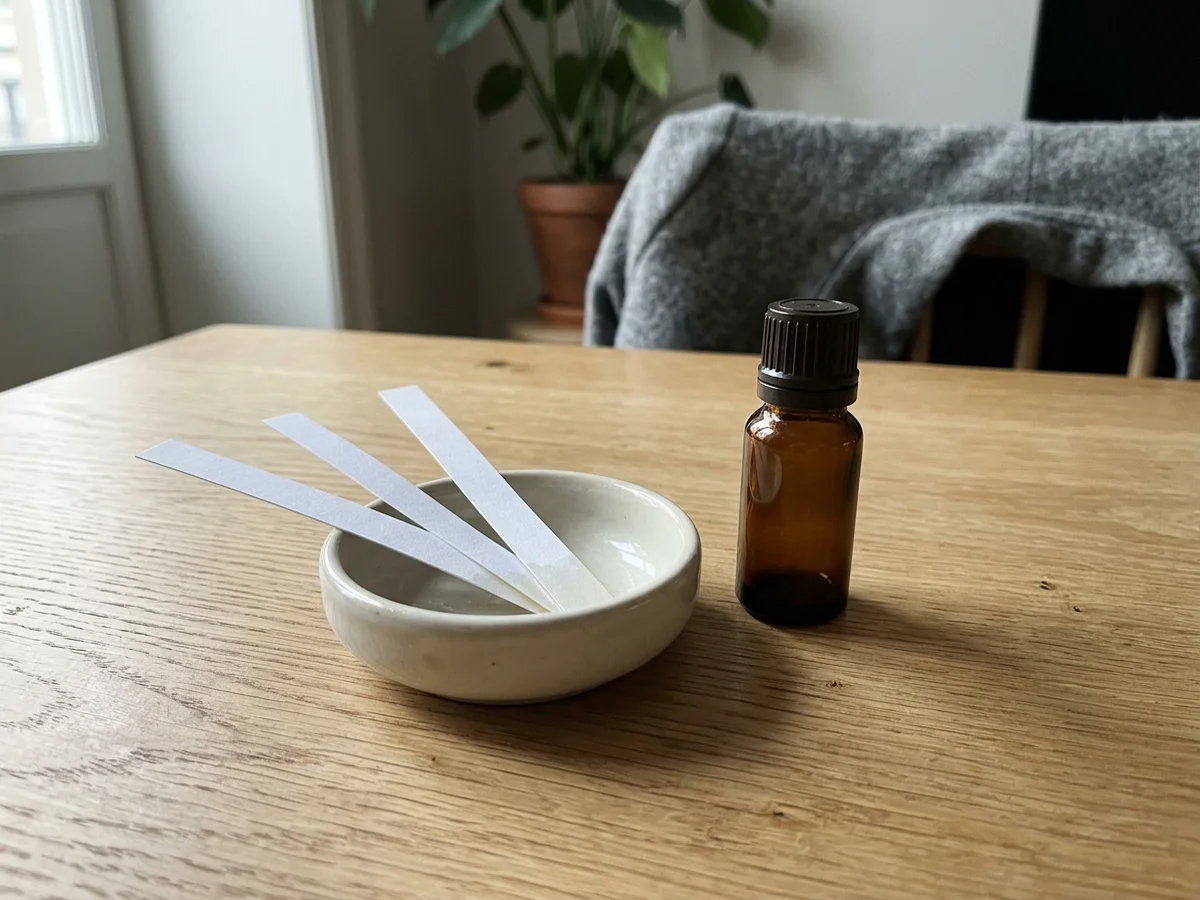
Put one drop on a paper strip and wave it at a distance rather than inhaling from the bottle, since the neat oil is a skin and eye irritant. Come back after ten minutes and again after an hour, because the opening and the drydown are different smells and the middle is the part to judge. Try it next to a crushed coriander seed from your kitchen rather than your memory of the leaf. Stop after a few samples, since noses tire quickly.
Let the bottle breathe a little
If you've had a bottle for a while and open it after a long gap, take a moment before judging the scent. The first whiff after a cap has been tight for weeks can seem sharper than what you remember, and it settles within a minute or two. Smell it on a fresh strip, away from your face, and give your nose a break with a sniff of your own sleeve between samples. Trust the second impression more than the first.
If you love a fresh green herbal note, this is the wrong oil. If a rounded, warm-spicy middle that sits well with citrus and wood sounds good, you are in the right place; our blending guide lists pairings that suit it.
Coriander Essential Oil
Coriander Essential Oil from our own shop, in sizes from 0.5 oz to bulk.
From $12.99
Shop Now →Sources & Further Reading
- EFSA FEEDAP Panel, 2023. Safety and efficacy of coriander oil as a feed flavouring. pmc.ncbi.nlm.nih.gov/PMC10613936
- Machado et al., 2023. Coriander from Portugal: fruits and aerial parts. Plants 12(14):2749. pubmed.ncbi.nlm.nih.gov/37514362
- Povoa et al., 2024. Coriander from Alentejo, Portugal. Foods 13(6). pubmed.ncbi.nlm.nih.gov/38540919
- Buck et al., 2020. Key aroma compounds of two Bavarian gins. Applied Sciences 10(20):7269. doi.org/10.3390/app10207269
- Msaada et al., 2007. Variation of coriander fruit essential oil with maturity. Food Chemistry 102(4). doi.org/10.1016/j.foodchem.2006.06.046
- Zheljazkov et al., 2014. Hydrodistillation time and coriander oil composition. J Oleo Sci 63(9). pubmed.ncbi.nlm.nih.gov/25132088