What Blends with Coriander Oil? Pairings That Work
Coriander seed oil blends easily because it is mostly one smooth molecule, linalool, with very few sharp edges. That makes "what goes with it?" less useful than "what is missing from it?" What it lacks is a bright top and a dry or resinous base, and those are the jobs a partner oil can do.
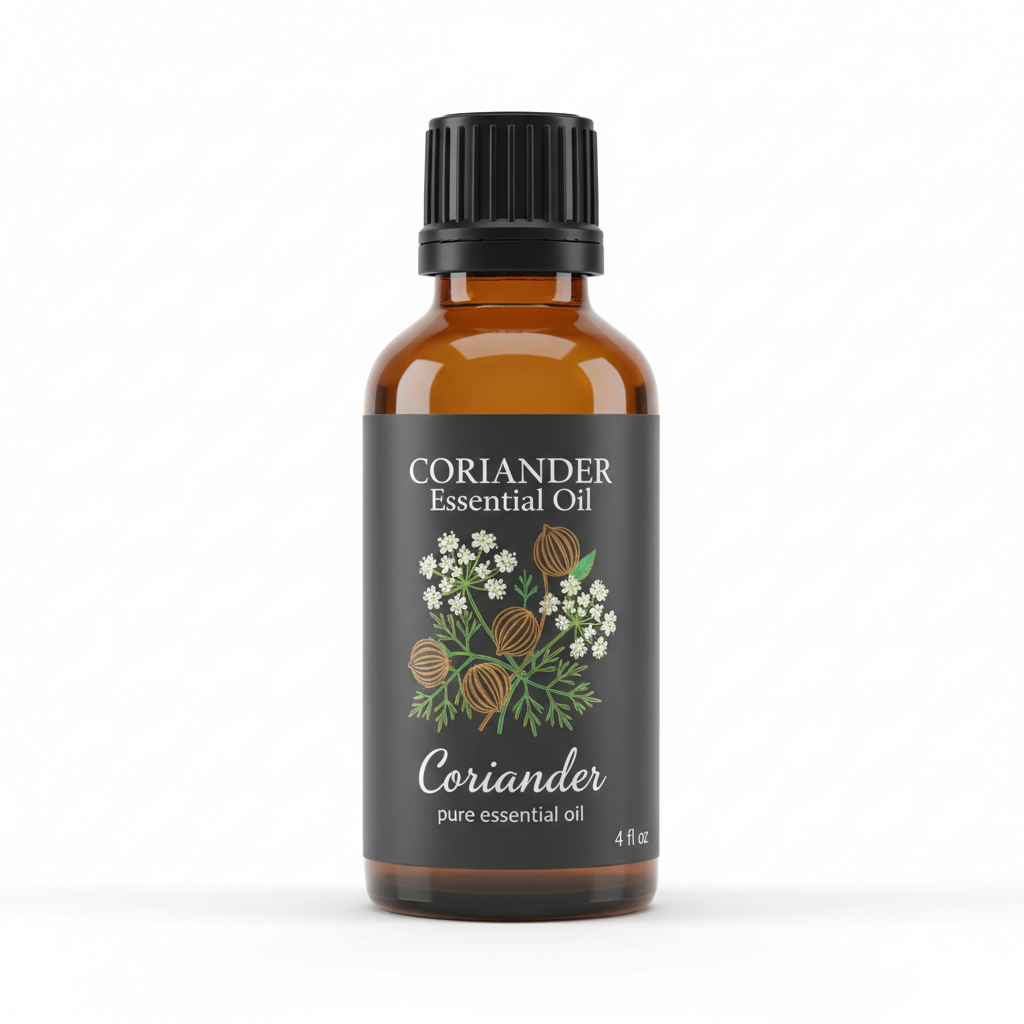
Coriander Essential Oil
Our own Coriander Essential Oil, in sizes from 0.5 oz to bulk.
From $12.99
Shop Now →What coriander brings
EFSA's 2023 assessment of coriander fruit oil gives a sense of the build: linalool specified at 65 to 78%, with smaller amounts of alpha-pinene, gamma-terpinene and camphor (EFSA FEEDAP Panel, 2023, coriander fruit oil opinion). We describe our oil as warm, woody and softly spicy with a light floral edge, a middle note. Reasoning from that, coriander is a body rather than a headline. It fills the middle and joins a bright top to a deeper base without calling attention to itself. The flip side is that it is easy to bury, so the partner is the oil to measure carefully.
Partners worth trying
We suggest bergamot, black pepper, cypress, jasmine, lavender and sweet orange, and frankincense and sandalwood are also natural companions. We do not sell any of them, so look for them at an aromatherapy supplier. For a few of them there is composition data that explains the choice.
- Sweet orange is a plain citrus top. Expressed orange oil is about 94% limonene and carries almost no linalool (0.3 to 0.4%) in the batches EFSA assessed (EFSA FEEDAP Panel, 2021, sweet orange oil opinion), so it brightens without overlapping coriander's main molecule.
- Black pepper adds a dry, peppery edge. Its oil is led by beta-caryophyllene with limonene and sabinene (EFSA FEEDAP Panel, 2022, black pepper oil opinion), so it brings contrast rather than smoothness.
- Bergamot and lavender share coriander's linalool and add a sweet ester, which pushes a blend floral. See our bergamot article and coriander versus lavender.
- Cypress, frankincense and sandalwood are the dry, woody and resinous end of the list, a natural base under a coriander middle.
Three directions to try on a paper strip
- Sunny and bright: coriander with sweet orange. Expect the orange to arrive first and the coriander to sit warmly underneath, a little like zest over toast.
- Warm and peppery: coriander with black pepper. You'll notice the pepper lifts the spice in the coriander, and the whole thing feels drier and more grown up.
- Soft and floral: coriander with lavender or jasmine. Here the sweetness leads, so go lightly on the partner or it will take over.
These are descriptions of what to look for, not recipes. Your nose is the final judge, and two people will rank these differently.
Finding a ratio
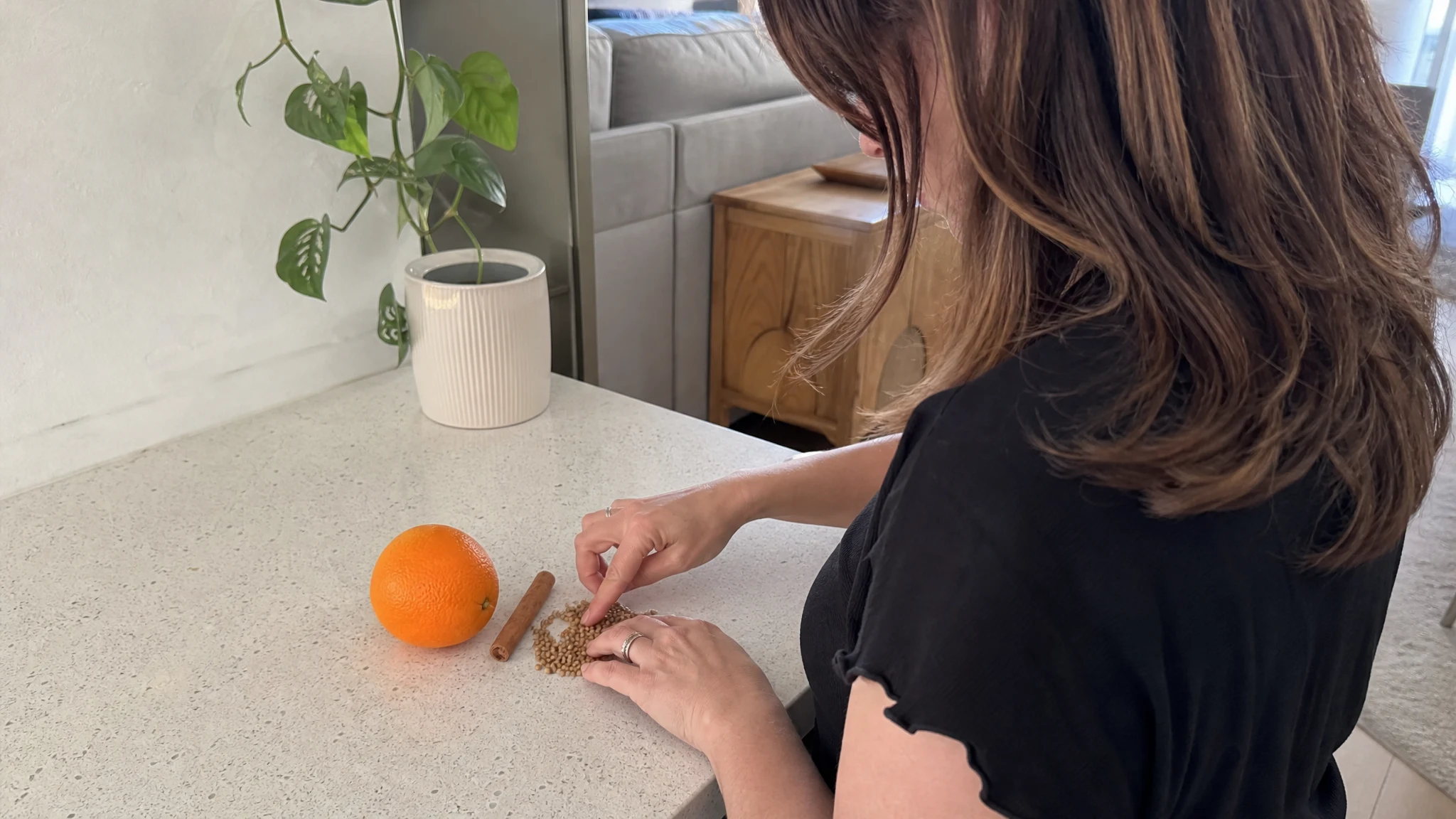
There is no published sensory study of these pairings, so treat any ratio as a starting point. A method that works: put coriander on a paper strip, add the partner at about a quarter of the coriander by weight, smell after a few minutes, and change one thing at a time. A quarter is a first guess drawn from the "easy to bury" idea above.
Small bottles complicate the maths. A 10 ml roller at 1% total oil holds 0.1 ml of oil, about 2 drops at a rough 20 drops per ml, and you cannot split 2 drops into four to one. Work by weight on a scale that reads to 0.01 g, or make a larger batch. Our roller blend article does the drop maths for that size.
Keep a scent notebook
It sounds fussy, but a few lines in a notebook save you from the most annoying moment in blending: smelling something wonderful and having no idea how you made it. Write down the oils, the amounts, the date and one word for how it smelled when fresh. Come back a day later and add one more word. Blends change as the lightest notes fade, and the notebook is how you learn which ones you like once they have settled. If you blend often, our shop lists the sizes we sell, and our bulk page and guide to buying coriander oil in bulk cover larger batches.
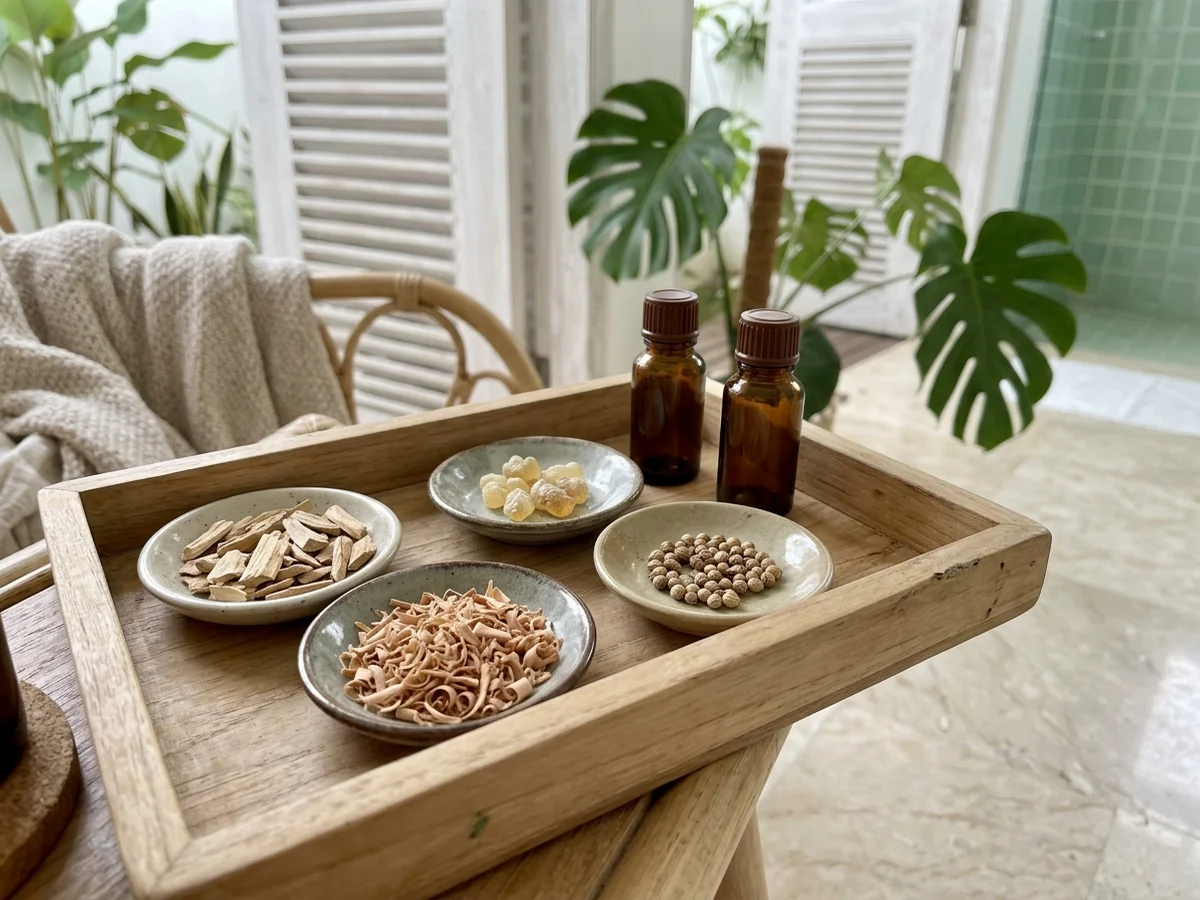
Throw out the strips that did not work and keep the ones that did, labelled in pencil. A little shoebox of paper strips is a surprisingly good way to teach your nose what each pairing is doing.
Keep one total
For skin, our guidance is 0.5% to 2% in a carrier, and the limit applies to all the oils together, not to each. The Tisserand Institute lists 0.2 to 1% for sensitive skin, 0.5 to 1.2% for the face and 1 to 3% for the body (Tisserand Institute, dilution guidelines). Linalool-bearing partners also stack up the linalool, and oxidised linalool is a known contact allergen (Bared Christensson et al., 2010, oxidized linalool patch tests). Our side effects article covers it.
Let a blend rest
A blend straight after mixing is rarely at its best. Cap it, leave it for a day, and smell it again. You'll notice the oils have knitted together and the edges have softened, and sometimes a pairing you were unsure about turns out to be the one you reach for.
Diffusing
A diffuser has no dilution percentage, so there is no number to give. A little goes a long way in a diffuser, and we suggest keeping the oil away from children and pets. Our posts on diffusing coriander and pets have the cautions.
Gin makers know this trick well. In a 2020 analysis of two gins, one with 50 botanicals and one with 15, linalool had the highest odour impact in both (Buck et al., 2020, aroma compounds in gin). A smooth linalool middle with brighter and drier notes around it is a very old idea, and coriander does it beautifully.
Coriander Essential Oil
Coriander Essential Oil from our own shop, in sizes from 0.5 oz to bulk.
From $12.99
Shop Now →Sources & Further Reading
- EFSA FEEDAP Panel, 2023, coriander fruit oil opinion
- EFSA FEEDAP Panel, 2021, sweet orange oil opinion
- EFSA FEEDAP Panel, 2022, black pepper oil opinion
- Tisserand Institute, dilution guidelines
- Bared Christensson et al., 2010, oxidized linalool patch tests
- Buck et al., 2020, aroma compounds in gin, Applied Sciences