Is Coriander Oil Phototoxic? Sun Sense for Skin
"Is it phototoxic?" is a fair question to ask of any oil you plan to wear outdoors, and the answer for coriander seed oil comes down to understanding where phototoxicity actually comes from. The references we read do not rate coriander either way, so we treat it with ordinary sun sense, and this page explains how we get there.
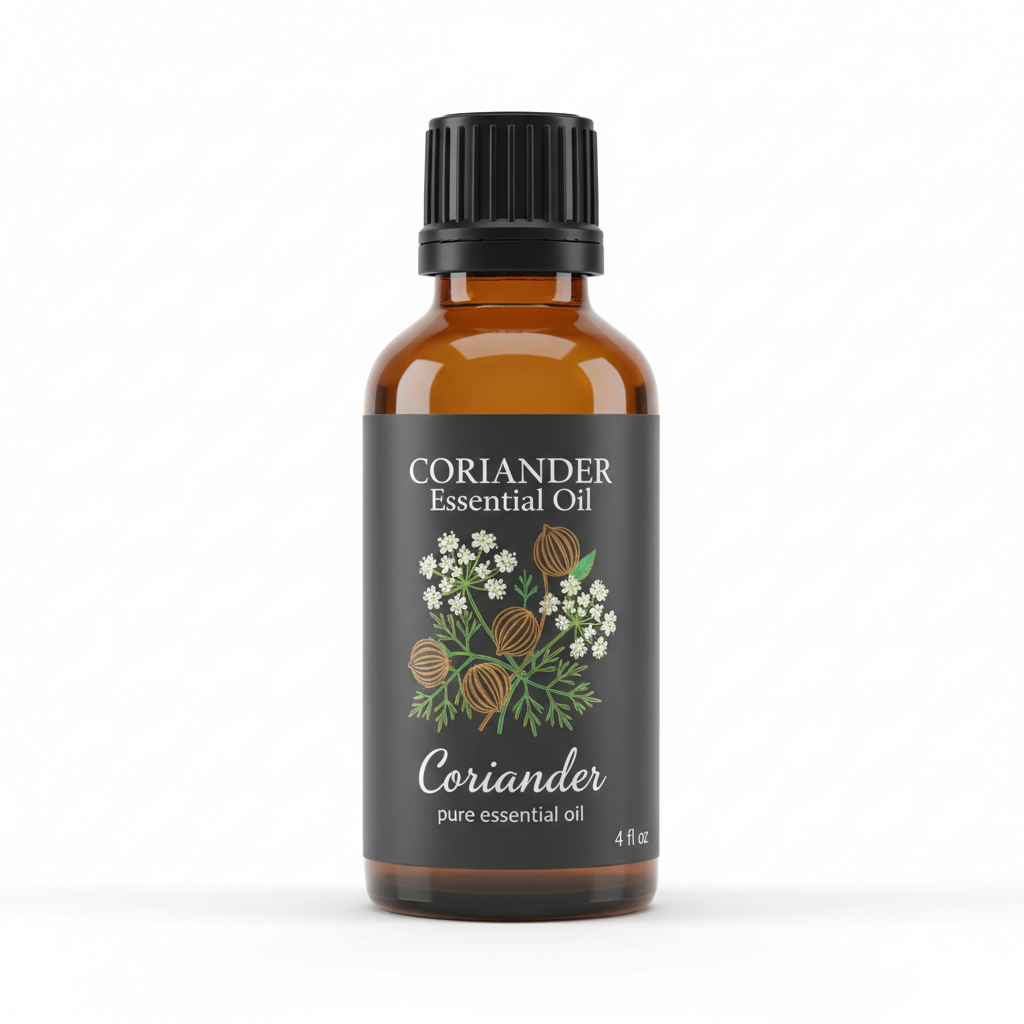
Coriander Essential Oil
Our own Coriander Essential Oil, in sizes from 0.5 oz to bulk.
From $12.99
Shop Now →We should say up front who we are in this conversation: we love this oil, and we would still rather you were a little too careful than a little too casual about sunshine. Nobody has ever regretted waiting until evening to try a new scented oil on their skin.
Where phototoxicity comes from
Almost all plant phototoxicity is caused by furanocoumarins, compounds that turn reactive when UVA light reaches skin carrying them. The Tisserand Institute notes they are found mainly in two plant families, Apiaceae and Rutaceae, and that the oils with the strongest effect are expressed citrus oils pressed from the peel (Tisserand Institute, phototoxicity and sun safety). Its best-known example is bergamot, where the IFRA guideline caps ordinary bergamot oil at 0.4% in a product worn on sun-exposed skin, while bergapten-free (FCF) bergamot is considered non-phototoxic.
Where coriander sits
Coriander belongs to the Apiaceae, the second family on that list, which is why a casual "no" would be too quick. At the same time, neither the Institute's article nor EFSA's 2023 opinion on coriander fruit oil mentions phototoxicity or furanocoumarins (EFSA FEEDAP Panel, 2023, coriander fruit oil opinion). EFSA does class the oil as an irritant and a skin sensitiser, and notes its opinion was written for animal feed. So our position is simple: sun response is unrated for coriander oil, and we recommend habits that suit an unrated oil.
Does distilling settle it?
It helps, but it is not a guarantee. Furanocoumarins are not very volatile, so distilled citrus oils contain almost none, and ours is a steam-distilled seed oil. Yet the same Tisserand page points out that angelica root and cumin seed oils, both Apiaceae and both distilled, can carry furanocoumarins over. Cumin seed is a close botanical cousin of coriander, so "it is steam-distilled" is a reasonable point in coriander's favour, though not proof. If you are building a leave-on product and need furanocoumarin data, ask us in writing through the contact page before you rely on an assumption.
Habits for an unrated oil
The Tisserand Institute advises avoiding UV for at least 12 hours after a phototoxic oil on skin. For coriander that is a precaution, not a rule, but it is cheap to follow:

- Use it in evening body oils, on skin that will be covered the next day.
- Stay at the low end of our 0.5% to 2% range. At 0.5% in an ounce of carrier you are using roughly 3 drops.
- Check the general ranges: 0.5 to 1.2% for the face and 1 to 3% for the body (Tisserand Institute, dilution guidelines).
A rash after sun is not always phototoxicity. Oxidised linalool is a documented contact allergen (Bared Christensson et al., 2010, oxidized linalool patch tests), so a dermatologist is the person to tell the two apart. Our side effects article explains the linalool side.
When citrus is in the blend
If a blend includes ordinary expressed bergamot, the bergamot sets the sun limit, not the coriander. Staying at or below 0.4% of the finished product is the IFRA guideline the Institute cites, and one drop in a 10 ml roller already reaches about 0.5% at a rough 20 drops per ml. Furanocoumarin-free bergamot with the supplier's document is the easy fix. Our bergamot article and roller blend article do the arithmetic.
A sensible way to try it
If you are new to coriander seed oil, here is how we would go about it. Pick an evening when you have nothing outdoors planned the next morning. Make a small batch of body oil at the low end of the range and label the bottle with the date. Do a patch test on the inside of your forearm first and leave it alone for a day. If all is quiet, use it that evening on skin that clothing will cover the next day.
It is not a glamorous routine, but it is a pleasant one. A scented body oil after a shower, with the window open and the day behind you, is exactly where a warm, softly spicy aroma like this one belongs. The scent you will notice is rounded and gentle, with a faint citrus peel in the background, and it tends to be at its most noticeable right after you apply it and then settles into something quieter.
What to do about summer
Summer is when this question comes up most, because people want to wear a scent on their wrists and neck all day. For those days we suggest leaving coriander out of anything you apply to sun-exposed skin, and enjoying it instead in a diffuser, on a tissue tucked in a drawer, or in an evening-only body oil. A scent does not need to touch your skin to do its job in a room.
If you make rollers or lotions for other people, put the same thought on the label: say what is in the bottle, and suggest it is saved for covered skin until you have the documents you need. Our rule of thumb as a small business is simple: when a reference does not rate something either way, we act as though it deserves care until someone shows us otherwise.
Who should check first
Anyone with a history of fragrance or photosensitive reactions, or who takes a medicine that makes skin sun-sensitive, should ask a dermatologist or pharmacist before leave-on use. Our posts on children, pregnancy and pets report what the sources say.
Coriander is a warm, easygoing oil that fits easily into an evening routine. Keep it low, keep it covered by day, and enjoy it after sundown.
Coriander Essential Oil
Coriander Essential Oil from our own shop, in sizes from 0.5 oz to bulk.
From $12.99
Shop Now →