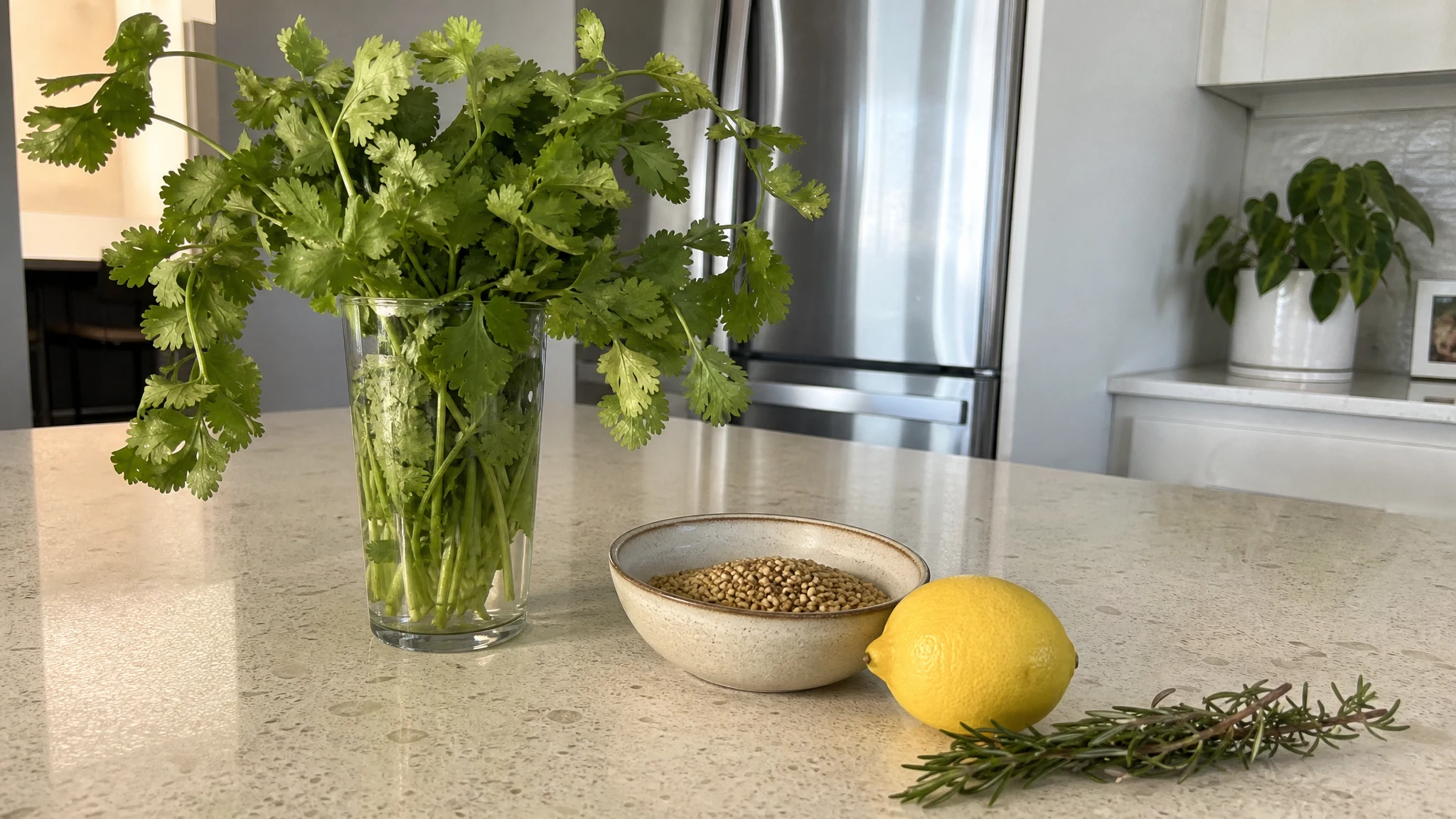
Coriander Oil Substitute: What to Use When You Run Out
You reach for the coriander and the bottle is empty. Before you grab whatever is closest, ask what that oil was doing in the blend, because coriander seed oil can play three quite different roles and no single oil plays all of them.
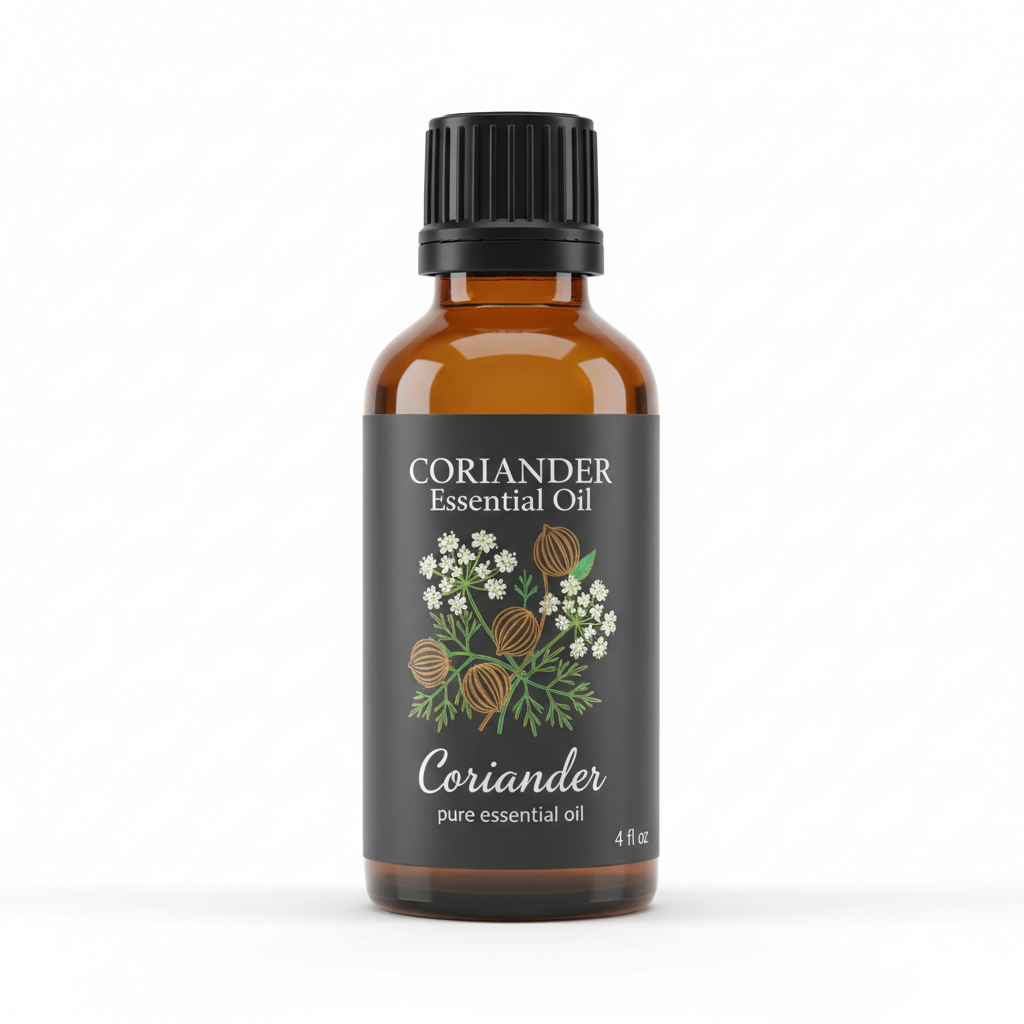
Coriander Essential Oil
Our own Coriander Essential Oil, in sizes from 0.5 oz to bulk.
From $12.99
Shop Now →Start with the job
We describe our coriander as warm, woody and softly spicy, with a rounded sweetness and a light floral edge, and we place it in the middle of a blend. If it was the warm-spice body, you want another warm, rounded middle note. If it was the bridge between a bright citrus top and a woody base, almost any oil that shares its main molecule, linalool, can carry part of that. And if the coriander smell was the whole point of the blend, the honest answer is to wait for a restock, because nothing else smells like it.
Oils that share the linalool
Coriander fruit oil is built around linalool: the oil EFSA assessed in 2023 was specified at 65 to 78% (see EFSA FEEDAP Panel, 2023, coriander fruit oil opinion). Lavender and bergamot also carry linalool, but they bring a sweet ester called linalyl acetate along with it. In one 2026 study a lavender oil held about 25% linalyl acetate and 23% linalool (Yas et al., 2026), and a Calabrian bergamot held roughly 13.5% linalyl acetate and 11% linalool, with limonene leading (Bava et al., 2026). Those are single samples, but the pattern is the useful part: both pull a blend toward floral or citrus and away from dry spice. Our coriander versus lavender comparison goes deeper.
Cardamom for warmth
If it is warmth you are missing, cardamom is the nearest in spirit and the furthest in chemistry. EFSA's assessment of cardamom seed oil found it dominated by terpineol acetate (about 35%) and 1,8-cineole (about 23%), with linalool at just 4% (EFSA FEEDAP Panel, 2019, cardamom oil opinion). In practice that means cardamom keeps the spice but adds a cooler, cleaner edge and loses coriander's smoothness. Our cardamom comparison sets the two side by side.
Fragrance oils, CO2 extracts and leaf oil
These share a name with coriander but are different materials. A fragrance oil is a formulated mixture, and the FDA notes that fragrance formulas are among the cosmetic components most likely to be trade secrets (FDA, Fragrances in Cosmetics). A CO2 extract of the seed still has linalool as its lead compound but a different supporting cast. Leaf oil is a different story altogether: in 11 Portuguese samples the aerial parts were dominated by 2-trans-decenal and n-decanal rather than linalool (Machado et al., 2023, coriander fruit and aerial-part oils), which is why it smells so unlike the seed. Our posts on fragrance oil and leaf oil explain the difference.
The dilution does not transfer
The 0.5% to 2% we recommend for skin belongs to our coriander oil. Every oil has its own limits, and drops are a poor unit for swapping because a drop of one oil is not a drop of another. Look up the replacement's guidance from its supplier or a safety reference, and remember that all the oils in a bottle count toward one total. The Tisserand Institute's general ranges (0.5 to 1.2% for the face, 1 to 3% for the body) are a sensible frame (Tisserand Institute, dilution guidelines). Our side effects article covers the coriander side.
Try before you commit
Before you pour a replacement into a full batch, make a mini version on a paper strip or in a tiny test bottle. Smell the recipe's other oils together first, then add the candidate and smell again. You'll notice quickly whether the gap you felt was warmth, sweetness or body. It takes five minutes and saves a whole batch.
A gentle way to swap
Work by weight if you can, put the new oil on a paper strip next to your blend, and begin at about half the amount you used of coriander. Smell it after a few minutes, then raise it only if the blend still feels thin. If you are choosing partners rather than replacements, what blends well with coriander is the better starting point.
Plan for the next time
The easiest fix for a missing oil is not running out. If a blend or a product has become a favourite, write the full recipe down and note roughly how much oil you use in a month. We would reorder when a bottle is a third full instead of when the last drop is gone, and keep it capped and cool so it lasts to the end. It is a small habit, and it keeps you from swapping oils halfway through a project. Our shop lists the sizes we sell, and our bulk page and guide to buying coriander oil in bulk help when you want a bigger bottle on hand.
And if you ever do change an oil in a recipe you love, label the new version as a new version. A name like "winter blend, take two" keeps your notes honest and your original intact.
Keep the original recipe separate
Write the swapped version on a fresh label with the date and the new oil's name, and keep a small sample of the original if you have any left. Next time you smell the two side by side, you'll notice exactly what the stand-in changed, and that comparison teaches you more than the recipe does.
A replacement can rescue a batch, but it will always be a different blend. When the coriander character matters, the smartest substitute is a little patience.
Coriander Essential Oil
Coriander Essential Oil from our own shop, in sizes from 0.5 oz to bulk.
From $12.99
Shop Now →Sources & Further Reading
- EFSA FEEDAP Panel, 2023, coriander fruit oil opinion
- EFSA FEEDAP Panel, 2019, cardamom oil opinion
- Yas et al., 2026, Lavandula angustifolia composition, Chemistry and Biodiversity
- Bava et al., 2026, Calabrian citrus oils, Veterinary Parasitology
- FDA, Fragrances in Cosmetics
- Machado et al., 2023, coriander fruit and aerial-part oils
- Tisserand Institute, dilution guidelines