Coriander Oil in Pregnancy: What to Ask Your Midwife
Eating coriander in a curry and bringing a concentrated seed oil into your skincare or your air are two very different questions during pregnancy. We sell an external aroma and cosmetic oil, so your midwife or doctor is the right person for the final word. What we can do is share what we found and give you good questions to take with you.
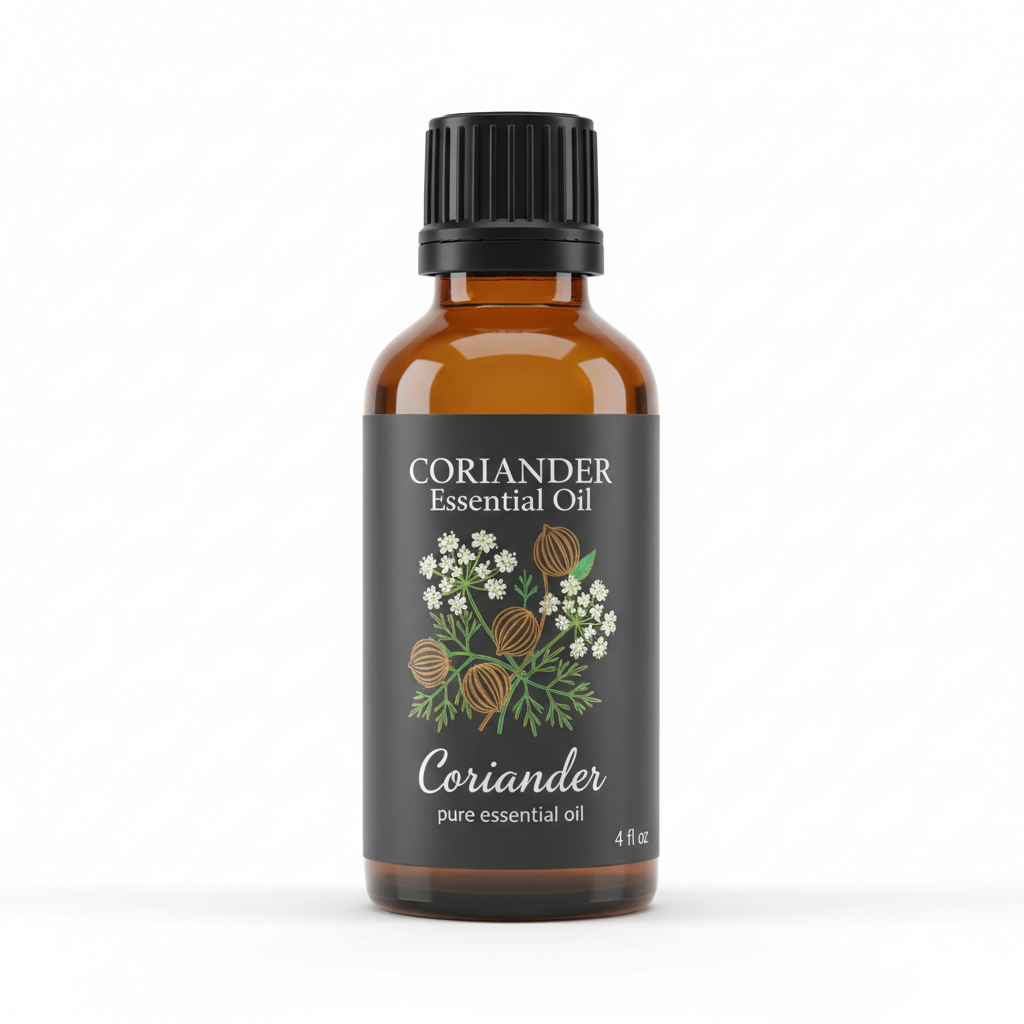
Coriander Essential Oil
Our own Coriander Essential Oil, in sizes from 0.5 oz to bulk.
From $12.99
Shop Now →What the guidance says
The Tisserand Institute says people who are pregnant, or who have epilepsy or asthma, should seek advice from a doctor or suitable practitioner before using essential oils (Tisserand Institute, safety guidelines). It does not give a pregnancy percentage for coriander, and neither do we. We found no human pregnancy or breastfeeding study of coriander essential oil.
What is known about linalool
Linalool is the main molecule in coriander seed oil, around 60 to 73% in Portuguese fruit samples (Machado et al., 2023). In a rat study from a fragrance-industry research group, pregnant Sprague-Dawley rats (25 per group) received linalool by gavage on gestational days 7 to 17 at 250, 500 or 1,000 mg/kg a day. Fetal alterations were unaffected at every dose, and the authors reported a maternal no-observed-adverse-effect level of 500 mg/kg/day and a developmental one of at least 1,000 mg/kg/day (Politano et al., 2008).
That is reassuring as far as it goes, and it only goes so far: it used isolated linalool, swallowed by rats, so it speaks to neither whole coriander oil nor skin nor inhalation nor people. EFSA's assessment of coriander oil also describes it as an irritant to skin and eyes and a skin and respiratory sensitiser, though that opinion was written for animal feed (EFSA FEEDAP Panel, 2023).
Skin, and the aging of linalool
Linalool that has sat in air forms hydroperoxides, which are contact allergens: in a Danish patch-test series of 6,719 patients, 3.1% reacted to linalool hydroperoxides (Botvid et al., 2026). A skin reaction is a nuisance at any time, so keeping the bottle capped and cool, as our storage article suggests, is worth the effort. Our side effects article and linalool article cover the chemistry.
Food versus a bottle
The comfort of the spice rack does not transfer to a bottle. EFSA quotes an estimated dietary intake of coriander oil of 0.049 mg per kg of body weight per day, about 3.4 mg for a 70 kg adult. A drop of oil weighs roughly 43 mg by our arithmetic (a 0.05 ml drop at the 0.857 relative density on the certificate we publish), so one drop is over ten times that. Dietary exposure and a bottle are different scales, and we are not aware of a pregnancy study at either scale for this oil. Our ingestion article explains why we never recommend swallowing it.
Skin or air
Skin raises questions of dilution, area and allergy, while air raises how long you sit in it and who shares the room. We have no coriander-specific inhalation data for pregnancy to rank them. Whether to run a diffuser at all is a good question for your midwife; if you do, a light hand matters, as in our diffusing guide.
Making the most of the conversation
Appointments are short, and a bottle name does not tell your midwife much. Bring the label, or a photo of it, and be ready to say how you plan to use the oil: on skin, in a diffuser, in a product you make. Mention how often, and for how long each time. The more specific you are, the more useful the answer will be.
It also helps to write the questions down beforehand. Nerves and a waiting room have a way of wiping the list from your head, and a note on your phone fixes that. Jot the answer next to each question as you go, and keep the note with your other pregnancy papers.
Questions to bring to your OB-GYN, midwife or pharmacist
- Given my history and trimester, should I avoid scented oils on my skin or in a diffuser entirely?
- If some use is fine, what dilution ceiling should I stay under, and over how large an area of skin?
- Is the first trimester different?
- If I am breastfeeding, is there guidance on oils on skin near the baby?
- Which reactions should make me stop and call you?
Keep the label and the date
Whatever you decide, keep the bottle's label, the date you opened it and any notes about how you used it. If you do speak to a professional later, those details turn a vague question into a useful one. And it never hurts to tell the people who share your home that the oil is on pause for now, so no one reaches for it on your behalf.
While you wait for answers
Waiting is the part nobody mentions. In the meantime you can keep a house smelling pleasant without any oil at all: fresh air from an open window, a pot of tea, a strip of lemon peel or a few whole coriander seeds in a small dish near the kitchen. Those are ordinary kitchen smells, and they let you enjoy the house while the real question gets a real answer. If we are being honest, an unopened bottle on a shelf is a perfectly good place for our oil to sit until you have heard from the people who know your situation.
If you have epilepsy, asthma, a history of fragrance or celery-family allergy, or take anticoagulants, those conversations matter even more. And if you simply want a restful room, a window open to fresh air costs nothing while you wait for the answers.
Coriander Essential Oil
Coriander Essential Oil from our own shop, in sizes from 0.5 oz to bulk.
From $12.99
Shop Now →Sources & Further Reading
- Tisserand Institute. Safety guidelines. tisserandinstitute.org/safety/safety-guidelines
- Machado AM et al., 2023. Plants 12(14):2749. pubmed.ncbi.nlm.nih.gov/37514362
- Politano VT et al., 2008. Evaluation of the developmental toxicity of linalool in rats. Int J Toxicol 27(2):183-188. pubmed.ncbi.nlm.nih.gov/18404542
- EFSA FEEDAP Panel, 2023. Safety and efficacy of an essential oil from the fruit of Coriandrum sativum L. PMC10613936
- Botvid S et al., 2026. Contact Dermatitis 94(5):504-514. pubmed.ncbi.nlm.nih.gov/41638887