Coriander Oil on Skin: Dilution by Area, Step by Step
Two very different things are sold as "coriander seed oil", and mixing them up is the easiest way to get a skin recipe badly wrong. One is a fatty oil pressed from the seed. The other is the aromatic essential oil, the one we sell, and it is made to be used in small, carefully measured amounts.
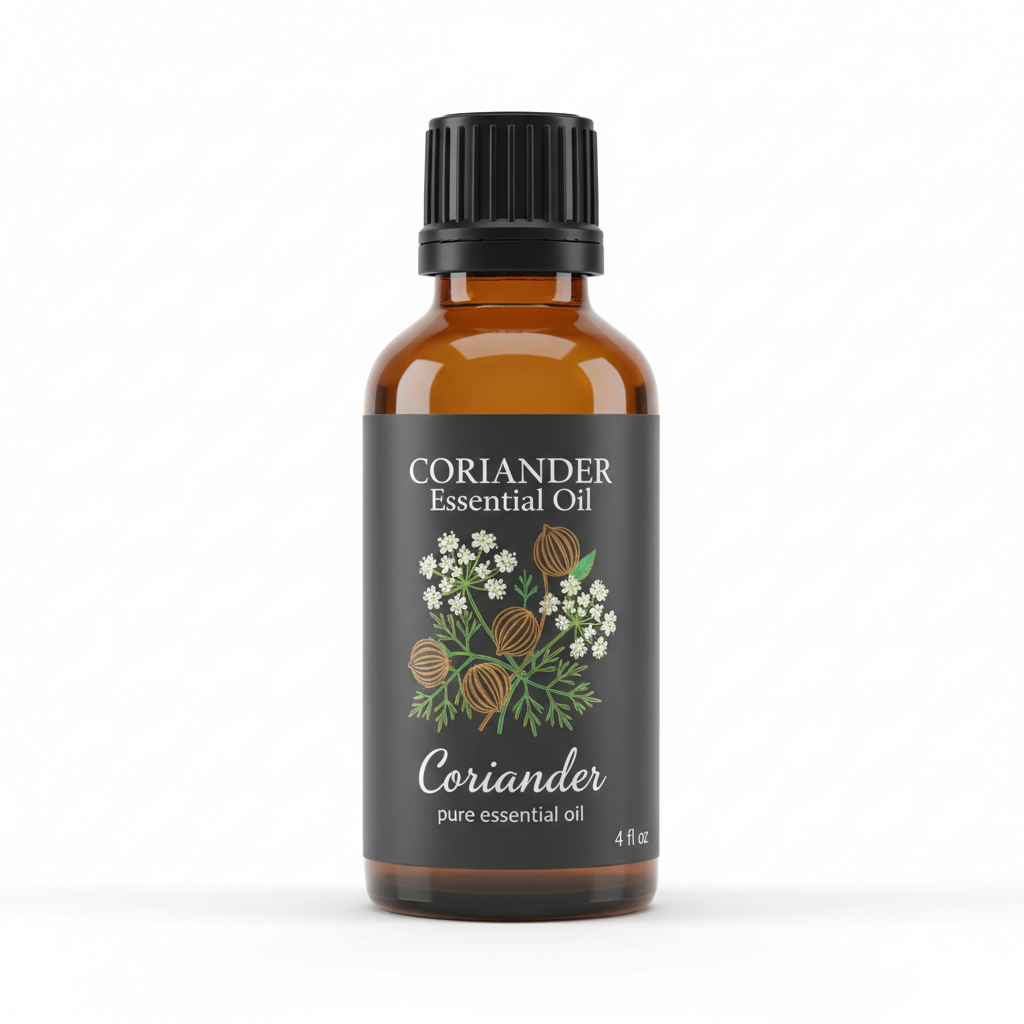
Coriander Essential Oil
Our own Coriander Essential Oil, in sizes from 0.5 oz to bulk.
From $12.99
Shop Now →Two oils, one name
Coriander seed holds both a volatile oil, mostly linalool, and a fixed oil that is mostly petroselinic acid: in a 2026 study of six genotypes, petroselinic acid made up about 70 to 86% of the fixed oil (Ali Ali et al., 2026, coriander genotypes and sowing dates). A recipe that calls for coriander seed oil at 10% of a serum almost certainly means the fatty oil. Copying that percentage with an essential oil would be many times over any sensible ceiling. And "smooth" and "linalool-rich" describe how our oil smells and what it is made of. They are not skin claims, and we do not make any.
Does this skin want it?
EFSA's 2023 opinion on coriander fruit oil, written for animal feed, classes it as an irritant to skin and eyes and a skin and respiratory sensitiser (EFSA FEEDAP Panel, 2023, coriander fruit oil opinion), which is a description of the neat oil and a good reason to dilute. We would hold off, or ask a dermatologist first, if you have eczema, rosacea, broken or freshly shaved skin, or a known fragrance allergy. Our posts on pregnancy and children cover those groups.
Choosing a ceiling by area
We recommend 0.5% to 2% in a carrier, starting low. The Tisserand Institute's guidelines vary by area (Tisserand Institute, dilution guidelines), and we find them a useful refinement, so for each area we would settle on the lower of the two upper limits.
| Area | Tisserand guideline | Our ceiling | Where to start |
|---|---|---|---|
| Sensitive skin | 0.2 to 1% | 1% | 0.2 to 0.5% |
| Face | 0.5 to 1.2% | 1.2% | 0.5% |
| Body | 1 to 3% | 2% | 0.5 to 1% |
The Institute describes these as guidelines, and its body range matches fragrance levels in commercial personal care products. They count every oil in the bottle, not just the coriander.
The arithmetic for 30 ml
Volume of oil is the percentage times the carrier volume. At a rough 20 drops per ml:
- 0.5% is 0.15 ml, about 3 drops.
- 1% is 0.3 ml, about 6 drops.
- 1.2% is 0.36 ml, about 7 drops.
At 0.2% you would be measuring a single drop, which no dropper does well, so make a bigger batch and scale down. Our massage oil article works the maths for 30 to 120 ml, and for scent partners, what blends well with coriander is the place to start, keeping in mind that a partner uses part of the same ceiling.
Keep it fresh
Linalool itself is a weak allergen, but it oxidises in air, and the oxidation products are the concern. In 3,418 people with dermatitis patch tested with oxidised linalool, reactions rose from under 1% at 2% to 7.2% at 11% (Bared Christensson et al., 2010, oxidized linalool patch tests). That shows a hazard linked to air exposure, not your odds with a diluted oil. We say our oil typically keeps 2 to 3 years tightly capped in a cool, dark place, so buy a size you will finish. Our storage article has the habits, and a finished oil is only as long-lived as its carrier.
Mixing without the mess
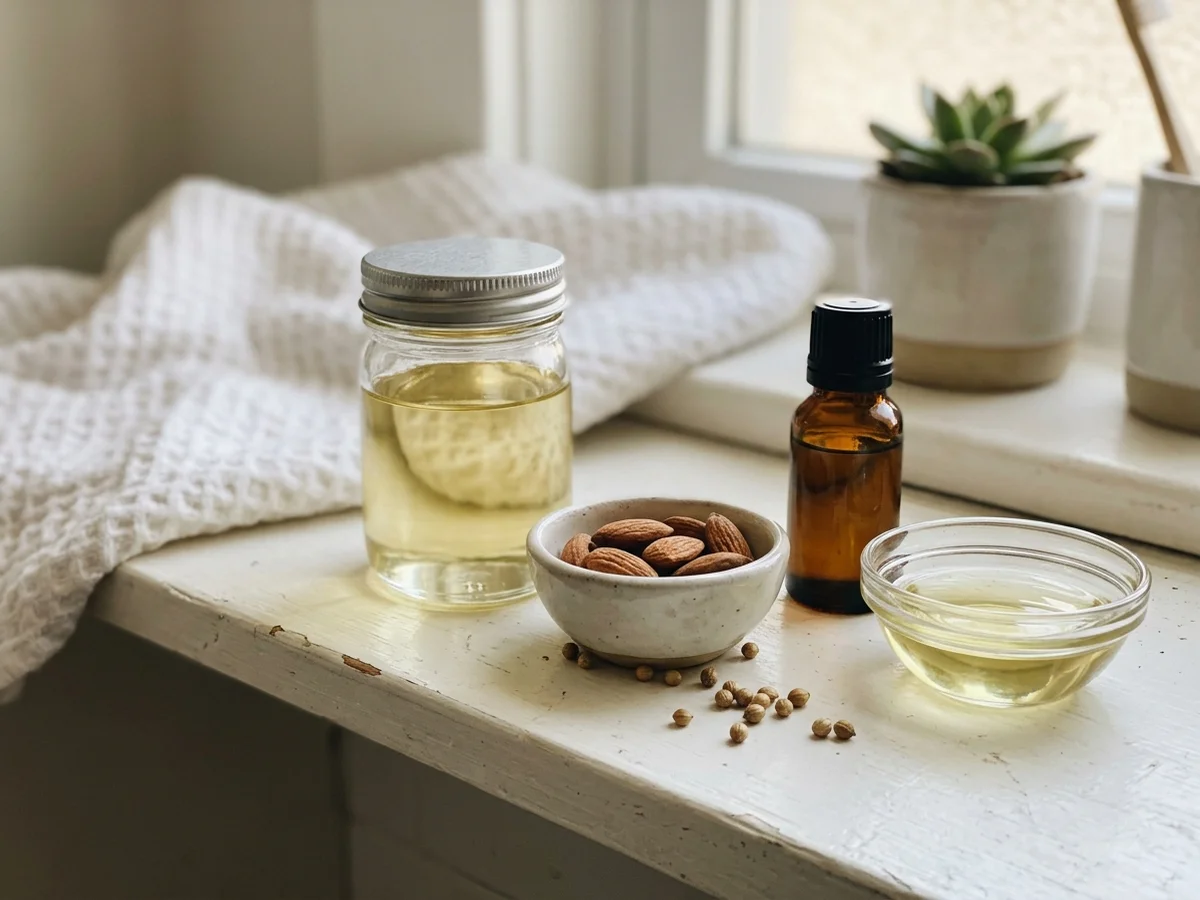
A calm, tidy mix makes accuracy easier. Measure the carrier first into a clean, dry bottle, then add the coriander with a small syringe or pipette, holding it over the bottle so a stray drop lands where it should. Cap, swirl gently for a minute and label the bottle with the percentage and the date. A bottle with no label is a bottle you will not trust in a month.
When the oil is in, smell it. You'll notice a gentler, rounder version of the scent than the neat oil gives you, and that is the level you want on skin. If it still seems strong, make the next batch weaker instead of trying to fix this one by guesswork.
Trying it on yourself
We suggest a patch test. The Tisserand Institute does not generally recommend them and describes dose escalation from about 1% in 0.5% steps for people at higher risk (Tisserand Institute, irritation and allergic reactions). Combining the two, start at the lowest strength in the table, use a small area, add no other new scented products that week, and increase only if your skin is happy.
Writing it down
Keep a small card or note with each recipe: the carrier, the volume, the percentage, the number of drops or millilitres, and a word on how it felt and smelled. After a few batches you will have a short list of favourites you can repeat exactly, and a record of anything you would change. It is the easiest habit in home blending and the one that saves the most wasted oil.
One new thing at a time
It is tempting to start a new body oil, a new moisturiser and a new soap in the same week, but that makes it impossible to tell what your skin is reacting to. Add a single scented product at a time, give it a few days, and keep the others unchanged. Your skin is a very good communicator when you let it speak one sentence at a time.
Done this way, coriander is a lovely, quiet scent in a body oil, and the maths is only a few drops.
Coriander Essential Oil
Coriander Essential Oil from our own shop, in sizes from 0.5 oz to bulk.
From $12.99
Shop Now →